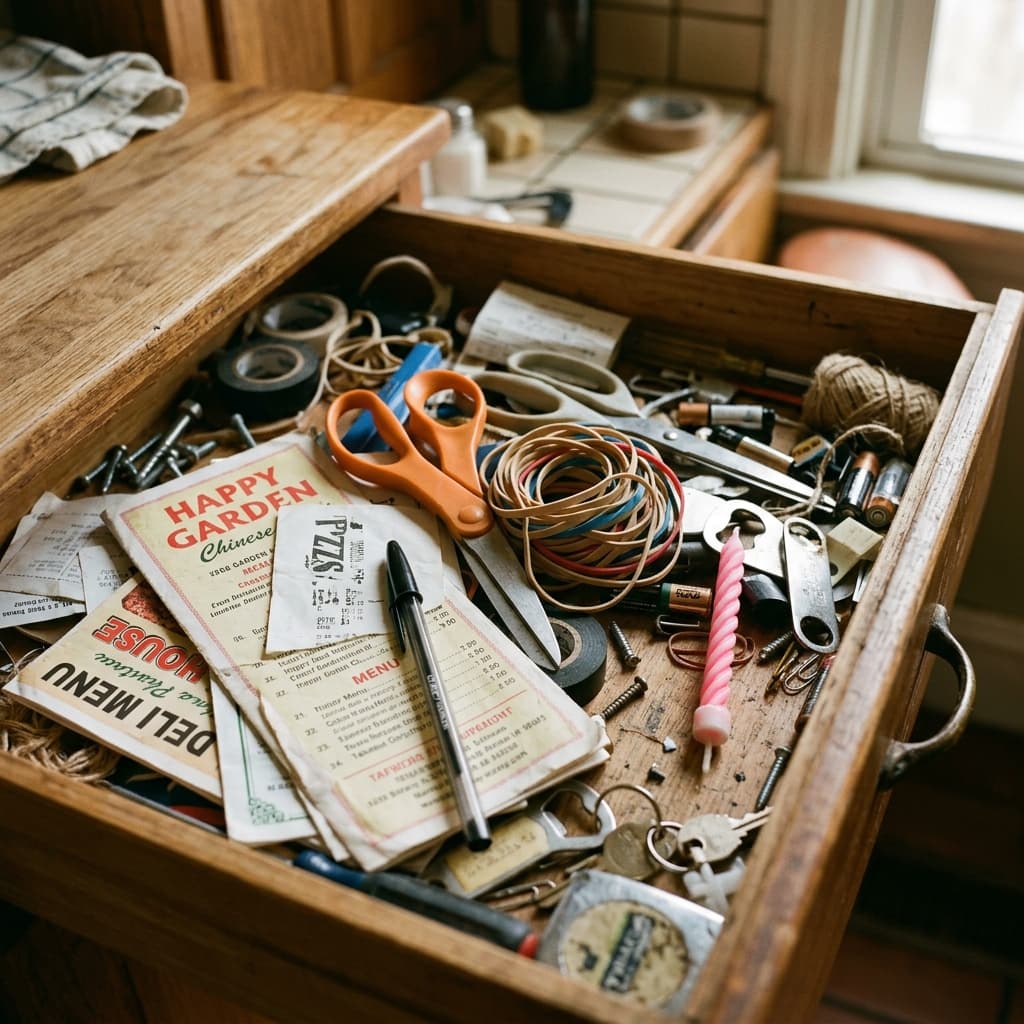
The drawer to the left of the stove has been curated by a version of me I have never met. She is not the person who organizes the bookshelves or folds the towels in thirds. She is the one who makes split-second decisions about what to keep, where to put it, and what to shove in sideways when the drawer is already full. She has terrible filing skills and impeccable taste in what matters.
The Scissors
Orange-handled. The blades are slightly loose at the pivot, so they make a particular clicking sound when they close, like two pieces of metal gossiping. I have owned these scissors through four moves and at least three purges where I stood over a box marked “donate” and these scissors were in my hand, cutting the tape.
They are not good scissors. The right blade does not meet the left cleanly; you have to angle them for a straight cut. But my hand knows the angle. My thumb fits the upper loop exactly, with a small gap of air between the plastic and the first knuckle. The grip is so practiced that I can find these scissors in the drawer by feel, in the dark, without looking.
The body selects its tools by fit, not by quality. This is something the minimalists do not account for: the object that should have been replaced years ago but whose shape has been memorized by your hand.
The Birthday Candle
Shaped like the number four. Pink wax, slightly bent at the top where the flame made it lean before someone blew it out. There is no practical reason to keep a used birthday candle in a kitchen drawer. It cannot be relit with any dignity. It serves no function.
But my hand, when it reaches into the drawer for tape or a pen, touches the candle and registers it. A small bump of wax against the fingertip. A texture that says: she was four. She sat in the high chair for the last time that year. The frosting was blue because she asked for blue, specifically sky blue, and the bakery gave us royal blue and she did not mind at all.
Mihaly Csikszentmihalyi, the psychologist at the University of Chicago, studied the objects people keep in their homes and found that the most cherished possessions are almost never the most expensive or the most beautiful. They are the ones that anchor the self to a specific moment: the concert ticket, the sea glass, the broken watch. The object’s value is not in what it is but in what the hand remembers when it touches it.
The Takeout Menus
Three of them. Folded in quarters. Two are for restaurants that closed during the pandemic, and I order from the third one using an app on my phone, which means I have not unfolded any of these menus in at least three years.
I keep them because the drawer feels wrong without them. Rather than a thought, it registers as a physical sensation. I tried removing them during a cleaning fit last March and the drawer looked naked, like a bookshelf with a gap. The menus are anything but information. They are padding, spatial filler, the drawer equivalent of white noise. My hand expects their presence the way it expects the counter to be at the height it has always been.
The drawer, I am beginning to realize, follows the hand’s expectations rather than any logic.
The junk drawer is not junk. It is the body’s filing system, organized by touch rather than category.
The Pen That Works and the Three That Do Not
There is one pen in the drawer that writes. It is a black ballpoint, no brand, the kind that comes free with a bank account. It writes on the first stroke every time. It is, objectively, the only pen worth keeping.
The other three are imposters. A blue gel pen that skips every third letter. A mechanical pencil with no lead. A Sharpie with a dried-out tip that leaves a mark like a whisper. I test them every few weeks, scribbling on the back of an envelope, and they fail every time, and I put them back.
Sherry Turkle, the MIT professor who studies our relationships with objects, writes about the way we invest things with a kind of emotional potential. The dead pens exist less as pens than as the possibility of pens. They represent the idea that more writing instruments means more readiness, more capacity, more preparedness for the note you might need to write. Throwing them away would mean admitting that one pen is enough, and the hand resists that admission because the hand likes options, even fictional ones.
The Rubber Band Ball
I do not remember starting it. At some point, a rubber band came into the house wrapped around a bundle of asparagus, and instead of throwing it away, I stretched it around a grape-sized ball of aluminum foil. Then another one came, and another. The ball is now the size of a clementine. It has layers. If you cut it open, you would find a geological record of produce purchases: the thick red band from the broccoli, the thin yellow from the green onions, the pale blue from a bag of organic something.
The rubber band ball is the most honest object in the drawer. Nobody decides to make a rubber band ball. The hands decide. They encounter a rubber band, and instead of throwing it in the trash, they stretch it around the growing sphere. The hands are doing something the mind did not authorize: building something useless and perfect and entirely without purpose, one band at a time.
It is the hands’ art project. The mind merely provides the funding.
I closed the drawer last night after looking for tape. I found the tape. I also found the scissors, the candle, the menus, the pens, the rubber band ball, a battery of uncertain charge, two twist ties, and a magnet shaped like Oregon.
All of it held there by a hand that never asked permission to keep any of it.
The drawer closed with its usual sound: a soft thud followed by the rattle of things settling into the positions they have occupied, undisturbed, for years.
