The apartment I lived in before my daughter was born was four hundred and eighty square feet. I know the number because the listing said it, and because I measured it myself one Sunday afternoon when I was trying to figure out whether a bookshelf would fit against the wall by the window, and it would not. The kitchen counter doubled as my desk. The bedroom was also the living room. There was one window, and it faced a brick wall so close I could have reached out and touched it if the window had opened more than six inches, which it did not.
For the first year, I apologized for that apartment. When people came over, which was rarely because there was nowhere to sit, I would say things like “It is temporary” or “We are looking for something bigger,” as if the smallness were a condition I was suffering rather than a space I was living in. I treated four hundred and eighty square feet as a problem to be solved, a holding pattern between here and the real life that would begin when I had enough room for it.
I do not remember the exact moment the shift happened. Nothing about it was deliberate. It was more like eyes adjusting to dim light: a slow, involuntary recalibration in which the things I could not see in the darkness gradually became visible, and what they turned out to be was enough.
What the Walls Held
Small spaces have a quality that large spaces do not. I did not understand this until I lived in one long enough to stop resisting it. In a small room, you can feel the walls. Not physically, but proprioceptively: the body registers the boundaries, calibrates itself to the dimensions, and settles into them the way a hand settles into a glove. There is a containment that the nervous system reads as safety, because the space is knowable. You can see every corner. You can reach every surface. There is nowhere for threat to hide, and there is nowhere for you to hide from yourself.
In the apartment, I could stand in the kitchen and see the bed and the desk and the window and the door. Everything I owned was within arm’s reach or close to it. The tea was three steps from the pillow. The notebook was on the counter beside the stove. The smallness, once I stopped fighting it, created a density of attention that I have been trying to reconstruct ever since. Every object had to earn its place, because there was no room for objects that did not. The mug from a conference I did not enjoy: gone. The books I was keeping out of guilt: gone. The clothes I wore to be someone I was not: gone. What remained was spare and honest and mine, and the sparseness felt not like deprivation but like clarity, the way a clean window lets in more light than a cluttered sill.
The Corners I Return To
I live in a bigger place now. A house with stairs and a kitchen and a room where my daughter sleeps and a room where I write. The house is not large by any standard, but it is large compared to four hundred and eighty square feet, and I have noticed something: in the larger space, I have recreated the small ones. I have built corners.
The desk where I write is in one corner, with the pothos plant in its terracotta pot and the notebook and the pen and the window that faces east. When I sit there in the morning, the corner is the whole world. The rest of the house falls away. The bills on the kitchen counter, the laundry on the stairs, the slow accumulation of toys and papers and evidence of a life in progress: they exist, but they are outside the corner, and the corner is where my attention lives for those first minutes of the day, and the attention, bounded by the edges of the desk and the wall and the reach of the morning light, is more vivid for being contained.
The car is another corner. Engine off, radio off, phone face-down on the passenger seat. The windows create a small container with a particular acoustic quality: the outside world is muffled, the inside world is close, and the space between the steering wheel and the seat back is exactly the right size for sitting with something I am not ready to carry into the house. I have cried in this corner. I have sat in this corner for eleven minutes because my hands were shaking and I did not trust them on the steering wheel. The car does not judge what happens inside it. It just holds the dimensions, and the dimensions are enough.
The shower is the smallest corner of all. Eyes closed, water on the skin, the particular acoustics of tile and steam that make the world contract to the size of a body. In the shower, I am not a mother or a writer or a person with a to-do list. I am a body in warm water, and the smallness of the space makes the body the only subject, and sometimes that is the only place where a feeling can safely arrive.
The Science of Containment
Carol Ryff, a psychologist at the University of Wisconsin-Madison, identified six dimensions of psychological well-being, and one of them is what she called environmental mastery: the sense that you can manage, shape, and tend to the world around you. Her research found that environmental mastery is one of the strongest predictors of flourishing, stronger than income, stronger than social network size, stronger than most of the metrics we use to measure whether a life is going well.
What Ryff’s research implies, though she does not state it this way, is that a small, well-tended space generates more well-being than a large, chaotic one. Not because small is inherently better, but because small is tendable. You can know a four-hundred-and-eighty-square-foot apartment the way you know your own body: intimately, completely, with the kind of proprioceptive confidence that allows you to walk through it in the dark without hitting anything. That knowledge, that felt mastery, is what the nervous system reads as safety. And safety, for the body, is far less about the absence of danger than about the presence of a boundary you trust.
I think about this often when the house feels too big, when the clutter has accumulated past the point where I can see every surface, when the rooms have more in them than I can tend. The solution is never to organize the whole house. The solution is to find the corner. To sit at the desk, or in the car, or in the shower, and let the walls close in to a distance I can know, and let the knowing be enough.
What I Miss
I miss the apartment sometimes. Not the brick wall outside the window or the kitchen counter that was also a desk. I miss the involuntary simplicity: the fact that curation was not a choice but a structural necessity, because four hundred and eighty square feet does not tolerate excess. In a larger space, excess accumulates by default. Things arrive and do not leave. Surfaces fill. Drawers become archives of objects I cannot name a reason for keeping but cannot bring myself to discard. The discipline that the small apartment imposed without my consent is something I now have to impose on myself, and I am not always good at it.
But I do not need the apartment to have the lesson. The lesson was never about square footage. It was about what happens when the body is in a space it can know completely, when every object has earned its place, when the boundaries are close enough to feel, and when the containment, which looked from the outside like limitation, turns out to be the thing that allows the deepest kind of attention. You do not need four hundred and eighty square feet to practice this. You need one corner, one surface, one moment where the space is small enough to hold you and you are still enough to let it.
Freedom is not having room for everything. It is having room enough for what matters, and the clarity to know the difference. That clarity comes from the edges, not from the expanse.
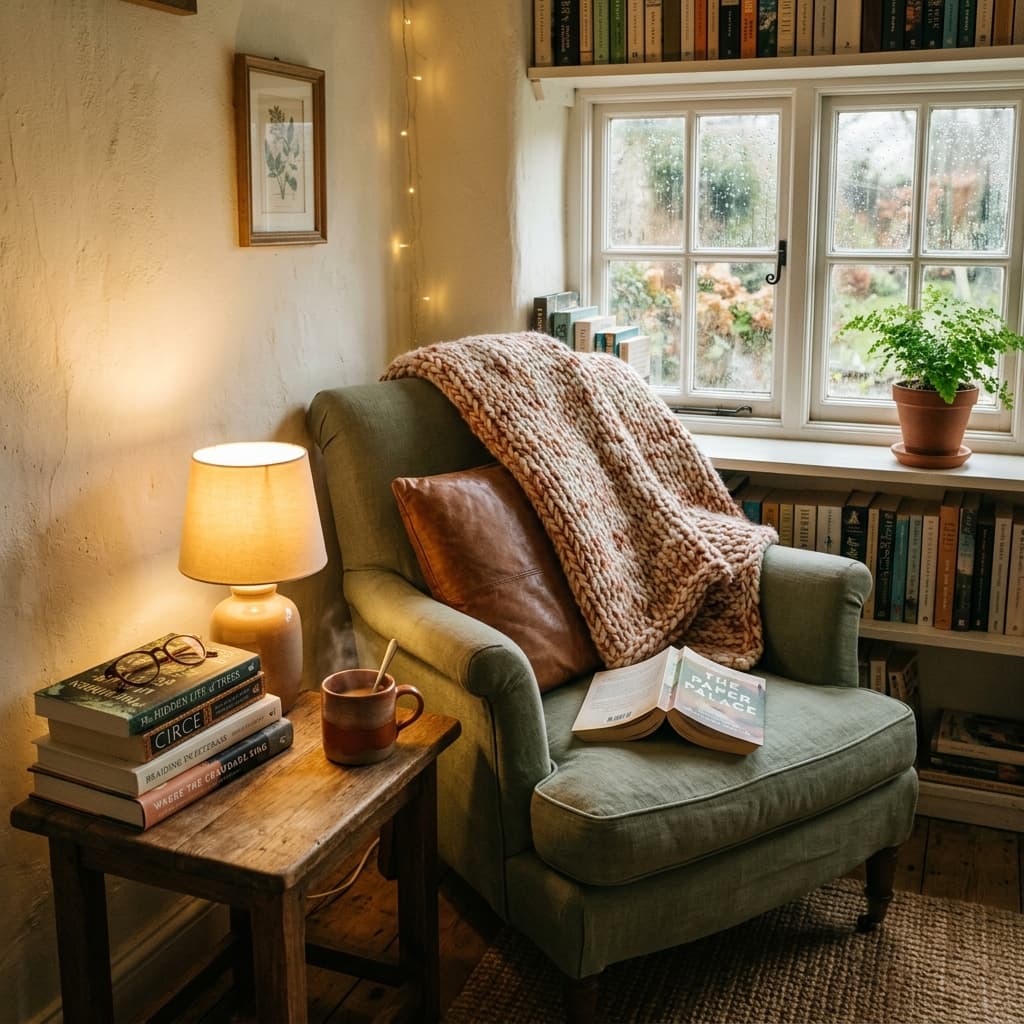
Find a small space today. It could be a chair by a window, a corner of a room, the front seat of your car after the engine goes quiet. Make it yours, even temporarily. Sit in it for five minutes with nothing to do and nothing to hold. Let the walls be close. Let the edges of the space be a container, not a cage, and notice what your body does when it can feel the boundaries, when there is nothing to scan, nothing to manage, nothing to tend except the small, knowable space between you and the nearest wall. If five minutes feels like too long, try two. The space does not need to be big enough for a life. It just needs to be big enough for a breath.
