What would your home say about you if you were not in it to explain? If a stranger walked through your rooms with no context, no narration, no tour of what each object means, what story would the objects tell on their own? I asked myself this question on a Sunday afternoon, standing in the doorway of a room I could barely cross without stepping over something, and the answer that came back was not one I wanted to hear.
The Accumulation
Things arrive so quietly. A candle from a shop you passed on a walk. A mug from a trip that meant something at the time. A stack of magazines you will read when things slow down, which they never do. A coat that does not fit but cost too much to give away. None of these objects are problems individually. Taken together, they become a kind of sediment: the geological record of every impulse, every good intention, every I might need this someday that accumulated over years until the shelf was full, the drawer would not close, and the room felt smaller than its walls.
I did not notice the accumulation while it was happening. That is the nature of it. Each addition is too small to register. A single book does not change a room. But forty books you have not read, stacked on the floor because the bookshelf is full, change not just the room but the feeling of being in it. They become a low-grade obligation. Every time you pass them, a voice too quiet to hear consciously says: you should read those. You are behind. You are not the person those books were bought for.
What Objects Hold
William Morris, the designer and social thinker, wrote in 1880 a principle so clean it has survived nearly a century and a half of accumulation: have nothing in your houses that you do not know to be useful, or believe to be beautiful. The sentence sounds simple. It is not. Because Morris assumed that you know what you find useful and what you find beautiful, and most of us have lost track of both.
Objects hold more than space. They hold identity. The running shoes you bought in a version of yourself that ran. The sewing machine from a year you were going to learn to sew. The bread maker, the yoga mat, the watercolor set. These amount to more than things. They are the ghosts of selves you tried on and did not become, and keeping them is a way of keeping the possibility alive without doing the work of living it. Letting them go feels like admitting something, and the admission is the hard part, not the decluttering.
I kept a box of fabric in the spare room for four years. Good fabric, linen and cotton, bought with the specific intention of making curtains I never made. Every time I opened the cupboard, the fabric sat there with the patience of something that has been waiting a very long time. Letting it go meant accepting that I was not going to make curtains. That the version of me who sewed was a character I had invented, not a person I had become.
The Practice of Subtraction
In Japanese aesthetic philosophy, the concept of ma refers to the meaningful use of negative space: the emptiness between objects, the silence between notes, the pause between words. Far from absence, ma is presence of a different kind. A room with ma has space that is deliberately left unfilled, not because there is nothing to put there, but because the emptiness itself has value. It gives the eye and the mind somewhere to rest.
Simplifying a home aims at something other than a magazine-spread emptiness. The goal is creating ma: room for the eye to travel without snagging, space on the counter where you can set down a cup of tea without moving three things first, a shelf with enough air between objects that each one can be seen for what it is. Rather than a void, the cleared surface becomes a small act of hospitality toward yourself.
I started with one drawer. The kitchen drawer that held, among other things: six pens that did not work, a roll of tape with no tape left, two phone chargers for phones I no longer owned, a set of keys to an apartment I had not lived in for three years, and a birthday candle in the shape of the number four. My daughter is nine. The drawer took eleven minutes. When I closed it, the room felt lighter in a way that had nothing to do with the drawer.
What Remains
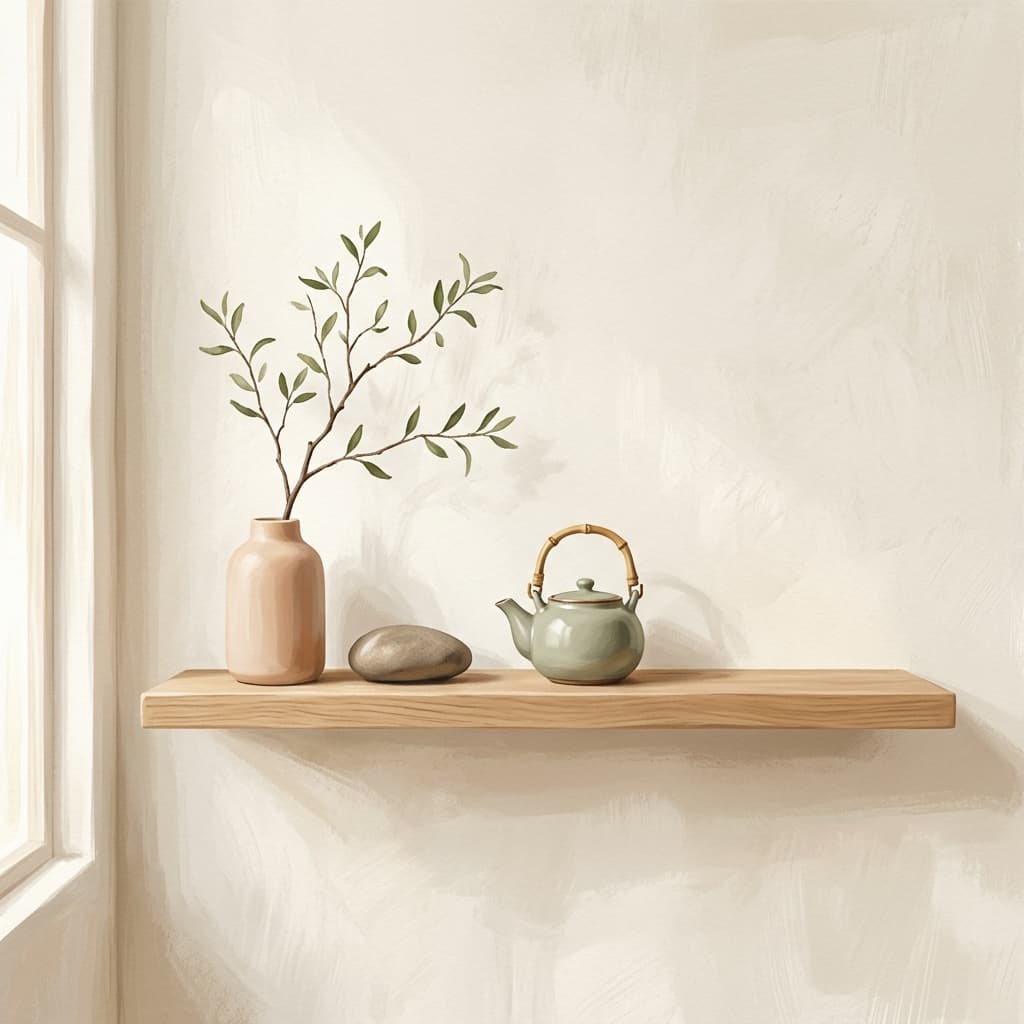
What surprised me about simplifying had less to do with what I let go of than with what I noticed once it was gone. The grain of the wooden shelf, visible for the first time in years. The way the morning light fell on a clear surface and pooled there, warm and unhurried, with nowhere particular to be. The weight of a single vase, placed deliberately, holding three stems of something I had cut from the garden. The room did not look empty. It looked like it was breathing.
The objects that remained after the simplifying were the ones I would have packed in a fire. Not the expensive things or the practical things, but the ones that carried something irreplaceable: my grandmother’s teapot with the chipped spout, a smooth river stone my daughter found on a beach in winter, a photograph in a frame that sits on the windowsill where the afternoon light reaches it. These objects did not need to compete for attention anymore. In the quieter room, they could finally be heard.
A home does not need to be full to feel like yours. Sometimes it needs to be emptied just enough for you to remember what you put there on purpose.
If your home feels heavy, if the rooms have accumulated a weight that has nothing to do with furniture, you do not need to simplify everything at once. One drawer is enough. One shelf. One corner where you clear just enough space to set down a cup and sit without the visual noise of things that no longer belong to the life you are actually living. The empty shelf is not a failure to fill. It is a choice to leave room for what has not arrived yet, or for nothing at all. Both are allowed.
