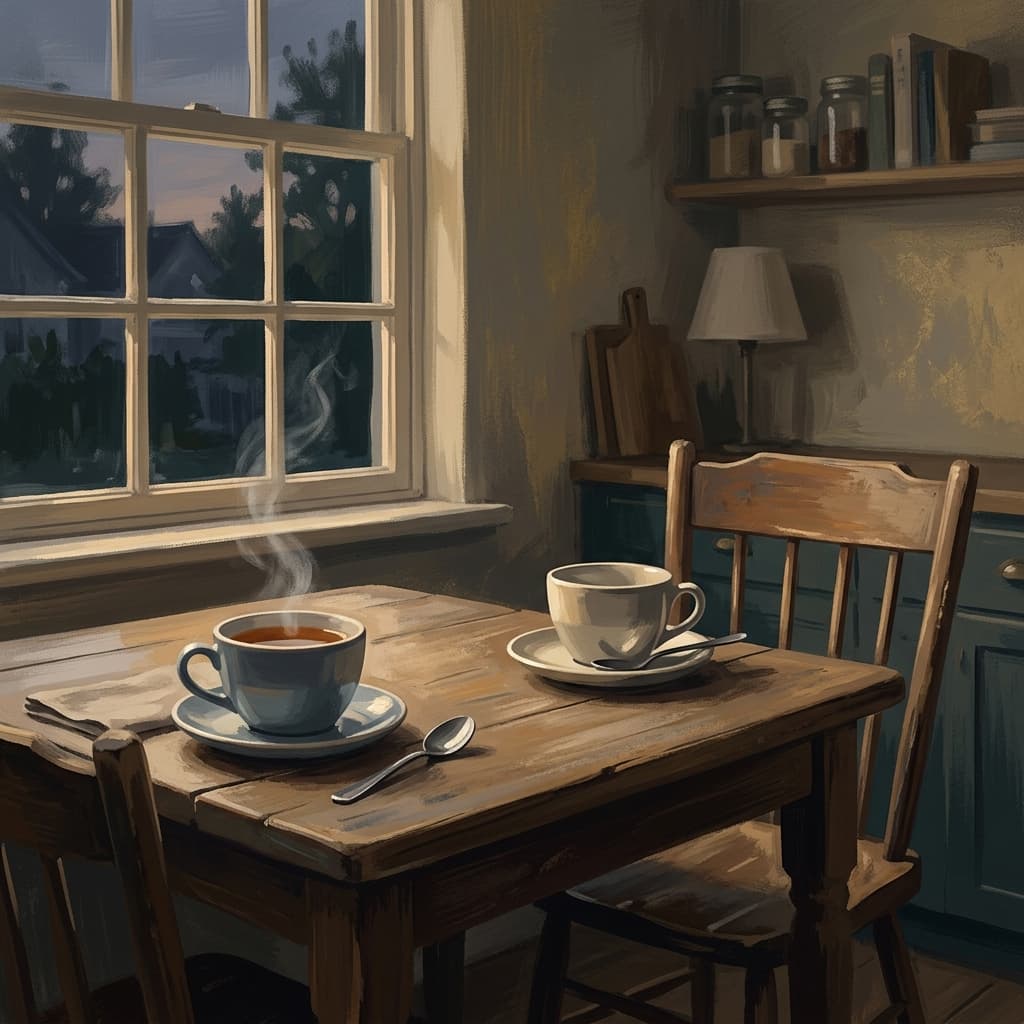
The hardest relationships to leave are the ones that are almost good enough, not the ones that are outright terrible. The ones where nothing is wrong, exactly, but something essential has gone quiet; where the other person has not changed, but you have; where the love is still technically present but has stopped being a living thing and become, instead, a fact you repeat to yourself on difficult evenings.
The Almost
I stayed in a relationship for two years past its natural end because of the almost. Almost happy. Almost enough. Almost the thing I had hoped it would become. The almost was exhausting in a way that outright unhappiness would not have been, because unhappiness gives you permission to leave. The almost does not. The almost says: this could still work. This is not bad. Other people have worse. Who are you to want more than this?
The kitchen told the truth before I did. I stopped cooking for two. Not dramatically, not as a statement, but in the quiet arithmetic of a body that already knew. I would make one portion and leave the other person to find their own dinner, and neither of us said anything about it, because saying something would have meant naming what was already happening. We ate at different times, in the same house, and called it scheduling.
The Body Decides First
The decision to leave a relationship does not happen in the mind. It happens in the body, weeks or months before the mind agrees to process it. I felt it first as a flinch: a small contraction in my shoulders when I heard the key in the door. Not fear. Not anger. Just the body bracing for the effort of being present with someone it had already, quietly, begun to withdraw from.
Dr. Sue Johnson, the clinical psychologist who developed Emotionally Focused Therapy at the University of Ottawa, describes love as a physiological event: a pattern of neural firing, hormonal release, and autonomic regulation that the body either sustains or does not. When the pattern weakens, the body responds with what Johnson calls protest behavior first, reaching desperately for connection, then with detachment. Far from coldness, the detachment is the nervous system conserving energy for a transition it senses is coming.
I noticed the detachment in my hands. I stopped reaching for the other person’s hand in public. I stopped touching their shoulder as I passed in the hallway. The small, involuntary gestures of intimacy, the ones you do not think about until they stop, stopped. My hands knew before my heart did, and my heart knew before my voice could say the words.
Ambiguous Loss
Pauline Boss, the family therapist who spent forty years studying grief at the University of Minnesota, coined the term ambiguous loss to describe a category of mourning that has no clear endpoint: the parent with dementia who is physically present but psychologically absent, the soldier missing in action, the child who has cut contact. But ambiguous loss also describes something smaller and more common: the relationship that has ended emotionally but continues physically. You share a home, a calendar, a bed, and a silence that neither of you has yet agreed to name.
This is the cruelest form of ending, because it denies you the clean grief of a departure. You cannot mourn what is still, technically, here. You cannot rebuild in a space that is still occupied. So you live in the gap, performing the relationship through habit while the living thing at its center grows quieter by the week, until one morning you wake up and realize the silence has been there so long it has become the relationship.
What Closing Looks Like
In the stories, relationships end with slammed doors, thrown possessions, a dramatic speech that clarifies everything. In my experience, they end with a conversation at the kitchen table on a Wednesday evening, both people holding cups of tea that have gone cold, speaking in low voices because neither of you wants this to be louder than it needs to be. The door, when it closes, closes quietly. That is how you know it is real.
What no one tells you about the aftermath is how physical it is. The empty side of the bed that you feel with your whole body, not just your eyes. The single toothbrush in the holder. The weight of a grocery bag scaled for one. The strange, vertiginous freedom of an evening with no one to account for, which feels less like freedom and more like falling for the first several weeks.
But you adjust. The body adjusts. It learns the new weight of the bag, the new shape of the evening, the new silence that is not the same as the old silence. The old silence was full of what was not being said. The new silence is empty, but it is yours.
Some doors close quietly because the people closing them have already spent all their noise on the staying. The leaving, when it finally comes, is the quietest thing they have ever done.
If you are standing at the edge of an ending, if the almost has been your address for longer than you want to admit, you do not need to know yet whether leaving is the right choice. You only need to be honest about where you are. If the relationship is still alive, if there is still a pulse beneath the silence, then staying and tending it is a worthy choice. But if you have been tending something that stopped growing a long time ago, if the staying has become its own kind of exhaustion, then closing the door is the last honest thing you can do for both of you, and there is no failure in it. Take your time. There is no deadline on this.
