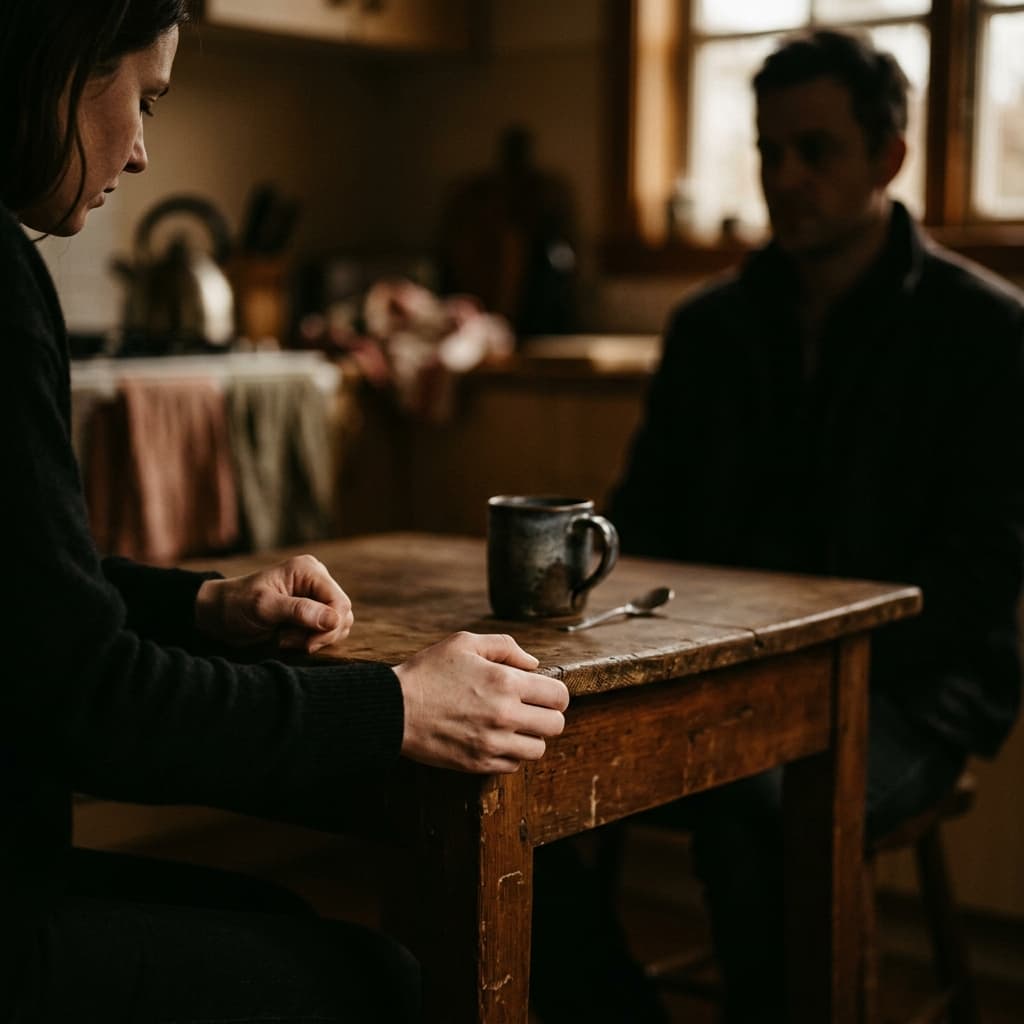
There is a silence that only comes after honesty, and it sounds nothing like the silence that comes before it.
The silence before is full. It hums with the sentence you are constructing, the variations you are testing, the exit routes you are mapping in case you decide, at the last moment, not to say it. That silence is productive. It is the silence of a person doing calculations.
The silence after is empty. The words are in the room. They are occupying space you cannot reclaim, and the other person has not yet responded, and in that gap, which lasts perhaps two seconds, your body does something extraordinary: it prepares for every possible future simultaneously.
What the Body Does in the Gap
I have been paying attention to this gap for years, and I can now describe it with some precision.
The hands go first. They either grip something, a table edge, a mug, the fabric of your own clothing, or they go very still, fingers slightly curled, as if the body is trying to make itself smaller. The stomach follows: a drop, the specific hollow feeling of having stepped off a ledge and not yet landed. Then the breathing. It stops. Not dramatically, not the way breathing stops when you are startled, but as if the lungs have decided to wait for the verdict before committing to the next inhale.
The shoulders rise. The jaw sets. The eyes either hold the other person’s gaze with a steadiness that costs you something, or they drop to a neutral surface: the table, the floor, your own hands. Choice never enters into it: the autonomic nervous system is doing its job, cycling through threat assessment faster than the conscious mind can follow.
Stephen Porges, the neuroscientist who developed polyvagal theory, describes this as neuroception: the body’s process of evaluating safety without the involvement of conscious thought. Before you have time to think was that the right thing to say, the vagus nerve has already scanned the other person’s face, read the microshift in their posture, registered whether the room has become warmer or colder, and begun preparing the appropriate survival response.
Your body knows how this conversation is going before you do.
The Three Silences
Not all post-honesty silences are the same. I have learned to distinguish three.
The first is the silence that breaks into recognition. The other person says I know, or I have been thinking the same thing, or simply yes, and the silence shatters like ice in warm water. The body’s response is immediate: the shoulders drop, the stomach releases, the breathing resumes in a single long exhale that feels like putting down something heavy at the top of a flight of stairs. This silence is the best-case scenario, and something behind the sternum unclenches within half a second.
It is also the rarest.
The second is the silence that breaks into damage. The other person’s face changes. You can see it happening: the eyes narrowing, the jaw setting, the body pulling slightly back, creating distance that did not exist thirty seconds ago. This silence ends with words that rearrange the room. The body responds by going cold, a specific chill that begins in the hands and moves inward, as if the circulatory system is retreating to protect the vital organs.
The third is the silence that continues. No recognition. No damage. Just the gap extending, and this is the one the body handles worst, because the nervous system is designed to respond to signals, and continuing silence provides none. The body stays in threat assessment indefinitely, scanning and rescanning a face that gives nothing away. Porges would call this a failure of neuroception: the system cannot determine whether the environment is safe, and so it oscillates between mobilization and collapse. The person sitting in that silence feels something they often describe as going crazy, when what they mean is my body cannot find the off switch.
The Myth of Brave Honesty
Brene Brown has written extensively about vulnerability as courage. I have read her work. I have quoted it in conversations. And I want to push back on something specific, because I think it matters.
Brown treats the act of being honest as the brave part. The disclosure is the courage. And for the person standing on the far side of the silence, preparing to say the thing, that framing is useful. It is a hand on the back. It says you can do this.
But the two seconds after you say it are not courage. They are the price of courage, and the price is paid entirely by the body. The hands that grip. The stomach that drops. The lungs that stop. Bravery has no part in them; they are involuntary costs, and the body pays them whether or not the honesty was the right decision. Brown writes about what you gain by being vulnerable. I am more interested in what it costs, because the cost is physical and non-negotiable and nobody talks about it.
In the two seconds after you say the true thing, your body prepares for every possible future simultaneously.
The body does not get to decide whether to be brave. It absorbs the consequences of a decision the mind already made.
What Survives the Gap
Deborah Tannen, the linguist, spent decades studying conversational styles and the mechanics of misunderstanding. Her work argues that most communication failures are structural: people from different backgrounds bring different assumptions about silence, directness, and what constitutes a reasonable response. I used to find this comforting. If the silence after honesty goes badly, maybe it is a structural misfire. Maybe the other person simply processes differently.
I am less sure now. Some silences are anything but processing delays; they come from the other person understanding exactly what you said, and needing time to decide what to do with the understanding. That is where the cost of being known makes itself felt, not a structural problem at all.
But here is what I have also learned, and I say this without softening it: the gap ends. Every time, it ends. The silence breaks, one way or another, and the body, which prepared for every possible future, discovers that the actual future is one specific thing. And one specific thing, even a devastating specific thing, is easier for the nervous system to process than infinite possibility. The body can grieve a real loss. It cannot grieve a hypothetical one.
The gap ends, and you survive the ending.
I want to say that surviving makes the next true thing easier to say. And in some bodies, with some people, in some rooms, that is accurate. The nervous system learns from experience. It files the record: I said the true thing and I survived, and the next time the true thing rises in the throat, the threat assessment runs a little faster, the hands grip a little less, the breathing stops for one second instead of two.
But I have also sat in the third silence, the one that continues, with people I loved, and I have felt the body’s full price of that silence, and I am not sure the lesson was I should be honest more often. Sometimes the lesson was some rooms change shape permanently when the true thing enters them, and the new shape is not always one you would have chosen.
I do not know how to resolve this. I do not think it resolves.
If there is a true thing you have been carrying, you do not have to say it today. But you might notice where it lives in your body: the throat that tightens around it, the chest that holds it, the jaw that sets when it rises. You can acknowledge it without speaking it. And if you do speak it, and the silence comes, you can let the body do what the body does in the gap. It has done this before. It will do it again. The gap will end. What comes after the ending is not something I can promise you.
