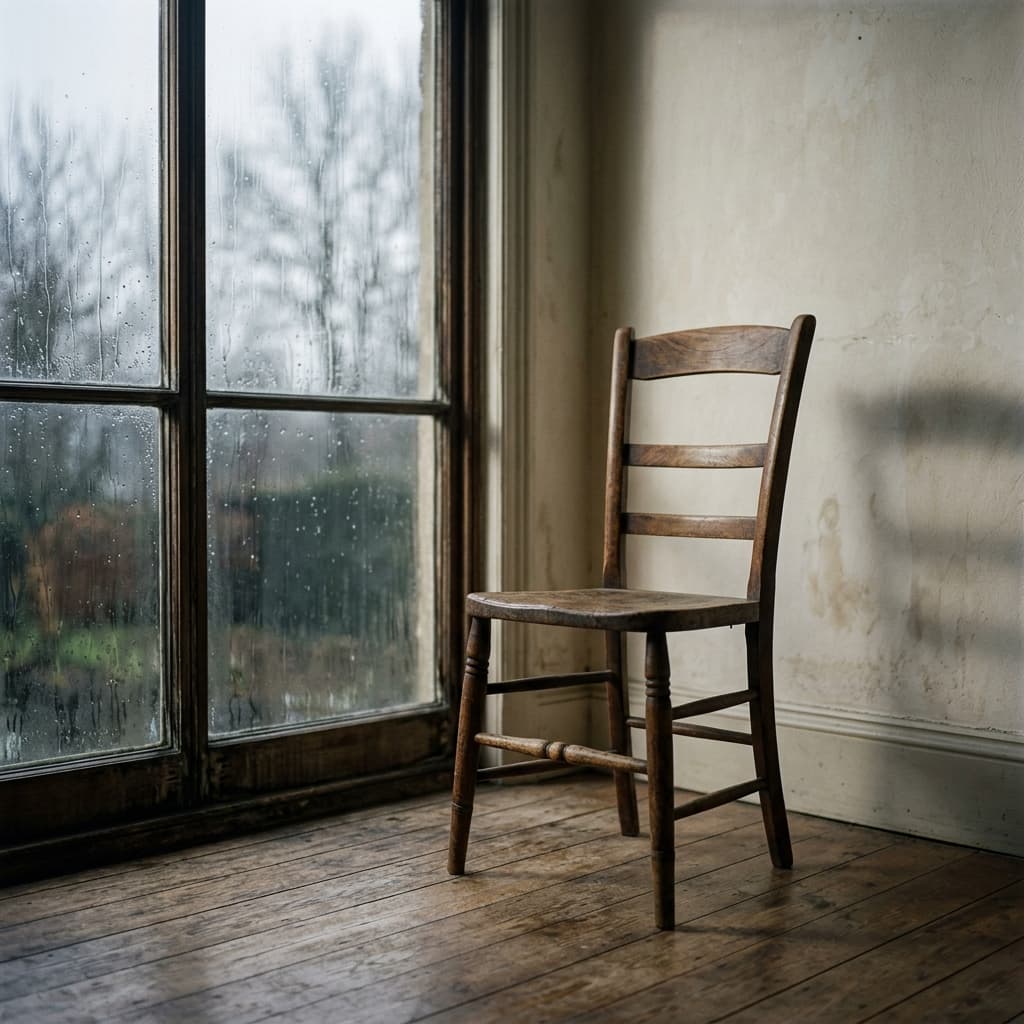
There are two kinds of courage, and we only celebrate one. The first is the courage of leaving: walking out, starting fresh, making the dramatic break that everyone can see and admire. We write stories about this courage. We build entire cultures around it. The second is the courage of staying: remaining in the difficult room, sitting with the unresolved conversation, enduring the season that has not yet turned. This courage has no audience. It produces no visible change. It looks, from the outside, like nothing at all.
But staying, when every nerve in your body is telling you to go, is one of the hardest things a person can do.
The Itch to Move
I know the itch well. It arrives as a restlessness in my legs, a literal urge to stand up and walk somewhere, anywhere, when I am sitting with something I do not want to feel. It came during a winter that felt like it would not end, three months of gray skies and a low-grade anxiety I could not locate or name. Every morning I woke with a tightness in my chest and a thought that arrived before my eyes were fully open: something needs to change. The thought was not wrong. Something probably did need to change. But the itch pointed nowhere in particular. All it promised was escape.
The difference matters. A direction says: here is where I need to go. An escape says: anywhere but here. And the trouble with anywhere but here is that here follows you. The tightness in the chest, the unnamed anxiety, the gray internal weather; these things travel. They do not respect a change of address.
What Distress Tolerance Actually Means
Marsha Linehan, the psychologist who developed Dialectical Behavior Therapy at the University of Washington, built an entire therapeutic framework around a deceptively simple idea: that the ability to tolerate distress without immediately acting to relieve it is a learnable skill, not a fixed trait. She called it distress tolerance, and she distinguished it clearly from distress approval. You do not have to like the difficulty. You do not have to pretend it is good for you. You just have to survive it without making it worse.
The without making it worse is the part that interests me. Because most of the time, when I feel the itch to move, the moving springs up as reaction before any real thought. A reflexive flinch away from discomfort. And reflexive flinches, in my experience, tend to create new problems that are structurally similar to the old ones. You leave the job but carry the pattern into the next one. You end the relationship but bring the avoidance into the one after. You move to a new city and find, within six months, that the weather inside has not changed at all.
Linehan’s insight leaves room for leaving. What she asks is that the decision to stay or go be made from a place of tolerance, rather than from the white heat of wanting the pain to stop.
Staying is not the same as being stuck. Staying is a choice made with open eyes. Being stuck is the absence of choice. The difference is not in the position. It is in the quality of attention you bring to it.
Rilke’s Patience
Rainer Maria Rilke, writing to a young poet in 1903, offered a piece of advice so precise it still cuts: “Be patient toward all that is unsolved in your heart and try to love the questions themselves, like locked rooms and like books that are now written in a very foreign tongue.” He was not counseling passivity. He was describing an active, muscular patience: the willingness to remain inside a question that has not yet revealed its answer, without forcing a resolution.
I think of Rilke’s locked rooms often. There have been periods in my life, whole seasons - when I lived inside a question I could not answer: Should I stay in this work? Is this the right city? Is this relationship growing or just continuing? The temptation during those seasons was always to pick an answer, any answer, just to end the discomfort of not knowing. But the questions were far from ready to be answered. They were still forming. And forcing an answer before the question has finished forming is how you get answers that do not fit.
The cold pressure of uncertainty in the pit of my stomach during those months was physical, constant, like swallowing something that would not go all the way down. I learned to sit with it, not comfortably, never comfortably, but with a kind of grim companionship. The uncertainty and I shared a body. We were going to have to coexist until one of us changed shape.
The Discipline of the Unmoved
There is a particular kind of exhaustion that comes from staying still when everything in you wants to run. This is the exhaustion of restraint. Holding still burns through you in a way that moving never would. The muscles that ache are not the ones that moved but the ones that held. I feel it in my jaw some evenings, clenched all day against words I chose not to say. In my shoulders, which spent the afternoon carrying a tension I decided not to discharge through action. In the heavy tiredness behind my eyes that comes from watching, waiting, enduring, and not yet knowing why.
This exhaustion is real, and it deserves recognition. We do not give awards for the days you did not quit. There is no visible trophy for the morning you woke up, felt the full weight of the gray, and got out of bed anyway, not because it felt good but because you were not finished here yet. The staying is invisible labor. But it is labor.
And sometimes, on the other side of it, you discover that the season has turned without your permission. The question answers itself. The gray lifts. The thing you were enduring shifts into something you recognize as yours: not easy, not painless, but no longer unbearable. You did not earn this change. You outlasted the weather that preceded it.
If you are in a season of staying, if you are holding still while the itch tells you to run, you do not need to justify your position. You do not need to know yet whether staying is the right choice. You only need to know that it is a choice, made by you, and that you are allowed to make it again tomorrow or not. If the staying has become something your body cannot carry, if it has crossed from difficulty into harm, then leaving, anything but failure, is wisdom. But if you are staying because some quiet part of you knows you are not finished here yet, then trust that knowing. Sit with the question a little longer. Let the locked room stay locked. Some doors open from the inside, but only after you have stopped trying to force them.
