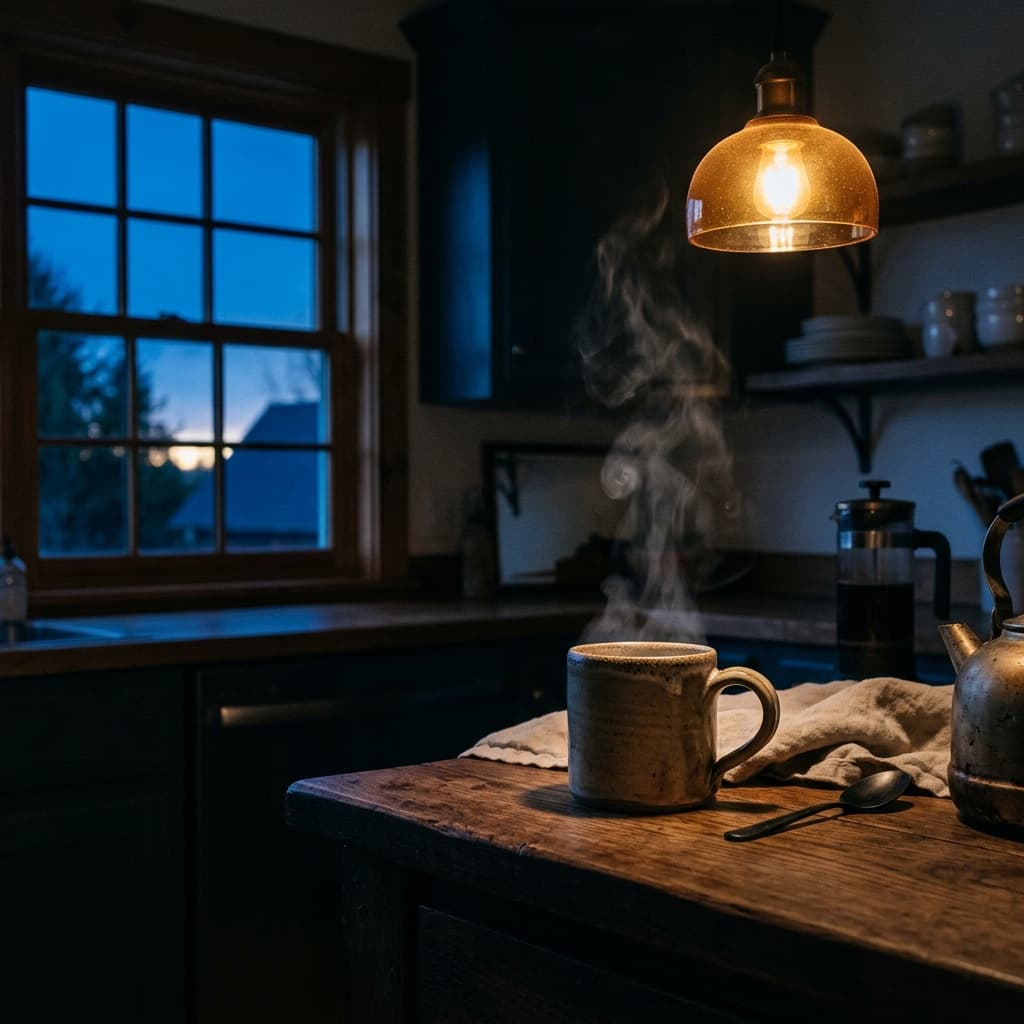
I have a life that happens before five in the morning, and I have never told anyone about it. Not because it is secret but because there is nothing to tell. I wake in the dark, and for forty minutes I am a person with no audience. I boil water in a kettle that clicks off with a sound so familiar it has become a kind of punctuation: the period at the end of sleep, the opening bracket of the day. I stand in the kitchen in bare feet on cold tile, and the house is so quiet I can hear the refrigerator’s hum shift pitch as the compressor cycles. No one is watching. No one needs anything. For forty minutes, every role falls away—mother, professional, friend. I am just a body in a kitchen, holding a warm cup, and that is all.
These are the hours no one sees. And they are the hours that hold everything else together.
The Back Stage
Erving Goffman, the Canadian-American sociologist who spent his career studying the performance of everyday life, made a distinction that has never left me. He described social existence as a kind of theater, with a front stage and a back stage. The front stage is where we present ourselves: composed, appropriate, performing the version of ourselves that the situation requires. The back stage is where the performance drops. Where you can scratch the itch, mutter to yourself, sit in the ugly chair, wear the shirt with the stain. Far from a lesser version of you, the back stage is the version that makes the front stage possible.
Goffman was writing about social interaction, but the framework applies equally to the structure of a day. The hours other people see are front stage: the meetings, the errands, the conversations, the visible labor of being a person in public. The hours no one sees are back stage: the 2 a.m. glass of water, the pre-dawn sitting, the late-night folding of laundry that will be unfolded and worn and folded again by this time next week. These hours have no witness and produce no visible result. They are maintenance, and maintenance is the architecture that nobody photographs.
What Happens in the Margins
I started paying attention to my unseen hours the way you might inventory a room you have been living in without really noticing. What I found was a life I had not been accounting for. The ten minutes after everyone leaves the house, when I stand in the hallway and listen to the specific quality of silence that an empty home produces: not absence but relief, the sound of a space exhaling. The twenty minutes before bed when I sit on the edge of the mattress and do nothing that could be described as productive. My hands rest on my knees. My shoulders drop by what feels like an inch. The day unstacks itself, piece by piece, like removing heavy books from a shelf until the wood stops bowing.
None of this appears on a calendar. None of it would survive a productivity audit. But without these margins, the center does not hold. I know this because I have lived the experiment in both directions. The seasons when I protected my unseen hours, I could sustain the visible ones. The seasons when I let them be colonized, by screens, by tasks, by the belief that every waking minute should be accounted for, the seam at the base of my patience began to fray. Not dramatically. Quietly. The way a seam gives before the fabric tears.
The Labor of Maintenance
There is a category of work that the world does not recognize as work because it produces no new thing. It only prevents deterioration. Washing the dishes so they can be dirtied again. Sweeping the floor that will need sweeping tomorrow. Answering the emails that will regenerate overnight like cells. This is maintenance labor, and the philosopher Shannon Vallor has written about how it is systematically devalued precisely because it is cyclical rather than progressive. It does not build toward a climax. It holds a steady state. And holding a steady state, it turns out, requires as much energy as building something new. Often more.
The unseen hours are where most maintenance happens. The quiet acts of keeping a life functional: setting the coffee maker the night before, laying out clothes for the morning, wiping down the counter one more time before turning out the kitchen light. The smell of dish soap on your hands at eleven at night. The specific weight of a wet towel draped over a drying rack. The click of the front door lock, checked twice because the body remembers the night you forgot. There is nothing glamorous about these acts. They are the stitches that hold the days together, and they are almost entirely invisible.
The hours no one sees are not the leftover hours. They are the load-bearing ones. Everything visible rests on the quiet labor that happens when the audience has gone home.
Protecting the Margins
I have become territorial about my unseen hours in a way I cannot fully explain. When someone suggests an early morning meeting, I feel a resistance that is out of proportion to the request. I object to the loss of the margin. The forty minutes of cold tile and warm cup and silence. The time when I am allowed to be the back stage version of myself, the one who does not smile on command, who sits with both hands wrapped around a mug and thinks about nothing in particular, who lets the kettle click off without immediately doing the next thing.
These margins are infrastructure. And like all infrastructure, they are most visible when they fail. You do not notice the foundation of a house until it cracks. You do not notice the unseen hours until they have been taken, and then you notice everything: the frayed patience, the shallow breathing, the sense of performing a life rather than living one.
The back stage is where you remember who you are when no one is asking you to be anything.
If you have unseen hours, the ones before the house wakes or after it settles, consider that they may be doing more than you think. You do not need to fill them with practice or productivity or self-improvement. You do not need to optimize them. You just need to notice that they exist, and that the person who lives inside them, the one with no audience and no agenda, is not the lesser version of you. She is the one who makes all the other versions possible. And if your days have no margins left, if the front stage runs from waking until sleep, then the smallest reclamation is this: five minutes, anywhere, where no one needs you to be anything. Stand in a doorway. Hold something warm. Let the quiet do its work.
