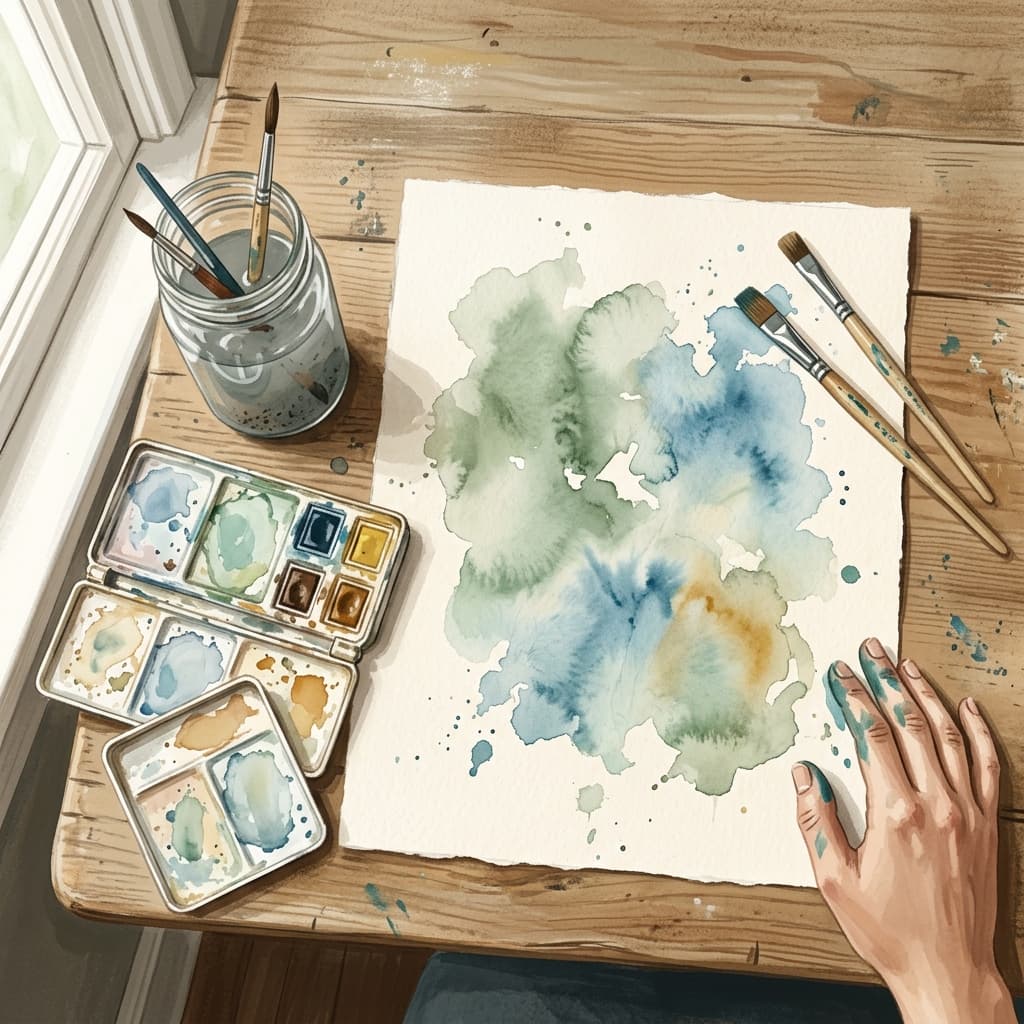
It was a Saturday afternoon in February, and I was sitting at the kitchen table with a set of watercolors my daughter had outgrown and a glass of water that was already turning gray. I had not painted anything in over fifteen years. The paper buckled under the first wet stroke. The colors bled into each other in ways I did not intend. The thing I was making looked like nothing recognizable, a wash of green and blue that could have been a landscape or a bruise or an accident. I kept going. Forty minutes later, I had produced something genuinely terrible, and I felt better than I had in months.
The Permission Problem
Somewhere between childhood and now, most of us stopped making things. Not because we ran out of ideas, but because we developed standards. A child paints without asking whether the painting is good. An adult cannot pick up a brush without the question arriving before the paint does: what is this for? Who is it for? Am I allowed to do this if I am not good at it?
The permission problem is not about time, though we often frame it that way. I have time for scrolling, for reorganizing the kitchen, for watching three episodes of something I will not remember next week. The permission problem is about worth. We have internalized the idea that creative activity must produce something: a product, a portfolio, an identity. Making something with no audience, no purpose, and no skill feels, to the adult mind, like a waste. But D.W. Winnicott, the British pediatrician and psychoanalyst, argued in his 1971 work Playing and Reality that creative play, far from being a luxury, is the primary way human beings learn to feel real. The child who smears paint on paper is not making art. She is making a self.
What Creativity Is Not
Creativity has nothing to do with talent, nor with the ability to produce something beautiful on the first try. What it takes is the willingness to produce something terrible and keep sitting at the table. This distinction matters because the talent myth, the belief that creative people are born with a gift the rest of us lack, has killed more creative practices than any lack of time or money ever has.
What I found, sitting at the table with the watercolors, is that creativity is a state, not a skill. It is the state of being absorbed in a process that has no predetermined outcome. Mihaly Csikszentmihalyi, the Hungarian psychologist who spent decades studying optimal experience at the University of Chicago, called this state flow: the condition of being so fully engaged in an activity that self-consciousness dissolves and time distorts. He found that flow does not require mastery. It requires a challenge that is slightly beyond your current ability, and a willingness to stay with the difficulty instead of quitting.
The watercolors were slightly beyond my ability. Everything about them was slightly beyond my ability. And that was the point.
The Body at Work
What surprised me most about returning to a creative practice was how physical it was. I had expected it to be cerebral, an exercise in imagination and vision. Instead, it was an exercise in hands. The feel of the brush handle between my thumb and forefinger, the specific resistance of the paper grain as the bristles dragged across it, the cold of the water in the jar when I dipped my fingers in to test the temperature. My hands were making decisions my mind had not approved, and the decisions were better for it.
There is a particular pleasure in the smell of paint. Not the chemical smell of acrylics but the earthy, mineral smell of watercolor pigment mixed with water, something like wet clay or river mud, a scent that connects you to the ground even when you are sitting at a kitchen table. I would lean in close to the paper and breathe it in, and the tight band across my sternum would loosen, the way it loosens when you step outside after being indoors too long.
The body, it turns out, wants to make things. It wants to use its fine motor skills for something other than typing. It wants to grip, press, drag, smooth, tear, fold. It wants to feel the resistance of material and the release of a line that lands where you meant it to, or close enough, or somewhere better than you planned.
What Returns
I paint badly every Saturday now. I do not show anyone. I do not photograph the results. Most of what I make goes into the recycling. But something has returned that I did not know I had lost: the experience of being absorbed in something that does not matter. Not in the nihilistic sense. In the liberating sense. The painting does not matter. The mattering is in the making.
What returns, when you give yourself permission to create without purpose, is a kind of attention you cannot access any other way. This is neither the focused attention of work nor the diffuse attention of rest, but the playful attention of a mind that has been released from the obligation to produce value. In that attention, unexpected things surface: a memory you had not thought of in years, a solution to a problem you were not consciously working on, a feeling you did not know you were carrying until the brush found a color for it.
You do not need to be good at the thing your hands want to do. You just need to let them do it. The practice is not in the product. It is in the returning.
If there is something you used to make, or something you have always wanted to try, or something that sounds appealing but impractical and pointless, consider the pointlessness a recommendation. Find the cheapest materials you can. Sit down for twenty minutes with no audience and no objective. Make something terrible. Then make something worse. The quality is not the point. The point is the feeling in your hands when they are finally doing what they have been quietly asking to do. Or do not. This is an invitation, not an assignment. Leave it on the table if it does not fit.
