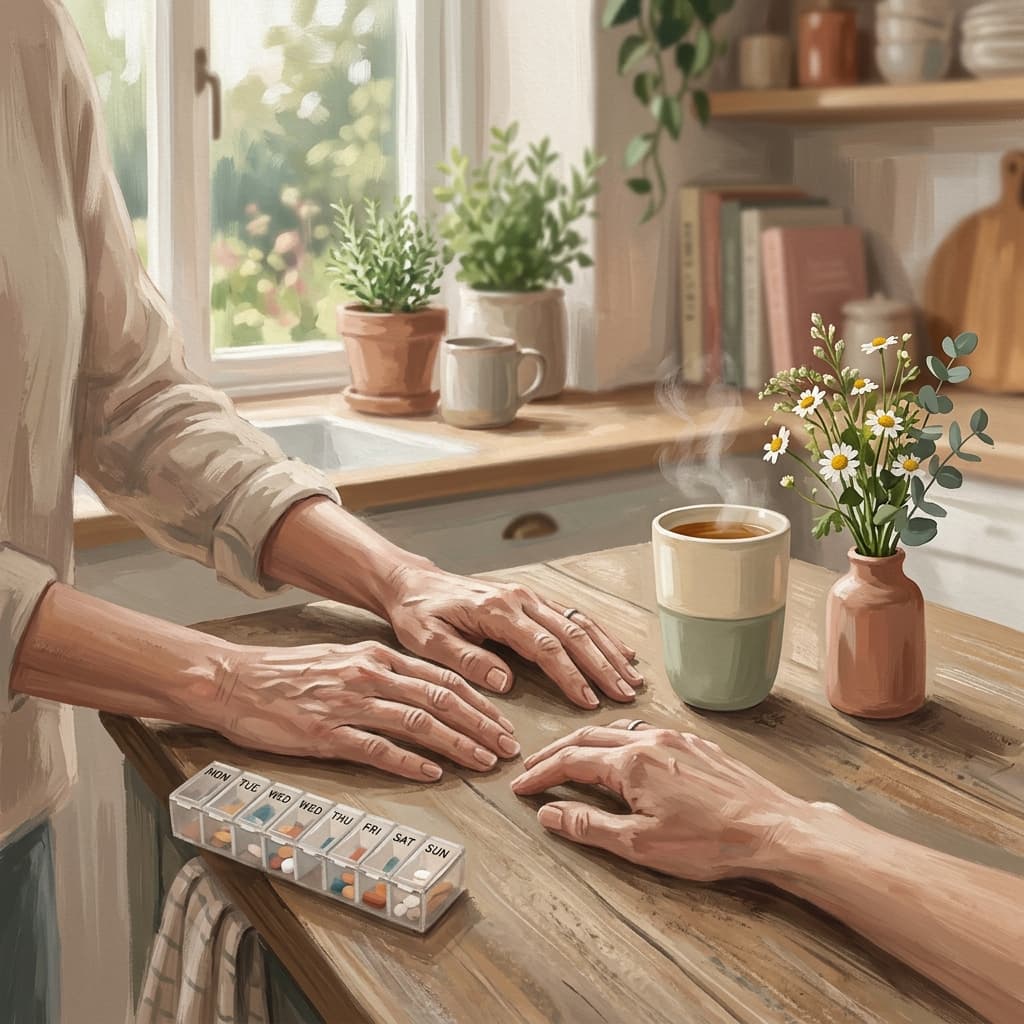
I did not become a caregiver. I became one in the way you become tired: gradually, and then all at once. One week I was visiting my mother on Sundays, bringing flowers and a bag of groceries. The next I was managing her medications, driving her to appointments, sitting in waiting rooms with a book I never opened because I was listening for her name to be called. The week after that I had a key to her place and a column in my calendar that said Mom that stretched from Monday to Friday with no end date.
The Invisible Shift
No one marks the moment you become a caregiver. There is no ceremony, no contract, no orientation. You simply begin doing more, and the more becomes the norm, and the norm becomes the expectation, and the expectation becomes the shape of your entire week without anyone, including yourself, naming what has happened. You have taken on a second life inside your first one, and the second life is not optional.
The tasks themselves were not difficult. Cutting vegetables into pieces small enough for her to manage. Sorting pills into the plastic organizer with the days of the week printed on the lids in letters too small for her to read. Washing her hair on Wednesdays because Wednesday was the day she used to go to the salon, and the routine mattered more than the reason. The doing itself was bearable. What wore me down was its relentlessness, the knowledge that tomorrow would require the same tasks, and the day after, and the day after that, with no pause, no promotion, no performance review.
The Feelings You Are Not Supposed to Have
Arthur Kleinman, the psychiatrist and anthropologist at Harvard Medical School, wrote The Soul of Care in 2019, a memoir about caring for his wife through ten years of Alzheimer’s disease. He described the experience with a honesty that most caregiving narratives avoid: the resentment that arrives alongside the love, the exhaustion that makes you cruel in small ways you are ashamed of afterward, the grief of losing someone who is still alive. He called caregiving the most human of acts and the most depleting, and he did not pretend that one cancelled out the other.
I recognized myself in his honesty. I loved my mother completely. I also, on certain evenings, sitting in her kitchen for the third hour while she told me the same story for the fourth time, felt a rage so clean and specific it frightened me. Not at her. At the situation. At the way her need had swallowed my evening, my weekend, my ability to sit quietly in my own home without the phone vibrating with a question I had already answered that morning. The rage was not the opposite of love. It was its exhausted companion.
No one tells you about the guilt that follows the rage. The guilt of wanting an evening to yourself. The guilt of feeling relieved when someone else takes a shift. The guilt of noticing, in the middle of cutting her vegetables, that you have not thought about your own dinner, your own body, your own hunger, in hours.
The Body of the Caregiver
Caregiving lives in the body. I felt it first in my lower back: a deep, persistent ache from bending over beds, lifting bags, standing in kitchens that were not designed for the amount of standing I was doing. Then in my shoulders, which climbed toward my ears and stayed there, braced against the next phone call, the next crisis, the next small emergency that was never quite an emergency but never quite nothing.
I stopped sleeping through the night. Not because she needed me at night, but because my nervous system had recalibrated to a state of permanent readiness, a low hum of alertness that treated every sound, the creak of the house, the wind against the window, the click of the radiator, as a potential summons. Charles Figley, the psychologist who first described compassion fatigue in 1995, called it the cost of caring: the secondary traumatic stress that accumulates in people who spend their days attending to the suffering of others. The cost is measurable. It is cortisol. It is disrupted sleep architecture. It is the immune system quietly downgrading its priorities because the body has decided that vigilance matters more than repair.
What I Learned to Protect
I did not learn to protect my time. I learned to protect fifteen minutes of it. A quarter of an hour, twice a day, that belonged to no one but me. I sat in the car before going into her place and drank a cup of tea from a thermos, feeling the warmth of the metal against my palms, watching the pigeons on the roof across the street, letting my shoulders drop for the length of a single cup. It was far from enough, but it was something.
I learned to say: I need to leave at five today. Not I will try to leave at five, which meant I would leave at seven. I need to. The need was real. The need was a body that had been standing in someone else’s kitchen for four hours and had its own kitchen to return to, its own vegetables to cut, its own evening to inhabit. Saying I need felt like selfishness. It was, in fact, the minimum requirement for continuing to show up tomorrow.
I learned that the best caregivers earn that title by knowing what they cannot give and saying so before the giving becomes resentment, not by giving everything. This is not a lesson I learned gracefully. I learned it from the floor of my hallway, sitting with my coat still on, too tired to stand up, too tired to cry, understanding finally that the help I had been offering was no longer help if it was destroying the person offering it.
You cannot pour from a body that has forgotten it is also a cup. The tending of others begins, always, with the admission that you too need tending, and that this admission is not weakness but the foundation of every sustained act of care.
If you are caring for someone, if the hours that used to be yours now belong to another person’s needs, you do not need to feel grateful every moment. You are allowed the rage and the guilt and the exhaustion and the love, all at once, without choosing between them. Protect what you can: fifteen minutes, a closed door, a cup of tea in the car. There is nothing selfish in needing what you need; it keeps you here to give what you give, tomorrow and the day after. Or, if today the only thing you can protect is one breath between tasks, start there.
