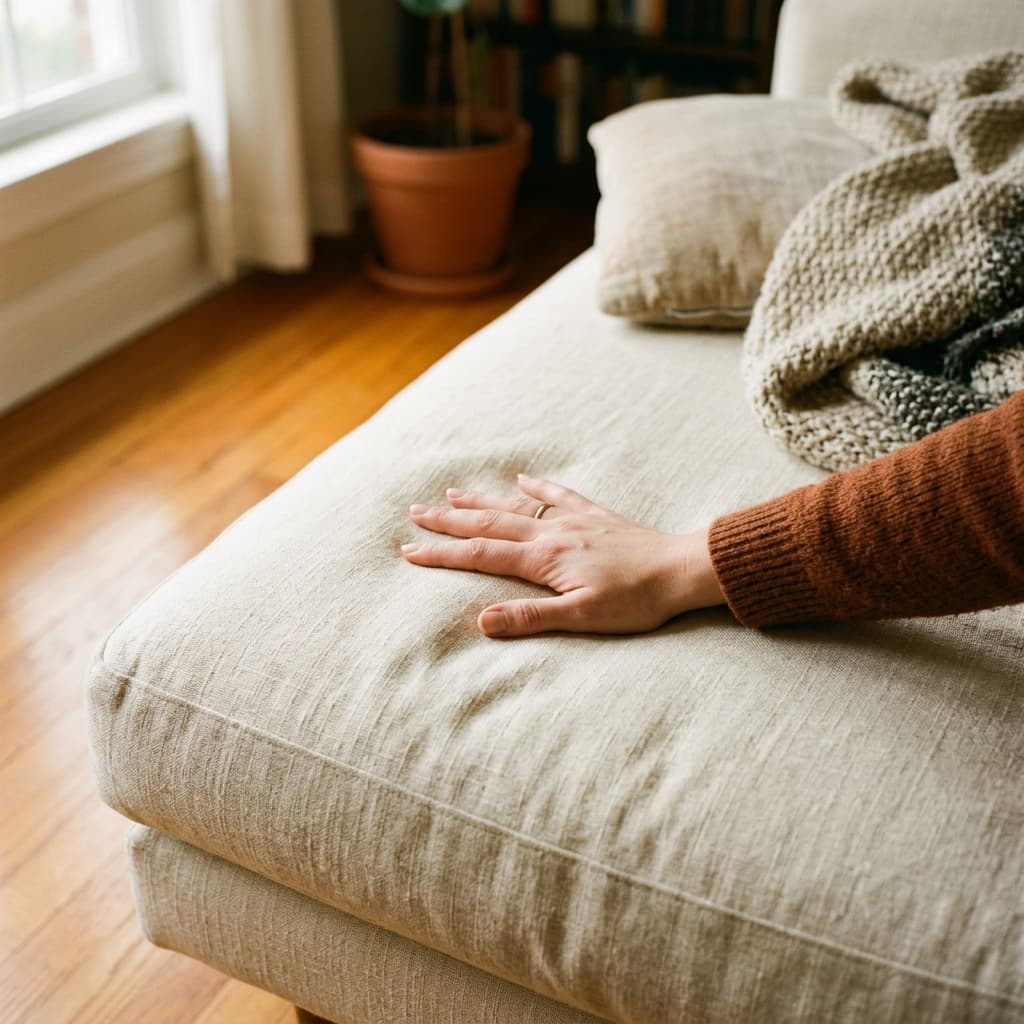
She left the room three minutes ago, and the cushion where she sat is warm. I put my hand on it, and a pull behind my sternum responds before my mind does. A kind of recognition. Not of her, exactly, but of the fact that a body was here, in this specific spot, and the evidence has not yet disappeared.
I do not know why I do this. I do not know why I have always done this: pressing my hand into the warm place on the couch, the warm place on the bed, the warm place on the chair where my daughter was sitting before she ran outside. It is not a decision. It is a reflex. The hand reaches for the warmth the way it reaches for a doorknob: without being asked.
The Catalogue of Warm Spots
I have been paying attention, and the catalogue is longer than I expected.
The steering wheel of the car after my partner has driven it. Not the whole wheel; just the parts where his hands were, at ten and two, slightly worn in the leather, holding the shape and temperature of his grip. I adjust the mirrors and sit inside the warmth he left on the seat, and for a few seconds the car feels like a shared space even though I am alone in it.
The handle of the kettle after someone else has made tea. The specific warmth of a recently held mug. The bathroom doorknob, first thing in the morning, when someone has already been through. The pillow on the other side of the bed, carrying the impression and the heat of a head that was resting there twenty minutes ago.
Each of these is temporary. The warmth lasts, depending on the material and the room temperature, somewhere between thirty seconds and four minutes. I looked this up once, the way you look things up when you are trying to understand a feeling by understanding the physics. The answer did not help. Knowing that a couch cushion retains body heat for approximately ninety seconds does not explain why my hand reaches for the warm spot every time, or why finding it produces a feeling I can only describe as relief. It is a small window. A brief overlap between someone’s presence and their absence. And my body, every time, reaches for it.
I wonder what it is reaching for.
The Circuit the Brain Cannot Separate
Matthew Lieberman, a neuroscientist at UCLA, has spent decades studying why the brain treats social connection as a basic need. In his research on the insula, the brain region that processes physical sensation, he found something I have not been able to stop thinking about: the circuits that register physical warmth and the circuits that register social warmth overlap almost entirely. When you hold a warm cup of coffee, the insula responds. When you feel connected to another person, the same region responds. The brain, at the level of neural architecture, does not fully distinguish between being warm and being loved.
This might explain the reflex.
When my hand finds the warm spot on the couch, the insula reads it as both temperature and connection. The warmth is thermal. But the feeling it produces, the loosening in the chest, the settling of something that was clenched without my knowing it, is social. My body is reading the warm spot the way it reads a hug: as evidence that I am not alone.
John Bowlby, who gave us attachment theory, described the infant’s need for proximity to the caregiver as the foundation of all later connection. The infant cries when the caregiver leaves. The infant calms when the caregiver returns. The system is organized around presence and absence: you are here or you are gone.
But the warm spot is neither.
It is the space between presence and absence. The person is gone, but the evidence of their body has not yet followed. I wonder if Bowlby’s framework, which maps attachment as a binary, misses this middle register: the trace, the residue, the thermal proof that someone was here and that their leaving is recent enough to feel.
The Language That Was Not Enough
Gary Chapman’s model of love languages sorts affection into five categories: words of affirmation, acts of service, gifts, quality time, and physical touch. The framework is useful. It gives people a vocabulary for what they need. But I have been thinking about what it does not include.
The warm spot on the couch is not physical touch. No one is touching me. It is the evidence of touch that has already ended, the thermal shadow of a body that has moved on. Chapman’s model accounts for the moment of contact but not for what remains after the contact is over. It accounts for the letter but not for the envelope, warm from the postman’s hand.
I think there is a sixth language, one Chapman did not name, and it is the language of traces. The warm spot. The dent in the pillow. The steam rising from the mug someone made for you and left on the counter before they went to work. They fall outside acts of service, gifts, and words altogether—involuntary residues of having been near another body, and the fact that they are involuntary is precisely what makes them trustworthy. You cannot fake a warm spot. You can only leave one by having been present, and you can only find one by paying the kind of attention the body pays without being asked.
Residual warmth is the body’s love letter: brief, physical, and gone before you finish reading it.
The warm spot on the couch is cooling. I can feel it changing under my hand, the temperature falling degree by degree toward the ambient temperature of the room. In a minute, maybe two, it will be indistinguishable from any other part of the cushion. The evidence will be gone. The window will close.
I keep my hand there anyway.
I keep my hand there because the warmth, while it lasts, is a kind of proof. Not of love, exactly, and not of attachment in Bowlby’s formal sense, but of something simpler and harder to argue with: that another body was here, that it left heat behind, and that my body noticed. In a world that moves quickly and forgets easily, the warm spot is the body’s way of saying I was paying attention. Someone was here. And for a few more seconds, the cushion remembers what the room is already beginning to forget.
If you find yourself pressing your hand into the warm place where someone was sitting, you do not need a reason. The hand is doing what hands do: reaching for evidence of connection. You can let it. You can feel the warmth while it lasts, and you can notice the specific quality of attention your body brings to it, the way it reads temperature as tenderness. The window is small. The warmth will not stay. But for the thirty seconds it is there, your body is reading a message the room is about to forget.
