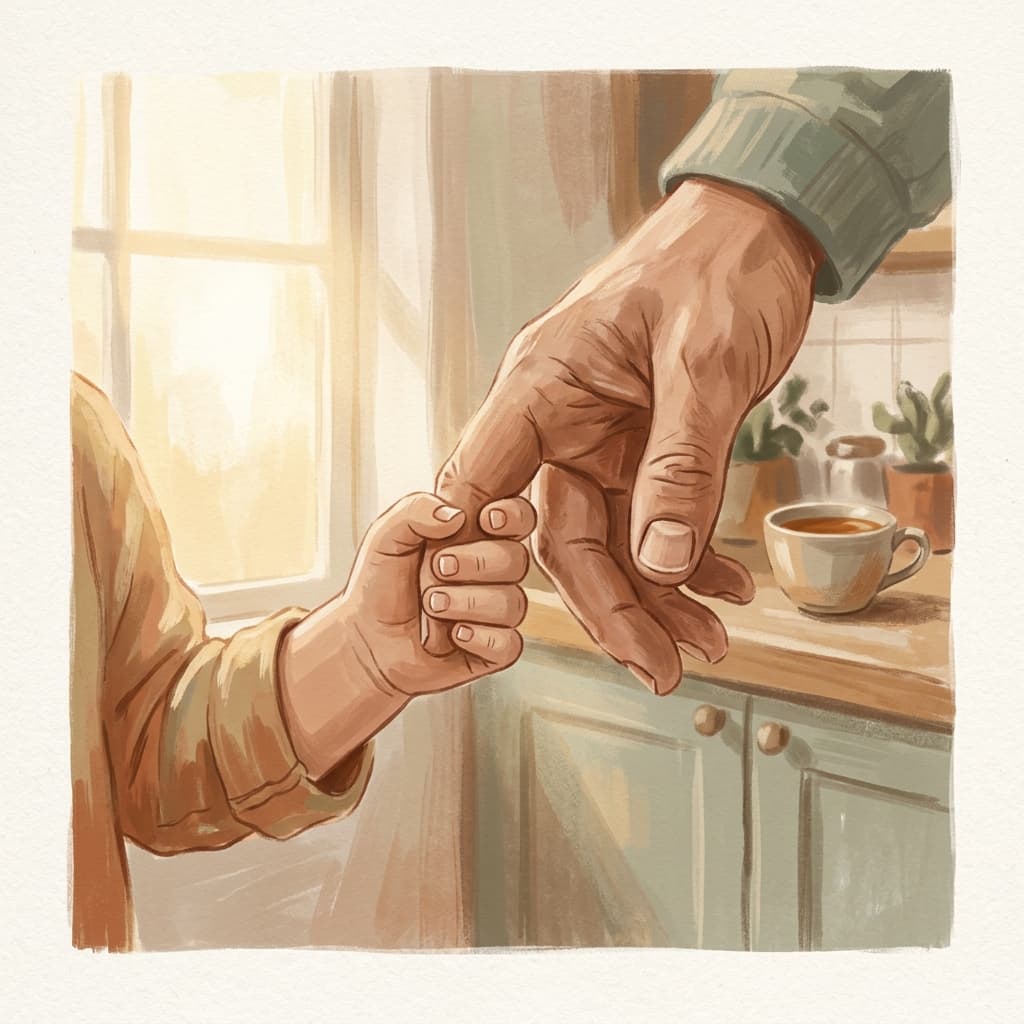
It was a Tuesday morning, and I was mid-sentence on a phone call I had been waiting for all week when a small hand wrapped around my index finger and pulled. Not hard. Not urgently. Just a child’s quiet, absolute certainty that my attention belonged to her right now. I felt the warmth of her palm against my knuckle, the slight dampness of her skin, and the tight knot behind my sternum loosened before my mind could form the thought: she is right. She is right, and the phone call can wait.
I hung up. I knelt down. She showed me a beetle she had found on the windowsill, its shell the color of an old penny, its legs moving in a pattern she wanted me to see. The whole encounter lasted two minutes. The phone call, it turned out, could be rescheduled. The beetle could not.
The Uninvited Teacher
No one tells you, before you become a parent, that the hardest part is not the sleeplessness or the logistics. It is the relentlessness of being needed in the present tense. A child does not schedule their need for your attention. They do not wait for a convenient pause. They arrive in the middle of your thoughts, your plans, your carefully structured morning, and they say, with their whole body: now. Be here now.
I spent years studying mindfulness before I had children. I read Jon Kabat-Zinn’s work on present-moment awareness at the University of Massachusetts Medical Center, where he founded the Stress Reduction Clinic in 1979. I sat on cushions. I followed my breath. I thought I understood what presence meant. Then I had a child, and I realized that everything I had practiced in quiet rooms was preparation for this: the loud, sticky, interrupted, deeply ordinary practice of being present with another human being who will not let you be anywhere else.
What Children Know About Time
Children live in undiluted time. They do not experience a walk to the mailbox as a task to complete. They experience it as a series of discoveries: the crack in the sidewalk that looks like a river, the sound of a gate hinge that resembles a bird call, the cold of the metal mailbox against small fingertips. A walk that takes me four minutes takes my daughter twenty. She is not slow. She is thorough. She is attending to what I have learned to ignore.
There is a name for what she is doing, though she would not know it. William James, writing in The Principles of Psychology in 1890, described what he called involuntary attention: the natural, effortless absorption in whatever is immediately present. He distinguished it from voluntary attention, the kind adults use when they force themselves to focus on a spreadsheet or a difficult conversation. Children live almost entirely in involuntary attention. They are drawn to whatever is vivid, strange, or close. They do not choose to pay attention. Attention chooses them.
Watching her, I feel the loss of my own involuntary attention like a phantom limb. Somewhere between childhood and now, I traded absorption for efficiency. I learned to filter the world down to what is useful, and in doing so, I stopped noticing the texture of the bark on the tree outside my window, the faint hum of the boiler starting up in the hallway, the specific weight of a cup of tea held in both hands on a cold morning.
Presence Is Not Performance
There is a version of present parenting that is, in truth, a performance. It looks like narrating every activity, documenting every milestone, arranging moments to be photographed and shared. I have done this. I have held a camera between myself and my child and mistaken the recording for the living. But presence with a child is not something you can prove to an audience. It lives in the moments no one photographs: the three minutes of silence while you both watch a spider cross the bathroom floor, the weight of her body against your ribs as she falls asleep on the sofa and you sit perfectly still because you do not want to disturb the warm, heavy peace of it.
Real presence with a child is boring. I mean this as the highest compliment I know. It is sitting on the kitchen floor while she sorts buttons into piles by color and you have no phone, no book, no secondary task, just the sound of buttons clicking against tile and the quiet companionship of doing nothing together. It is enduring the slowness without filling it. It is letting the moment be exactly as small as it is.
The Practice You Did Not Choose
Parenting, for me, became the attention practice I never would have chosen. It is rough and loud, anything but serene. It does not happen on a meditation cushion in a quiet room with a candle and a timer. It happens at six in the morning with milk spilled across the counter and a voice saying Mama, look, look at this, and the discipline of actually looking. Actually seeing the leaf she is holding up, the way the light catches the veins in it, the expression on her face that says: I found something worth showing you.
This practice has no graduation. There is no stage where you have achieved parental presence and can move on to the next thing. It renews itself every morning, every interruption, every small hand reaching for yours. And it changes you, not in the grand, transformative way that spiritual books promise, but in the slow, cellular way that water changes stone. You become, over years, a person who notices more. Not because you decided to, but because someone kept pulling you back.
A child does not teach you patience. A child teaches you that patience is not something you achieve but something you practice, badly, every single day, with your whole imperfect attention.
If you are in the thick of it, if the pull of small hands feels less like a spiritual practice and more like an interruption you cannot escape, you do not need to reframe it as beautiful. Some days it is just hard, and the hardness is allowed. But if you can, on one ordinary morning, let the phone call wait. Let the to-do list sit unanswered. Let the small hand win. You may find that the presence you have been looking for in quiet rooms has been standing at your knee this whole time, holding a beetle in her cupped palms, saying: look at this. Just look.
