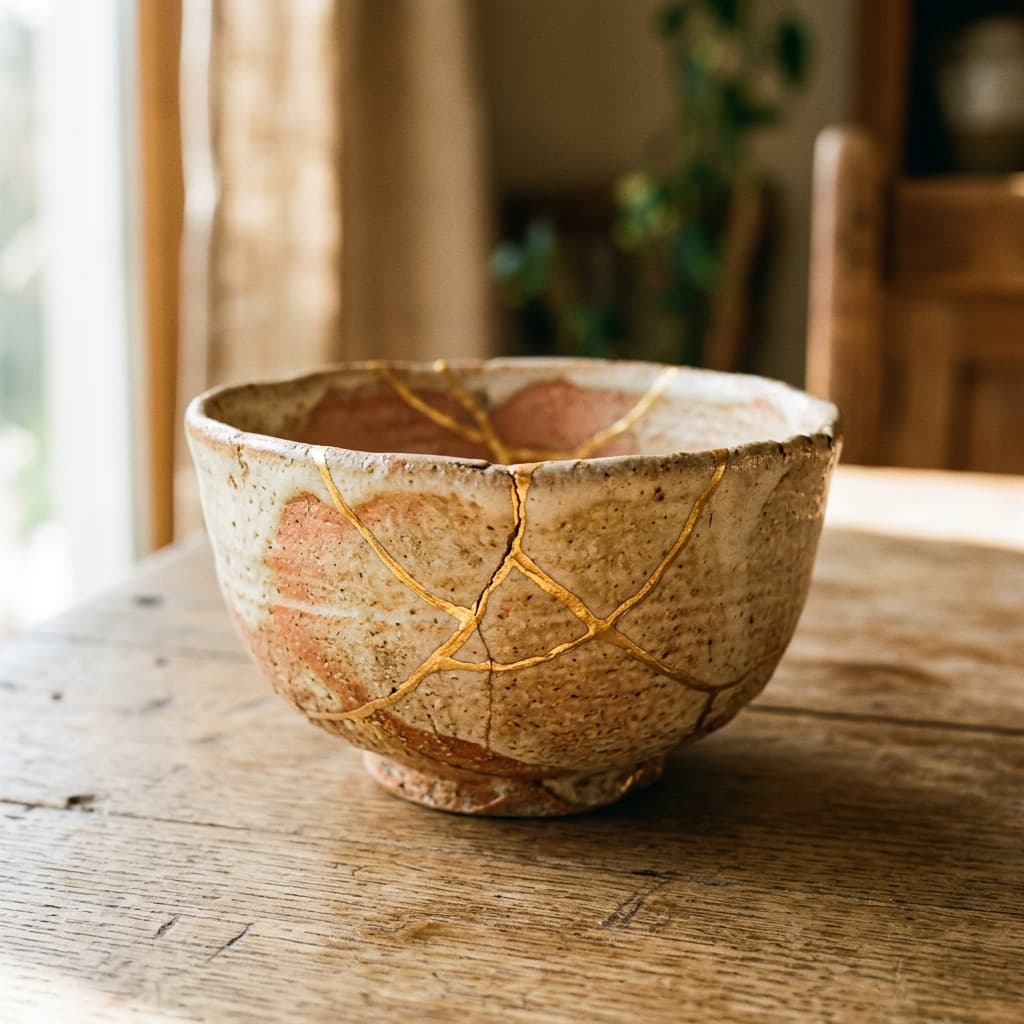
I broke the bowl on a Tuesday in January. It slipped from my hands while I was washing it, which is a gentle way of saying that my hands were cold and wet and I was rushing because the kettle was boiling and my daughter was asking me something from the other room and my attention was in three places at once, which meant it was in none of them, and the bowl, which had been faithfully holding soup and cereal and cut fruit for four years, hit the kitchen floor and split into four clean pieces, as if it had been waiting for the right moment to come apart.
It was ceramic, hand-thrown, with a glaze the color of storm clouds, the dark blue-gray that the sky goes just before rain. I had bought it at a Saturday market from a woman who told me she fired each piece in a wood kiln for three days, and I had carried it home in both hands, and it had become, without my deciding it, one of the objects I would grab if the house were burning. Not because it was valuable. Because it carried something. The shape of mornings. The particular weight of it in my palm when I held it with both hands the way I hold my tea, fingers wrapped around the belly of the bowl, feeling the warmth through the glaze.
My first instinct was to sweep up the pieces and order a replacement. The instinct was so automatic it was almost physical: a reaching for the dustpan, a mental tab opening to a website where I could find something similar, a forward motion toward the next thing. Discard, replace, move on. I have this instinct about more than bowls.
The Instinct to Replace
I recognize this pattern in how I have treated parts of myself. The trust that cracked after someone broke a promise: replaced with a new boundary so rigid it kept everyone out. The confidence that shattered when a project failed: replaced with a new project, started too quickly, designed to prove that the failure did not define me. The friendship that fractured over something neither of us could name: replaced with a different friendship, easier, shallower, requiring less of the vulnerability that had made the first one valuable and fragile.
Replacement is efficient. It is clean. It creates the appearance of resolution without requiring the slow, uncomfortable work of sitting with something broken and deciding, piece by piece, whether it can be made whole. The culture rewards this. Move on. Let it go. Start fresh. As if damage is always a door closing rather than, sometimes, a door opening into a room you have never been willing to enter.
What Kintsugi Actually Is
Kintsugi is the Japanese art of repairing broken pottery with lacquer mixed with powdered gold. The philosophy is simple and radical: the breakage is part of the object’s history. Rather than disguising the damage, kintsugi highlights it. The cracks become seams of gold, visible, luminous, more beautiful for having been broken and more honest for refusing to pretend the breaking did not happen.
I want to be careful here. Kintsugi has become a motivational metaphor in Western wellness culture, reduced to an Instagram caption: “You are more beautiful for having been broken.” That reduction strips away everything that makes the practice meaningful. Kintsugi is rooted in wabi-sabi, the Japanese aesthetic that finds beauty in imperfection, impermanence, and incompleteness. The practice comes first, and the metaphor emerges from the doing, from the hours of slow, precise, physical work that the repair requires.
I mention this because I did not repair my bowl as a metaphor. I repaired it because I did not want to lose the mornings it carried, and because I wanted to know what it felt like to choose mending over replacement, and because the pieces were sitting on the kitchen counter in a paper towel and every time I walked past them I felt something pull in my chest, a specific gravity, as if the broken bowl were exerting a physical force that said: not yet. Do not throw me away yet.
The Evenings of Mending
I ordered a kintsugi repair kit. It arrived in a small box with food-safe epoxy, gold powder, a mixing dish, and a brush so fine it looked like a single hair. The instructions said the repair would take several days, because each join needed to cure before the next could be attempted, and the curing could not be rushed.
The first evening, I laid the four pieces on the kitchen table and studied how they fit together. The breaks were clean but not straight; they followed the internal structure of the clay, splitting along lines of varying density that the potter had created, probably unknowingly, when she threw the bowl four years and three kiln-days before it hit my floor. I held two pieces together and felt the edges align, not perfectly, but close enough that the join was visible only as a hairline, a seam where the glaze did not quite match on either side.
Mixing the epoxy with gold powder changed it from clear to luminous. The color was warmer than I expected, not the bright gold of jewelry but a deeper, amber tone, like late-afternoon sunlight through honey. I applied it with the fine brush, drawing a thin line of gold along the first break, and then pressed the two pieces together and held them. The instructions said to hold for three minutes. I held for seven, because my hands did not want to let go, and because the act of holding, steady, still, breathing slowly, with the broken pieces pressed together between my palms, was doing something to my body that I was not ready to interrupt.
My breathing slowed without my choosing it. My jaw, which had been set in its usual evening clench, softened. The low hum of the day’s accumulation, the tasks undone, the emails unanswered, the guilt about the thing I forgot, went quiet. Not because I resolved any of it, but because my hands were occupied with something that required my full attention, and when the hands are full, the mind has permission to be empty.
It took four evenings to complete the repair. Four evenings of twenty minutes each, sitting at the kitchen table after my daughter was in bed, with the pieces and the gold and the fine brush and the particular silence of a house where everyone else is asleep. Each evening I joined one seam, held it, waited, and set it aside to cure overnight. Each morning I checked the join, running my thumb along the gold line to feel whether it had hardened, and each morning the line was solid, a ridge of warm gold against the cool gray glaze, permanent and visible and exactly where the break had been.
What the Bowl Teaches
The repaired bowl sits on the shelf above the kitchen sink now. The gold seams catch the morning light and throw small warm lines across the backsplash. It holds tea differently than it did before, not because its capacity changed but because I hold it differently: more carefully, with both hands, the way you hold something you almost lost. My thumb finds the largest gold seam each morning, the one that runs diagonally from the rim to the base, and traces it without my deciding to. The fingers remember the break and the repair simultaneously.
I do not want to draw a tidy line between mending a bowl and mending a life. Human repair is not that clean, and the people carrying real damage, the kind that fractures not along the lines of varying density but straight through the center, deserve more than a pottery metaphor. But I will say this: the instinct to discard and replace, the one that reached for the dustpan before the bowl had finished settling on the floor, is the same instinct I recognize in how I have treated my own cracks. The confidence that broke: replaced. The trust that fractured: replaced. The parts of myself that came apart under pressure: swept up and thrown away, because the mending would have required me to hold the broken edges together for longer than I was willing to be still.
The bowl taught me that the mending is not a means to an end. The mending is the practice. The four evenings at the kitchen table, the slow breathing, the steady hands, the gold applied one seam at a time, those were not preparation for the repaired bowl. Those evenings were the repair. Not of the bowl. Of the part of me that believes broken things should be discarded, including the parts of myself that have broken and the parts that will break again, because everything breaks eventually, and the question is not whether but how you hold the pieces when they do.
The cracks are not the end of the story. They are the place where the gold goes, if you are willing to sit with the broken pieces long enough to learn where they fit.
The next time something breaks, whether it is an object, a plan, or something quieter and harder to name, try pausing before you reach for the dustpan. Hold the pieces. Feel their edges. Ask whether what broke might be worth the slow, imperfect, unglamorous work of mending. Not because everything deserves repair. Some things break and should stay broken. But because the act of mending teaches you something that replacement never will: patience, attention, and the willingness to sit with something damaged and call it worth your time. The gold is not what makes the repair beautiful. The gold is just evidence that someone chose to stay.
