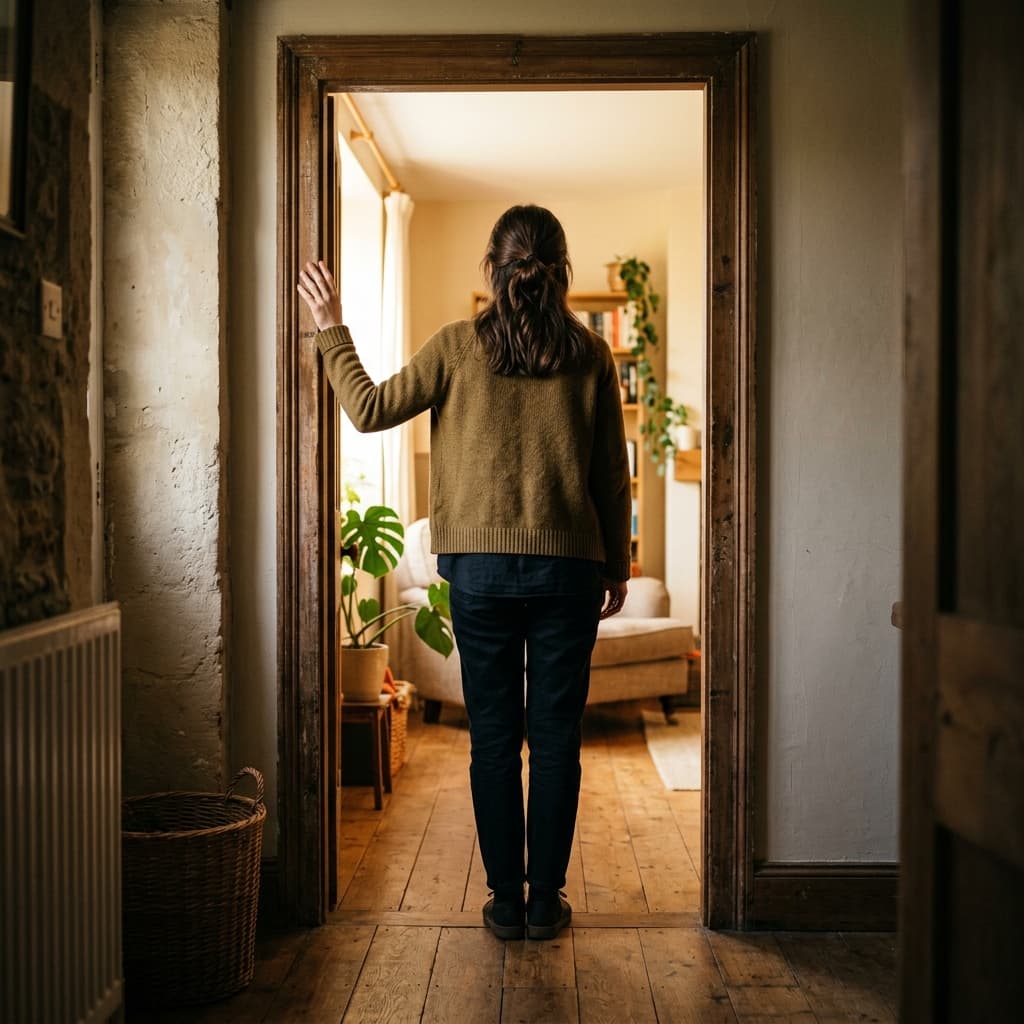
I am standing in a doorway with one hand on the frame, having forgotten what I came for. The kitchen is behind me. The bedroom is ahead. And I am in neither, suspended in the six inches of threshold that separates the two, my body paused mid-stride, my mind suddenly, inexplicably blank. I came here for something. The something has vanished.
This happens often enough that I have stopped treating it as a failure of memory and started treating it as a feature of architecture.
Thread One: The Doorway Effect
Gabriel Radvansky, the psychologist whose research on spatial cognition I find endlessly illuminating, has a name for this: the doorway effect. His experiments demonstrate that walking through a doorway creates an event boundary in the mind, a cognitive marker that separates what came before from what comes after. The brain, encountering the doorway, files the previous room’s contents, including your intention for entering the next room, into a completed episode. The episode closes. The new episode opens. And the intention, which belonged to the closed episode, is no longer readily accessible.
The doorway is, neurologically, an ending and a beginning.
I find this remarkable. Not the forgetting itself, which is mundane and mildly irritating, but the implication: that the mind uses physical space as a filing system. That the rooms of your home are not just containers for furniture but containers for mental states. That crossing a threshold is not merely a spatial event but a cognitive one, the brain reorganizing itself around the new environment, resetting, clearing the cache, preparing for whatever the new room requires.
Thread Two: The Body at the Border
Watch yourself the next time you approach a doorway. Not the forgetting part. Earlier. Watch the approach. The body does something at a threshold that it does not do in the middle of a room. It adjusts. The posture shifts, often so subtly that only deliberate attention catches it. The pace changes: a fraction slower, a micro-hesitation, the stride shortening by a centimetre as the body negotiates the narrow passage. The shoulders may draw in slightly, the body making itself marginally smaller to fit through the frame, even when the frame is wide enough to drive a car through.
The breath changes too. I have noticed this in myself: a slight inhale at the threshold, a gathering, as though the lungs are preparing for whatever atmospheric conditions exist on the other side. It is the same inhale you take before stepping outside, before entering a meeting room, before opening a door you have been dreading. The threshold breath. The body’s way of saying: I am about to enter a different space, and I need to be ready.
The body treats every doorway as a border crossing.
Thread One Returns: What Bachelard Knew
Gaston Bachelard, the philosopher of intimate spaces, understood doorways as sites of meaning far exceeding their architectural function. A door, he writes, is a site of decision, more than a simple opening in a wall. To open it is to choose. To close it is to choose. To stand in it, as I am standing now, one hand on the frame, intention dissolved, is to inhabit the moment between choices, the space where neither room has claimed you yet.
Bachelard’s doorway is a philosophical threshold. Radvansky’s doorway is a cognitive event boundary. The body’s doorway is both and neither. The body does not philosophize and does not run experiments. The body simply pauses, adjusts, breathes, and waits, and the waiting is not confusion but calibration. The skin and the breath are already taking in the new room before the mind has finished filing the old one.
Thread Two Returns: The Rooms We Become
I have different postures in different rooms. The kitchen posture is upright, hands active, weight forward on the balls of the feet. The living room posture is settled, weight back, shoulders open. The bedroom posture is softer, the spine losing its public architecture, the muscles releasing into the private shape that only the mattress sees. Each room calls a different body into being, and the doorway is where the transformation happens.
The threshold is a changing room. The body enters it as the kitchen self and exits as the bedroom self, and the transition is so seamless that we do not notice it, but the body notices. The body is the one doing the changing: adjusting the muscle tone, the posture, the breath depth, the jaw tension, recalibrating the entire physical self to match the demands and permissions of the new space.
This is why the forgetting happens. It is the cost of transformation. The mind cannot simultaneously maintain the old room’s agenda and execute the new room’s recalibration. Something has to give, and what gives is the intention that belonged to the old room, the small errand that was filed under kitchen and does not transfer automatically to bedroom.
Thread Three: Standing Still
There is a particular quality of standing in a doorway that I want to name, because I think it matters. It is the quality of being between. Not lost or stuck or confused, but genuinely between: between rooms, between selves, between the version of you that existed in the space behind and the version that will exist in the space ahead. The threshold is liminal in the truest sense: it is the place where transformation is happening and has not yet completed.
Most of us rush through doorways. We treat the threshold as a non-space, a nothing between two somethings, a gap to be crossed as quickly as possible on the way to the destination. But the body does not rush. The body takes its micro-pause, its threshold breath, its postural adjustment. The body registers the crossing as an event, even when the mind treats it as dead time.
I am still standing in the doorway. The hand is still on the frame. The intention has not returned. But I notice that the body is not distressed by this. The body is fine with the standing. The body is using the pause, recalibrating, reading the new room, adjusting the internal settings. The mind is the one that wants to remember and move on. The body is the one that knows the value of standing still in the in-between.
The doorway is not a passage. It is a changing room. The body enters as one self and exits as another, and the forgetting is the cost of transformation.
The next time you find yourself standing in a doorway, having forgotten why, try staying for three breaths instead of retreating to the previous room to retrieve the intention. Let the body do what it is doing: calibrating, adjusting, reading the new space. The intention may return on its own, rising from the body’s reorganization like a detail that surfaces once you stop straining for it. Or it may not, and the standing will have been its own small event, a moment of being between, which is its own kind of arriving.
