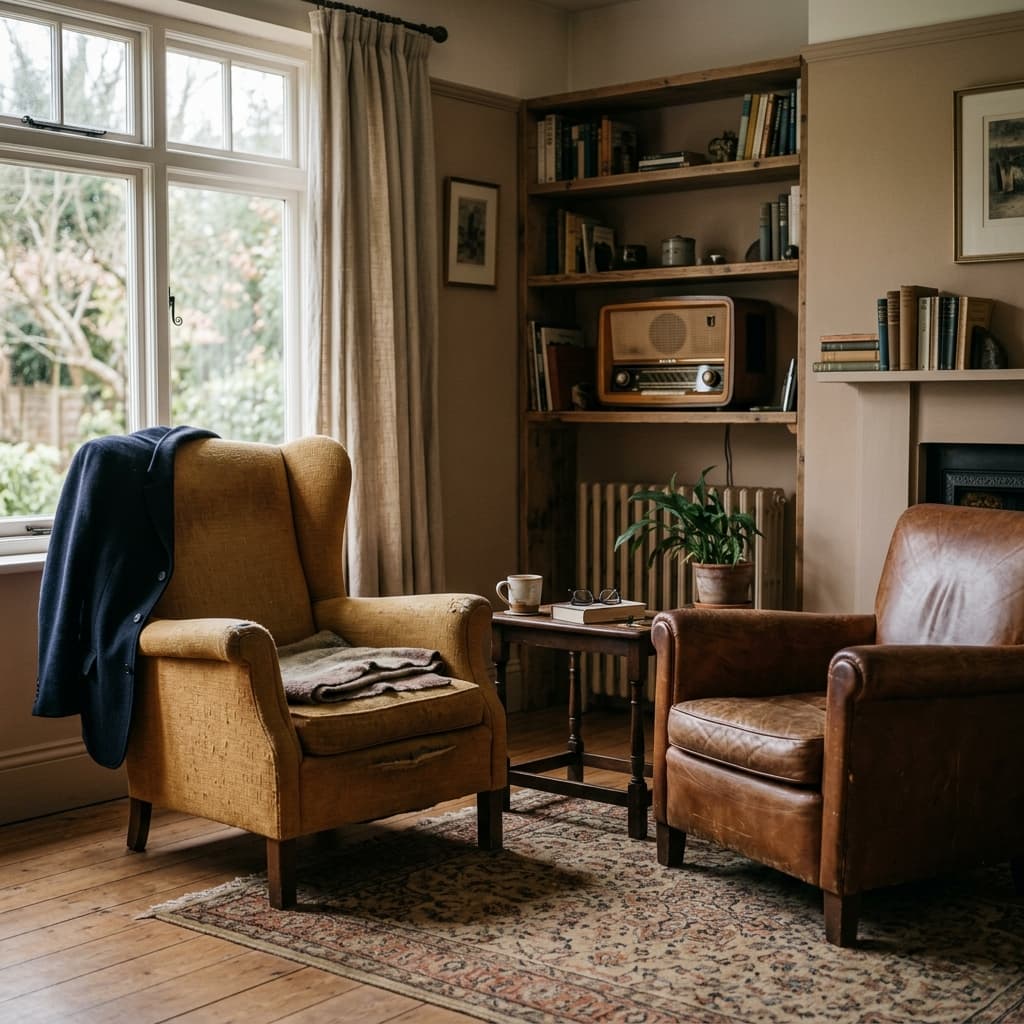
Every room I have lived in alone has had a chair that faces another chair. I did not notice this until the fourth room. By then the pattern was established and the chairs had already made their case: even when no one is coming, the body arranges the furniture for company. Even when the second chair will hold nothing but a jacket tossed over its back, the body positions it at a conversational angle, facing the first, as though the room might fill at any moment and you want to be ready.
I do not know what to make of this, so I am going to think about it out loud, which is what searching looks like when you have not arrived at the answer yet.
Thread One: The Geography of Absence
Olivia Laing, whose writing on loneliness in cities is the most honest account I have found, describes the lonely apartment as a space that begins to reflect its inhabitant’s interior weather. The walls close in or recede. The light changes quality. The furniture, she observes, starts to serve a psychological function that has nothing to do with sitting or eating or sleeping. It becomes a population. Each object stands in for a presence that is not there, and the arrangement of these objects becomes a form of social choreography performed for an audience of zero.
I recognize this. I have done this. I have arranged cushions on a couch as though the couch expected visitors. I have set a table for two on evenings when the second plate was decorative. I once bought a second nightstand for a bedroom where I was the only person sleeping, and I cannot tell you what I put on it because I do not remember, but I remember the purchase, the carrying of it up the stairs, the placement of it on the side of the bed I did not sleep on. The empty side. The side that was not empty once and that the nightstand was, in some way I could not articulate, refusing to let go of.
Thread Two: The Radio
I leave the radio on in the kitchen. Not for the content. For the voices. The radio provides something that music does not: the cadence of human speech, the rhythm of conversation, the particular frequency range of a voice speaking to someone. It does not matter that the voice is not speaking to me. It does not matter that the someone is an audience I am not part of. What matters is that the kitchen sounds inhabited. What matters is that the silence has been replaced by a reasonable facsimile of company, and the body, which tracks the auditory environment with a vigilance the mind does not share, registers the voices and relaxes by a degree.
This is not pathological. I want to be clear about this. This is not the behavior of a person who cannot tolerate being alone. I can tolerate being alone. I frequently prefer it. What I cannot tolerate is the sound of alone, which is different. Being alone is a state. The sound of alone is an experience: the hum of the refrigerator, the tick of the radiator, the specific quality of silence that a room produces when it contains one person and no voices, a silence that has a pressure to it, a weight, like water at depth.
The radio displaces the pressure. The voices fill the frequency range that the body associates with social presence, and the nervous system, which cannot distinguish between a voice from a person in the room and a voice from a box on the counter, responds accordingly: the shoulders drop. The breathing slows. The body behaves as though it is in company, because, acoustically, it is.
Thread One Returns: What the Chairs Know
Yi-Fu Tuan, the geographer whose work on the relationship between space and human experience I return to often, makes a distinction between space and place. Space is abstract, geometric, indifferent. Place is space that has been invested with meaning through bodily experience. A room becomes a place when the body has moved through it enough times, sat in its chairs, leaned against its walls, left its marks on the surfaces. Place is space that knows you.
I think the chairs facing each other are the body’s attempt to make place from space. The second chair is not furniture. It is a placeholder. It holds the shape of a possibility: someone could sit there. Someone might. The angle between the two chairs, the conversational distance, the facing-toward rather than facing-away—all of it amounts to spatial invitation, chosen for reach rather than for looks. The body is arranging the room as a question: will someone come? And the arrangement persists regardless of the answer, because the question, for the body, matters more than the reply.
This is not hope, exactly. Hope implies expectation. This is something quieter, more structural. This is the body’s refusal to furnish a room for permanent solitude. Even when the solitude is chosen. Even when the solitude is preferred. The body will not arrange the furniture as though company has been ruled out, because ruling out company is a spatial commitment the body is not willing to make.
Thread Three: The Door
I have noticed that I position my couch so that I can see the front door. Not directly. Not with the vigilance of someone expecting danger. But with the peripheral awareness of someone who wants to know that the door is there, that it opens, that the room is not sealed. The door is the room’s connection to the outside, to the possibility of arrival, to the idea that the space between alone and not-alone is as short as a knock.
I do not think I am waiting for a knock. I think I am waiting for the possibility of a knock, which is different, and which requires the door to be visible, to be part of the room’s composition, to exist in the field of vision as a reminder that the room is permeable. Closed but not locked. Alone but not sealed.
The couch faces the door. The chair faces the chair. The radio fills the kitchen with borrowed voices. And the room, arranged this way, holds a shape that is not loneliness and not company but something between, something the body has engineered out of angles and sound and the careful positioning of furniture that serves a purpose no furniture catalog would list.
What I Am Still Working Out
I said at the beginning that I do not know what to make of this, and I still do not. I am circling the question without landing on it. The question is this: is the furniture arrangement a form of self-care, the body creating the conditions for comfort even in absence, or is it a form of denial, the body refusing to accept the terms of a solitude it has chosen?
I do not think it is either. I think it is a negotiation. The body negotiating with the room. The room negotiating with the absence. The absence negotiating with the second chair, which sits at its conversational angle, holding its jacket, facing the first chair with the patience of an object that does not need the conversation to happen in order to hold the space for it.
Maybe that is what the furniture knows that I do not. That holding space for something is not the same as expecting it. That facing the door is not the same as waiting. That the chairs can sit across from each other, indefinitely, without resolving the question of who will sit in them, and the sitting is enough. The arrangement is enough. The angle is the answer, even when the answer is not a person but a geometry of care.
The body will not furnish a room for permanent solitude. Even when solitude is chosen, the second chair faces the first, and the angle between them is an invitation the body refuses to withdraw.
If you live alone, take a look at your room tonight with the eyes of someone who has never seen it. Notice the angles. The facing-toward. The objects that stand in for presences. You do not need to change anything. Just notice that the body has been arranging, quietly, a space that holds room for more than one, and that this arrangement, far from being loneliness confessing itself, is the body’s insistence that the room remain open. That the door stay visible. That the second chair keep facing the first.
