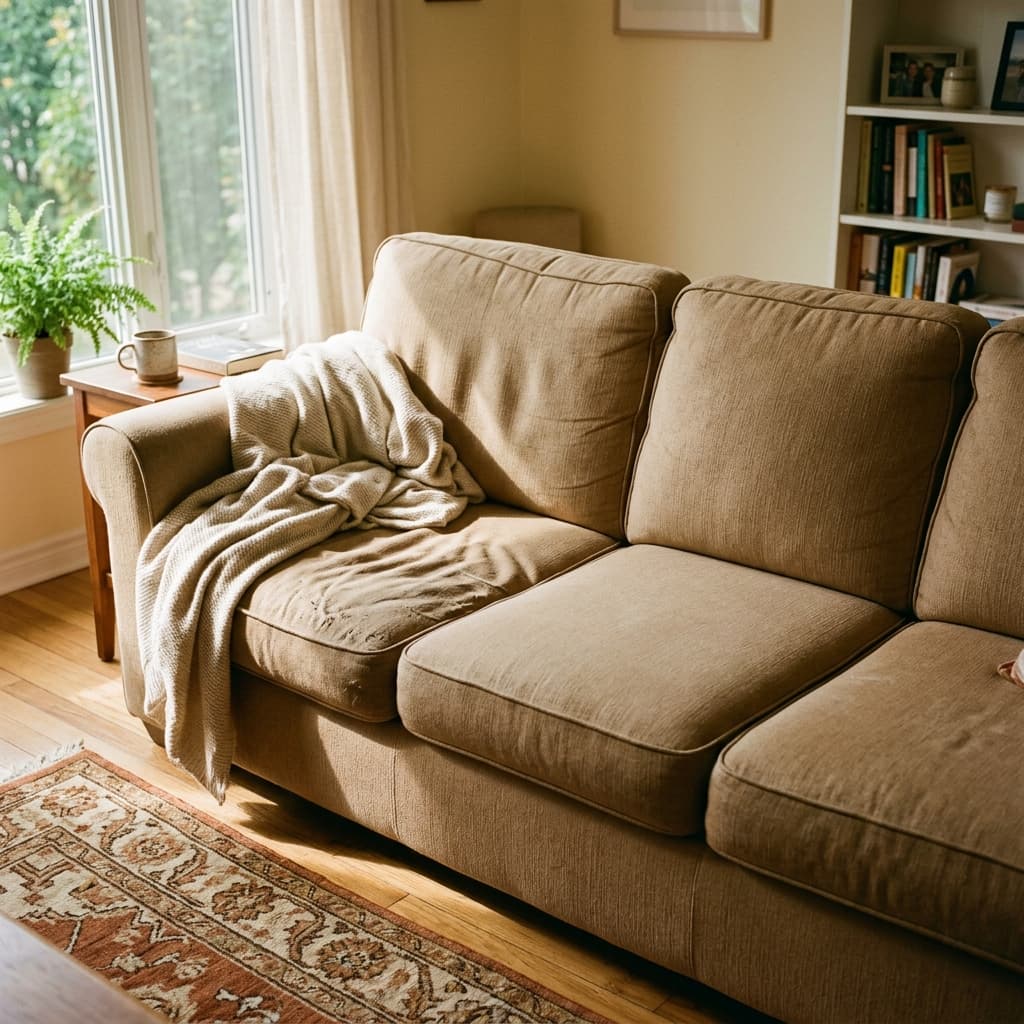
I have lived in this apartment for four years, and the couch has developed a posture. Specifically, my posture. The left cushion sags at an angle that matches the exact tilt of my reading position, and the right cushion remains pristine, because no one sits there. If you walked into my living room and looked at the couch without knowing anything about me, you would know three things immediately: one person lives here, she sits on the left, and she leans.
The couch has become a portrait. It is the most honest portrait of me that exists, more honest than any photograph, because it was painted not by a camera but by four years of sitting, and sitting, unlike posing, does not know how to lie.
The Archaeology of a Kitchen
Once you start looking for this, you cannot stop. Rooms learn bodies. They learn them the way a river learns a landscape: slowly, through repetition, through the steady application of weight and habit over time. The carpet between my bed and the kettle has a path worn into it, a faint lightening of the pile that traces the exact route I walk every morning before I am awake enough to vary my route. It is approximately sixteen steps. I know this not because I counted but because the carpet counted for me.
The kitchen tells a more specific story. The counter has a faint discoloration where I rest my hip while waiting for the kettle, always the same hip, always the same spot, a mark that no amount of cleaning fully removes, because what made it was never dirt but contact—the record of a body leaning against a surface ten thousand times, transferring something of itself, oil or heat or simply pressure, into the material. The light switch by the kitchen door has a slight indentation where my thumb hits it, not in the center but a little to the right, because I reach for it with my right hand while my left hand is usually holding something, a mug, a plate, a piece of toast being eaten on the way to somewhere else.
These marks are somatic archaeology. They are the body’s fossil record, preserved not in stone but in carpet pile and laminate and the particular way a door handle wears smooth on one side and stays rough on the other.
The Conversation Between Body and Room
Gaston Bachelard, whose writing on the phenomenology of domestic space remains the most beautiful thing I have ever read about houses, argued that we do not simply inhabit our homes. We dream them. We project our inner life onto the walls, the corners, the stairwells. The house, he said, is far from a box—it is a body for the body, a second skin that holds the shape of our most private gestures.
I love this, and I also think it is only half the story. Bachelard writes as though the influence moves in one direction: body to room. But I think the conversation goes both ways. The room shapes the body as much as the body shapes the room. My reading posture did not create the couch sag; the couch sag reinforced my reading posture, deepening the angle over time, making it more comfortable to lean that way and less comfortable to lean any other way. The carpet path did not emerge from my morning walk; the carpet path now guides my morning walk, the feet finding the worn track without conscious direction, the way a needle finds a groove in a record.
You and your room are in a feedback loop. You teach it your habits and it teaches them back to you, with slight modifications, until the room and the body are collaborating on a posture, a route, a daily rhythm that neither of you could have produced alone. The room is not a container. It is a collaborator.
The Return: Moving Day
I want to come back to the couch, because the couch is where this started and the couch is where I understood what rooms actually hold.
Three years ago, before this apartment, I moved out of a place I had lived in for six years. The movers came. The furniture went. And when the apartment was empty, when the last box had been carried down the stairs and the rooms held nothing but dust and the particular quality of light that only empty rooms produce, I walked through it one more time.
The carpet had my paths. The kitchen counter had my hip mark. The bathroom door had the scuff at the bottom where I kicked it open with my foot when my hands were wet. The bedroom wall had a faint shadow where the headboard had been, and inside that shadow, a smaller shadow where my shoulder had rested against the wall while reading in bed, night after night, for six years, pressing the same square foot of plaster with the same gentle pressure until the wall had absorbed something of me that no repainting would fully cover.
The apartment was empty. The apartment was full. Full of my shapes, my paths, my pressure marks, the accumulated evidence of six years of a body doing the same things in the same places with the consistency that only domestic life produces. I was leaving, but I was also staying. The room would hold my shape long after I had gone, the way a glove holds the shape of a hand, the way a shoe holds the shape of a foot, the way every surface that a body touches for long enough eventually learns the body’s name.
The New Room
Moving to a new place is starting the conversation over. The couch is neutral. The carpet is uniform. The light switches are smooth and indifferent. Nothing in the room knows you. Nothing has learned your weight, your lean, your particular way of opening a door or reaching for a shelf. You are a stranger in a space that has no record of your body, and the first few weeks are spent in a low-grade disorientation that has nothing to do with not knowing where the bathroom is and everything to do with not being known by the room itself.
Sarah Pink, the social scientist whose work on the sensory home informs how I think about domestic space, describes the process of making a house a home as fundamentally somatic: decorating and arranging barely enter into it. What makes a home is the body moving through the space often enough, repeatedly enough, that the space begins to hold the body’s patterns. You do not make a home with furniture. You make a home with repetition. With the same feet walking the same route to the same kettle, morning after morning, until the carpet softens and the counter darkens and the couch, finally, sags in the shape of your specific sitting, and you look at it one evening and think: there I am.
That is the moment. The moment the room holds your shape. The moment you sit down and the couch already knows where you go. It is a small thing, and it takes months to arrive, and when it does, it feels like the room has stopped being a space you live in and started being a space that lives with you.
A home is not where your things are. A home is where the surfaces have learned your weight, your warmth, your particular way of leaning. It is the place that holds your shape when you are not there to fill it.
If you have lived in your space for a while, try this: walk through it with the attention of an archaeologist. Look at the carpet for paths. Check the couch for your silhouette. Find the scuffs on the doors, the wear on the handles, the places where your body has been writing its signature in a language the mind never learned to read. You do not need to change anything. You do not need to feel anything in particular. Just notice that your room knows you, has been learning you, and is holding evidence of your life that no photograph, no journal, no memory could replicate. The room remembers what the mind forgets: where the body goes when it is not trying to go anywhere.
