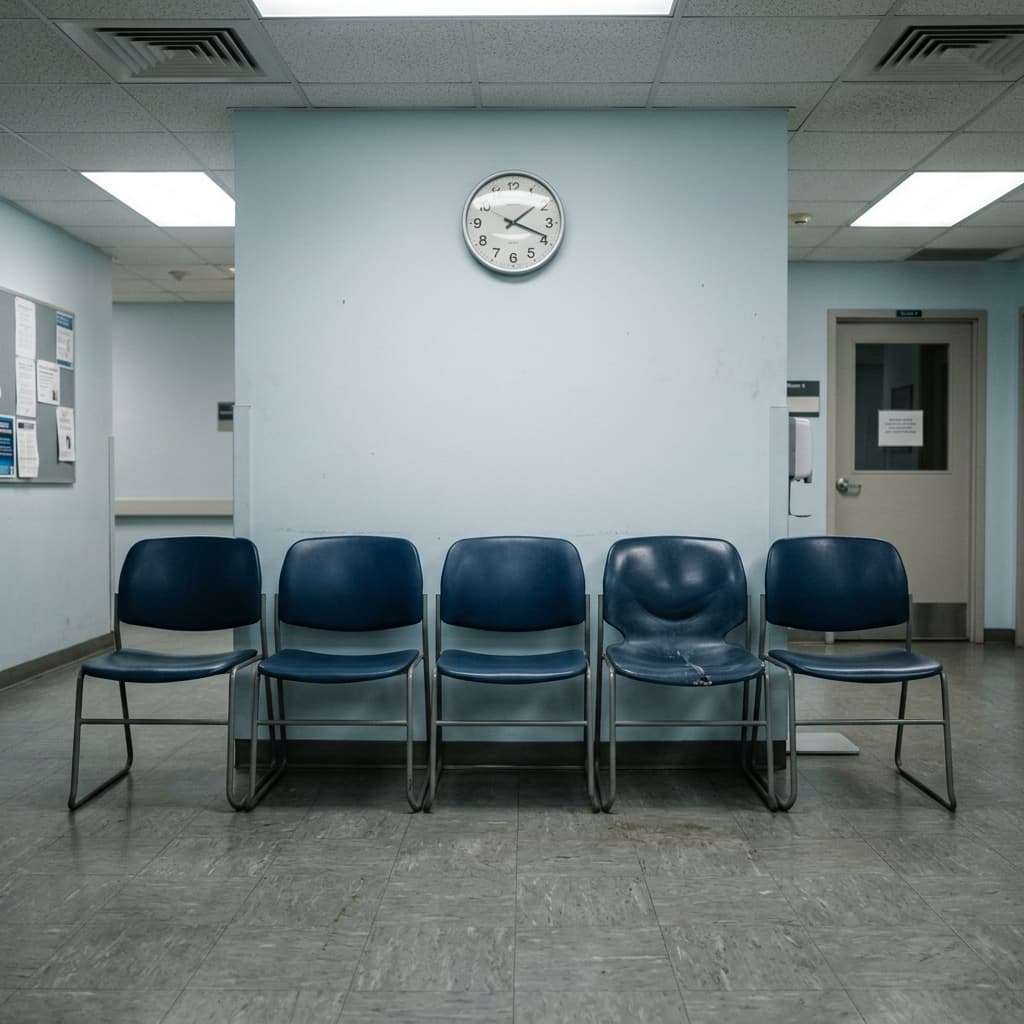
We call it killing time, but I think it is time that does the killing. Not dramatically. Slowly, in the way that a plastic chair in a fluorescent room slowly dismantles whatever composure you brought with you. Waiting has its own specific weight, and the jaw and the shoulders take it on first, well ahead of anything the mind is willing to admit.
I have been thinking about waiting. Not the philosophical kind, not the existential waiting that Beckett wrote about, though I will get to Beckett eventually because everyone does. I mean the ordinary kind. The waiting room. The queue. The airport gate. The held breath before a medical result. The particular quality of time that arrives when you cannot act, cannot leave, cannot make the thing happen faster, and must instead sit inside the gap between now and the thing you are waiting for.
I think the body finds this unbearable. Not always, but often. And I think the reason has less to do with impatience than with the fact that the body does not have an idle mode.
The Body Does Not Wait
Here is what I have noticed, though I am not sure I understand it yet. When the mind enters a state of waiting, it suspends. It pauses its active processing and enters a kind of cognitive holding pattern, looping through the same three or four thoughts: how much longer, what will the answer be, did I bring enough to read, how much longer. The mind can wait. It does not like it, but it can do it.
The body cannot. The body does not have a pause function. While the mind loops, the body proceeds. It continues its continuous work of temperature regulation, respiration, digestion, micro-adjustments to posture, monitoring of the environment for threat. And because the body does not know that it is waiting, it interprets the mind’s suspension as a discrepancy. Something is wrong. The mind has gone quiet but the situation has not resolved. The environment has not changed. No action has been taken. The body reads this gap, this mismatch between its own ongoing activity and the mind’s stalled processing, as low-grade alarm.
I think this is why waiting makes the body restless in a way that differs from ordinary boredom. Boredom is understimulation. Waiting is something else. It is the body’s response to a mind that has stopped piloting, a kind of somatic anxiety that does not have a clear object. You are not anxious about the thing you are waiting for, exactly. You are anxious about the waiting itself, about the body’s inability to find a mode that matches the mind’s holding pattern.
Rooms Designed for Nowhere
I have started paying attention to the physical design of waiting spaces, and what I have found is this: they are designed to be endured, not inhabited. The plastic chair that does not accommodate any specific spine. The lighting that is neither bright enough to read by nor dim enough to rest in. The temperature that is always slightly wrong. The clock, when there is one, positioned where you must crane your neck to see it, which is its own small punishment for wanting to know.
Alain de Botton writes about architecture as a form of emotional communication, buildings and spaces that speak to the body before the mind has formed an opinion. A cathedral says one thing. A waiting room says another, and what it says, I think, is: you are not the point. This space was built for throughput, comfort left out of the design. You are a body in transit between one state and another, and this room exists to hold you while the system processes your case.
I am not sure why this bothers me as much as it does. Maybe because the design of waiting spaces makes explicit something I would prefer to leave implicit: that there are hours in a life that do not belong to you. Hours where you are held in place not by choice or by purpose but by the machinery of someone else’s timeline. The spine feels the not-belonging-here in the chair that does not fit, in the air that does not move, in the absence of any surface that invites rest. The room is not hostile. It is worse than hostile. It is indifferent.
The Rehearsal
Harold Schweizer, whose book on waiting is the most honest treatment of the subject I have encountered, describes waiting as a form of suffering that is unique because it contains no event. Other forms of suffering attach to something: an illness, a loss, a blow. Waiting attaches to nothing. It is suffering in anticipation of an event that has not arrived, and the body, unable to respond to an event that does not yet exist, does the only thing it can. It rehearses.
I recognize this in myself. Sitting in a medical waiting room, I have watched my body cycle through possible futures as though they were weather systems. In the first ten minutes, the muscles are calm, the breath is even. By twenty minutes, the shoulders have risen half an inch. By thirty, the jaw is set and the stomach has tightened around nothing, a contraction without cause, a preparation for an impact that may or may not arrive. The body is responding to the possibility of bad news rather than to any news that has arrived, and the possibility, somatic ally speaking, is identical to the thing itself.
This is, I think, the cruelest aspect of waiting: the body does not distinguish between anticipation and experience. It prepares for every outcome simultaneously, holding contradictory futures in the muscles at the same time. You are fine and you are not fine. The news is good and the news is bad. The body, unable to resolve the ambiguity, carries all of it, and the weight of carrying all of it is heavier than the weight of any single outcome would be.
What I Do Not Know
I want to offer a practice here. I want to end this the way I usually end things, with a small invitation, a gentle suggestion for what to do with the body when the body is in a state of waiting. But I am not sure I have one.
I have tried breathing exercises in waiting rooms. They help, modestly, in the way that a glass of water helps when you are not thirsty but also not not-thirsty. I have tried the grounding technique, the one where you name five things you can see, four you can hear, three you can touch. It works for about ninety seconds, which is long enough to notice the texture of the plastic chair and not long enough to make the clock move.
What I keep coming back to, and I am not sure this is a practice so much as a concession, is the permission to find waiting difficult. Not to transcend it, not to transform it into a meditation, not to reframe it as an opportunity for presence. Just to let it be what it is: a hard thing the body does in rooms that were not made for bodies, while the mind loops and the clock does not move and the thing you are waiting for remains exactly as far away as it was when you sat down.
I think there might be something honest in that. In not fixing it. In letting the body be restless without treating the restlessness as a problem to solve. Far from failing to wait well, the body is responding accurately to a situation that is, genuinely, uncomfortable. What reads as a flaw in your practice is actually information about the experience of being a body that cannot idle, in a room designed for nowhere, suspended between what has happened and what has not happened yet.
Waiting is the body’s experience of a future that has not decided what it is. No practice makes that easy. Some things are just difficult, and the difficulty is the honest part.
I do not have an invitation this time. Or maybe the invitation is this: the next time you are waiting, and the body begins its rehearsal of every possible outcome, see if you can notice the rehearsal without joining it. Not stopping it. Not redirecting it. Just noticing that the body is doing its work, as it always does, in a room that was not designed for the work it is doing. That might be enough. I am not sure. I am still in the waiting room on this one, and the clock has not moved.
