Learning patience is like trying to fill a cup by waiting for rain: the cup is ready, the sky is ready, and the only variable is time, which is the one thing you cannot negotiate with.
I am thirty-nine years old and I am just now beginning to learn it. Not the idea of patience, which I understood by age seven, but the practice of it, which is entirely different and involves a set of muscles I did not know I had.
The Bread
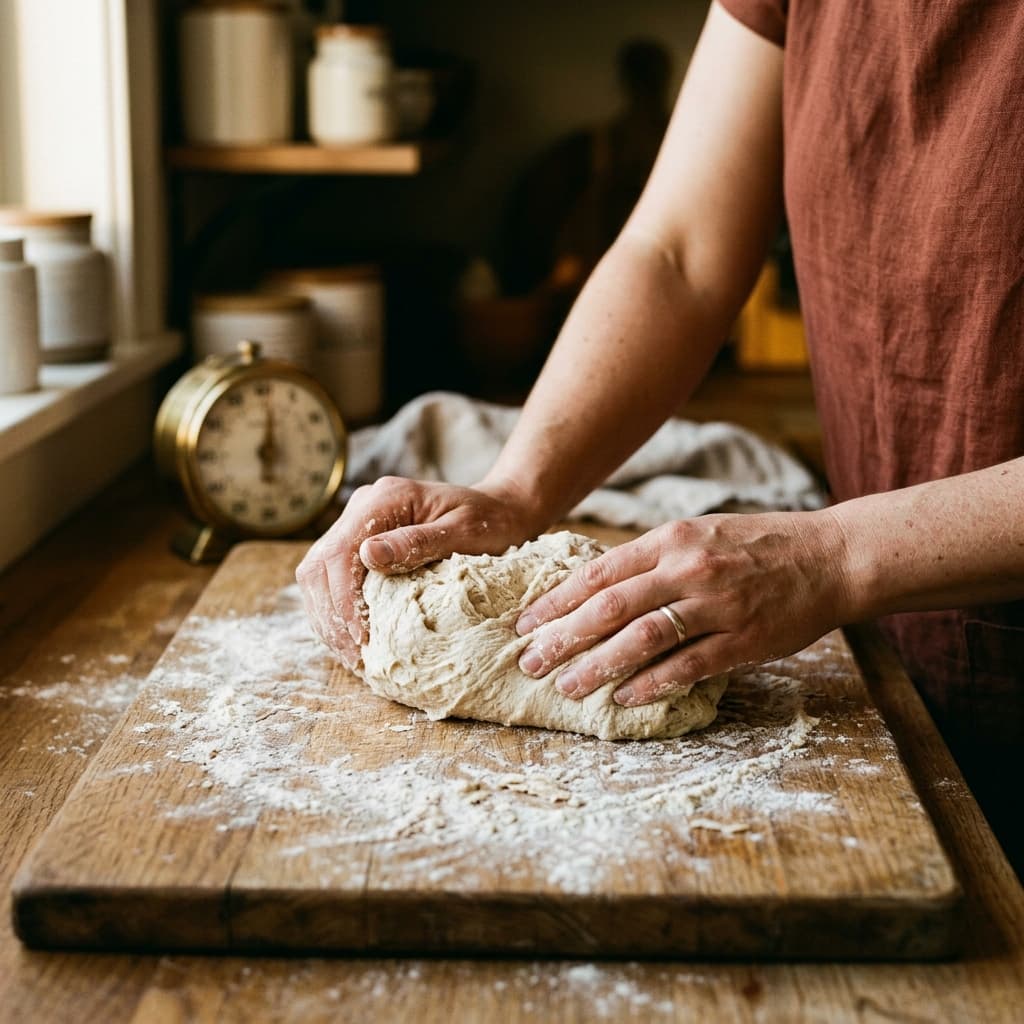
I started baking bread two years ago, for the usual reasons: the pandemic, the restlessness, the need to do something with my hands that produced a visible result. The sourdough starter lived in a jar on the counter and required feeding every twelve hours, which gave the days a rhythm they otherwise lacked.
The thing about bread is that you cannot rush it. The dough rises on its own schedule, which is determined by temperature, humidity, the mood of the yeast, and some other variable that I have never identified and suspect is spite. You can knead harder. You can turn up the oven. You can hover over the bowl with the focus of a surgeon. None of it matters. The bread takes the time the bread takes.
I learned this standing in my kitchen at 2 p.m. on a Saturday, checking the dough for the fourth time in twenty minutes. The dough had not risen. It was sitting in the bowl, inert, warm, indifferent to my schedule. My hand was on the towel that covered it. My jaw was tight. My right foot was tapping. Every molecule of my body was saying: hurry up. And the bread was saying, with the absolute authority of a biological process: no.
Patience, in that moment, was anything but a feeling—it was a physical negotiation between a body that wanted to intervene and a process that would not be intervened with. The jaw wanted to clench; I noticed it and let it soften. The foot wanted to tap; I noticed it and placed it flat. The hand wanted to lift the towel again; I moved it to the counter and left it there, palm down, doing nothing.
The Homework
My daughter is working through a math problem. She is nine. The problem involves fractions, which she finds insulting. She has been staring at the same line for four minutes. Her pencil is not moving. Her lips are pressed together. Her left hand is pulling at a strand of hair near her temple, wrapping it around her index finger and releasing it, wrapping and releasing, a self-soothing rhythm that she does not know she is doing.
I am sitting across the table. I can see the answer. It is right there, on the page, one step away from where she stopped. My mouth wants to say it. My hand wants to point. Every neuron in my prefrontal cortex is firing a single instruction: help her.
I do not help her. I sit with my hands around my coffee mug, which is warm enough to give my fingers something to hold, and I wait. The waiting only looks passive; it is the most active thing I will do all evening. My body is holding itself back from a reflex that feels like generosity but is actually impatience dressed in a parent’s clothing.
Simone Weil wrote that attention is the rarest and purest form of generosity. I think she was right, but I think she left out the part where attention hurts. The attention I am giving my daughter right now, the attention that consists of not-helping, of sitting with the discomfort of watching her struggle, of keeping my hands on the mug and my mouth closed, is a physical effort. My shoulders are creeping upward. My breath is held in my upper chest. My body is doing the opposite of what patience is supposed to feel like, and yet this is patience: the muscles straining against the impulse to act, the conscious decision to let the struggle be the teacher.
She gets the answer. It takes eleven minutes. She does not celebrate. She writes the number, puts down the pencil, and says, “Can I have a snack?” as if she has not just climbed a mountain while I sat at base camp trying not to carry her.
Patience is not the absence of urgency; it is the presence of urgency held in a body that has chosen not to act on it.
The Doctor’s Office
There is a specific quality of waiting in a medical waiting room that I have never encountered anywhere else. It is a humming readiness with nothing to be ready for. The body sits in the chair but does not settle. The hands pick up a magazine and put it down. The eyes read the same poster about hand-washing for the third time without absorbing it. The body is in a state of low-level alert that has no target, no task, no resolution.
I spent forty-five minutes in a waiting room last month. I tried to read. I tried to scroll. I tried to do the breathing exercises I recommend in my own essays. None of it worked, because patience in a waiting room has less to do with managing the wait than with tolerating the uncertainty that lives inside the wait. You are not waiting for a doctor. You are waiting for information that will either confirm or change the shape of your life, and the body knows this, and the body does not manage uncertainty well.
Ellen Langer, the psychologist at Harvard, writes about what she calls “premature cognitive commitment”: the mind’s habit of arriving at a conclusion before the evidence is in. I think the body does something similar. It braces for an outcome before the outcome exists. The muscles tighten around a future that has not arrived. The breath shortens to match a stress that is still hypothetical.
Patience, in the waiting room, is the practice of noticing the bracing and not believing it. The shoulders are tight; that is information, not prophecy. The breath is shallow; that is a pattern, not a prediction. The body has committed to a future that does not exist yet, and patience is the slow, muscular work of uncommitting, one breath at a time.
The Accumulation
The bread. The homework. The waiting room. These are small practices, and none of them feels like progress. That is, I think, the final joke of patience: you cannot feel yourself getting better at it. There is no metric. There is no before-and-after. There is only the next moment of wanting to act and choosing, again, to wait, and the muscles remembering, fractionally, how to hold the wanting without acting on it.
The slow-build is the point. Patience accumulates in the body the way sediment accumulates in a riverbed: one grain at a time, invisibly, until one day the river runs over a bed that was not there before, and the current is different, and you cannot point to the moment it changed because the moment was every moment, and none of them was dramatic enough to notice.
I am still learning. The jaw still clenches when the bread has not risen. The mouth still wants to say the answer when my daughter is working through a problem. The body still braces in waiting rooms. But the clenching releases a little faster than it used to. The mouth stays closed a little longer. The bracing loosens before the doctor appears. The muscles are learning. The muscles are always the slowest students, and they are the ones who remember longest.
The next time you are waiting, for bread to rise, for a child to find the answer, for news you cannot control, try placing your attention on the muscles that are holding the urgency. The jaw. The shoulders. The hands. You do not need to release them. Just notice them holding. Notice the effort, the strain, the body doing its patient, imperfect work of not acting. That noticing is the practice. It is the slowest thing you will ever learn, and you will not feel yourself learning it, and it will change the way you hold everything.
