During the worst weeks of the illness, the weeks when my body could not be trusted to do anything it had done the day before, the routine was the only thing that stayed. Tuesday I could walk to the store. Wednesday I was in bed until two. Thursday I felt almost normal. Friday my body punished me for cleaning the kitchen. The spiral had no pattern I could anticipate, no trajectory I could plan around. But the routine, the small morning sequence that I held on to the way you hold on to a railing when the stairs feel unreliable, that stayed. Glass of water, standing by the window. Bed made before leaving the bedroom. Phone in the drawer before sitting down. The illness could take my energy, my plans, my confidence that tomorrow would resemble today. It could not take the sequence.
I did not understand the value of routine until it became the only structure I had. Before the illness, I had resisted it. I associated routine with rigidity, with the color-coded planners and the five-in-the-morning cold-shower protocols of people whose lives looked nothing like mine. I wanted spontaneity. I wanted to wake up and follow the thread of the day wherever it led, as if freedom meant the absence of pattern rather than the presence of a pattern you had chosen.
What I got, in those years before the illness, was chaos wearing the costume of freedom. Without routine, every small decision became a negotiation. When do I eat? When do I work? When do I stop? Each question burned through a portion of whatever cognitive energy I had, until by mid-afternoon I was paralyzed, not by too much structure but by its absence. The days I felt most free were, paradoxically, the days I had the least capacity to do anything with that freedom.
What Routine Actually Is
A routine is not a schedule. A schedule tells you what to do at every moment. A routine is more like a riverbed: it gives the water a direction, a shape, a place to flow. The water is still free. It moves at its own pace, faster some days, barely moving on others. But without the riverbed, it spreads thin across the ground and goes nowhere, and by evening the ground is wet and nothing has been nourished.
The routines that have survived in my life are not the ambitious ones. The elaborate morning sequences, the productivity systems borrowed from people whose lives had different architecture: all of those fell away within weeks. What remained were the rituals I did not have to force. The ones that felt less like discipline and more like kindness, the way a hand on the banister feels like kindness when the stairs are steep.
I make the bed before I leave the bedroom. Not because a made bed is important but because the act of pulling the sheet smooth and folding the blanket is a specific physical gesture, hands moving across a flat surface, palms pressing wrinkles flat, that my body recognizes as the first deliberate act of the day. Before the bed, I am still half-asleep, still belonging to the night. After the bed, I belong to the morning. The transition lives in the making rather than the bed.
I drink a glass of water, room temperature, standing at the window. I feel the water move through my chest into my stomach, a sensation I could not have described five years ago because I was not paying attention, but that I now recognize as the body’s first signal that the day’s intake has begun, that something from outside has entered and been received.
I put my phone in a drawer before I sit down to write. The drawer is in the kitchen, far enough from the desk that retrieving it requires a conscious decision, which is the point. The phone is not the enemy. Its proximity is. Research on cognitive interference has shown that a phone’s mere presence, even face-down, even silenced, reduces available working memory. The drawer is less a punishment than a gift to the part of my brain that wants to think clearly but cannot when the dopamine machine is within arm’s reach.
The Science I Hold Lightly
Roy Baumeister, the social psychologist, coined the term decision fatigue to describe the deterioration of decision quality after a long session of decision-making. His research proposed that every choice, no matter how minor, draws from a shared reservoir of cognitive energy, and that routine conserves that reservoir by removing the need to decide the small things.
I find Baumeister’s framework useful as a metaphor, but I want to note that the specific “ego depletion” mechanism he proposed, the idea that willpower is a finite resource like glucose, has faced significant replication challenges in recent years. Large-scale replication studies have failed to reproduce some of the original findings, and the field is still working out what decision fatigue actually is at a mechanistic level.
What I trust is not the theory. What I trust is my body’s response to the presence and absence of routine. On the mornings when I follow the sequence, there is a specific quality of settledness that arrives by the time I sit down at the desk: a grounding in the feet, a clarity in the visual field, a readiness that is not alertness but something calmer, closer to availability. On the mornings when the sequence is disrupted, when I reach for the phone before the water, when the bed stays unmade because I am late, when the drawer stays closed because the phone is already in my hand, the absence shows up in my body before it shows up in my productivity. A slight hovering quality, as if my feet are not quite making full contact with the floor. A shallow breathing that I do not notice until someone asks me a question and I realize I have been holding.
The Evening Anchor
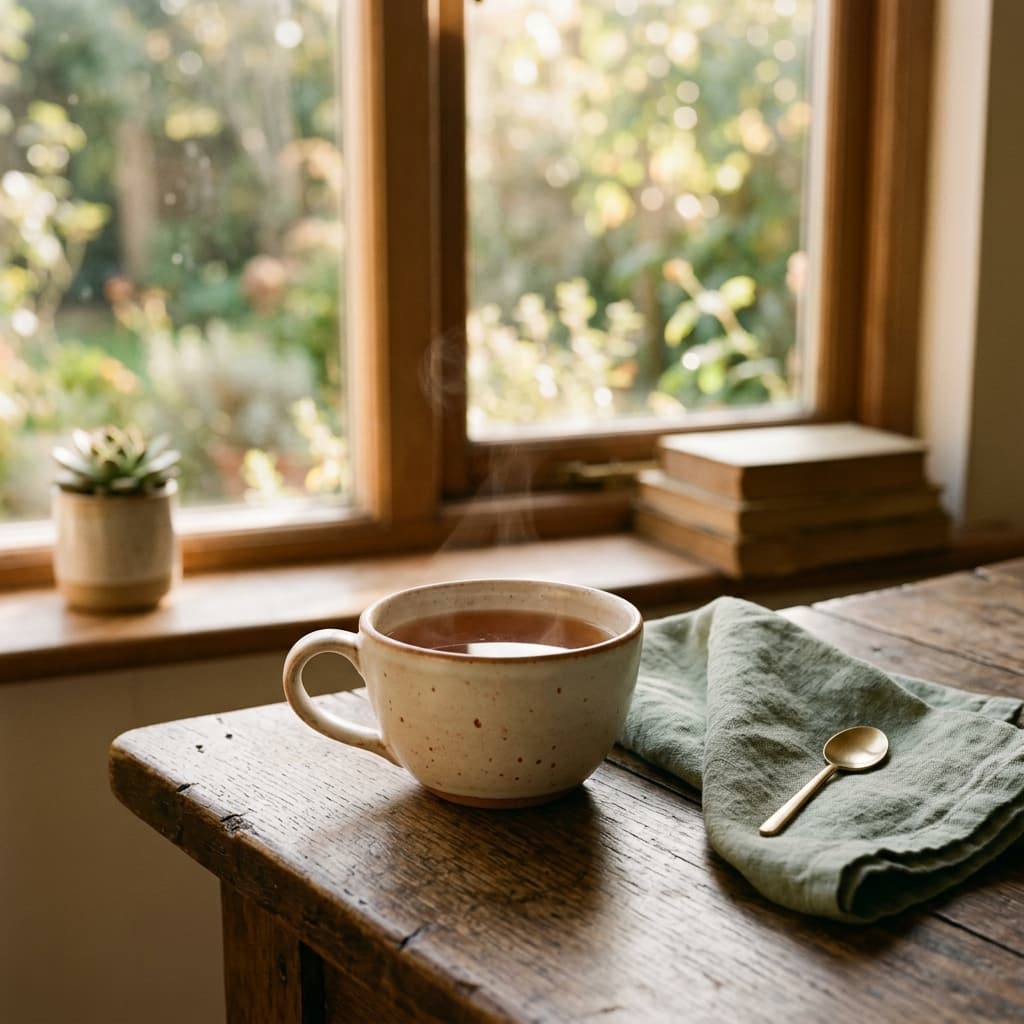
My evening routine is the simplest of all. Around nine, after my daughter is in bed and the house has settled into its nighttime acoustics, the different register of silence that a house makes when the daytime movement has stopped, I put the kettle on. I choose a tea. I sit somewhere quiet and drink it slowly, with both hands around the mug, feeling the warmth through the ceramic, the same warmth I felt at six in the morning but different now because the day is behind it, and the heat carries a quality of ending that the morning’s heat does not.
There is no journaling. No gratitude list. No stretching sequence. Just warmth in a cup and the particular weight of a day that is finishing. Nothing about it is optimized or impressive. But it is the signal my body recognizes as the beginning of landing, the way a plane’s wheels touch the runway before the engines reverse: a contact, a change in vibration, and then the slow deceleration that means the traveling part is over.
Without the evening tea, I drift past bedtime into the hollow hours, the ones after eleven when the phone becomes the only companion and the scrolling has no floor. With the tea, I land. The difference is not discipline. The difference is that the body has been given a cue it trusts, and trust, for the nervous system, is just a pattern that has been repeated enough times to become predictable, and predictability, for a body that has been through unpredictable things, is the deepest form of kindness I know how to offer myself.
The routines that last are not the ones you impose on your life. They are the ones you build around the person you already are, in the body you already have, on the days when that body can barely get out of bed and still knows how to make it.
If you have struggled with routine, try this: choose one anchor. Not a system, not a sequence, just one small act that you do at roughly the same time each day. A glass of water. Three breaths. Opening the curtains. Make it so small that it requires almost no effort, so small that even on the worst day, the day when the body has nothing left, the anchor is still reachable. Let it become familiar before you add anything else. And if it helps, notice what your body does when the anchor lands: whether the feet feel more solid on the floor, whether the breathing deepens by a fraction, whether something in the chest settles. That settling has nothing to do with productivity; it is the body recognizing a pattern it can trust. That is the whole architecture. Everything else is just rooms you add when you are ready.
