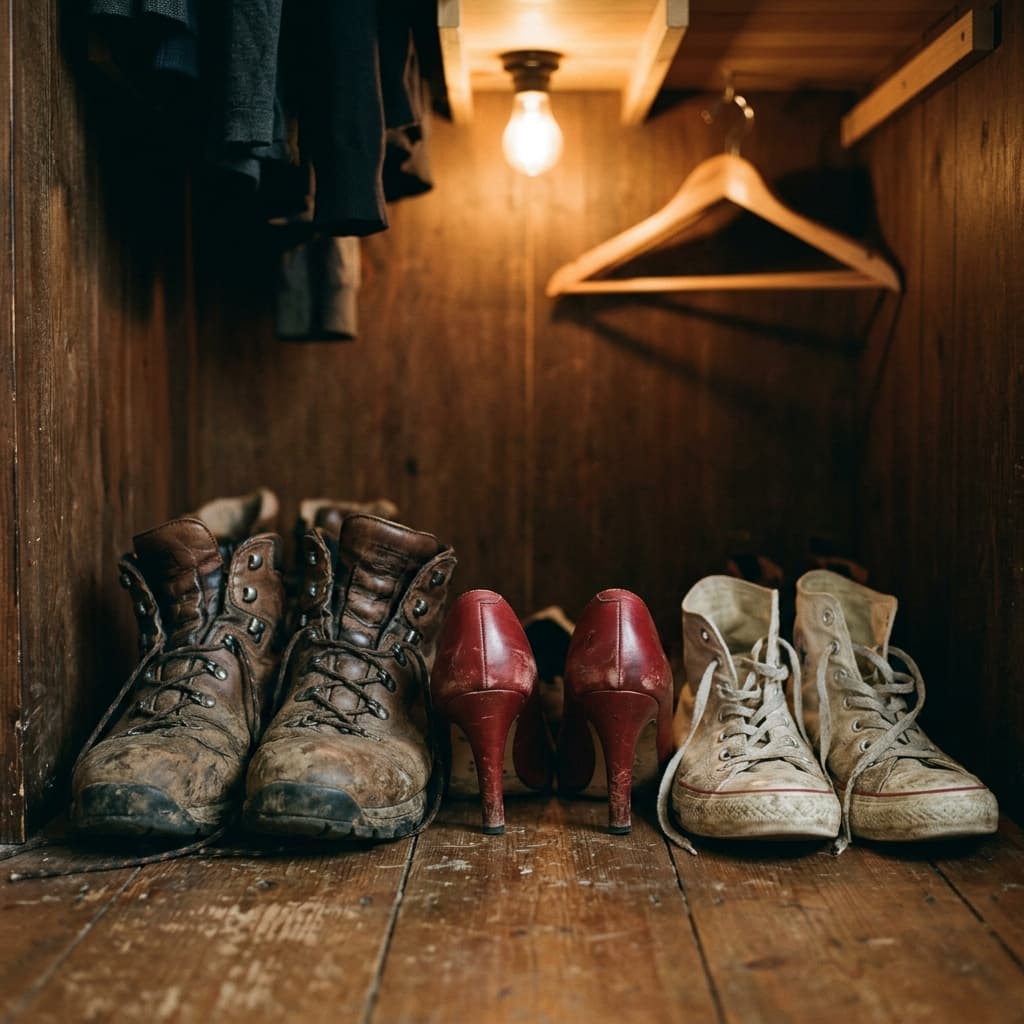
There are three pairs of shoes in my wardrobe that I will never wear again, and I will fight anyone who tries to take them. This is not rational. I am aware it is not rational. The shoes know it is not rational. We have an understanding, the shoes and I: they do not pretend to be useful, and I do not pretend that keeping them is about shoes.
Thread One: The Walking Boots
The first pair is a pair of walking boots that belonged to my father. They are two sizes too large for me. The leather has cracked along the toe crease in a pattern that maps exactly to his gait, the way his foot rolled slightly outward with each step, a pronation he refused to correct because he had been walking that way for sixty years and was not about to let an insole tell him otherwise. The laces are the replacements he bought in 2019, still threaded through the eyelets in the pattern he preferred, which was not the standard crisscross but a peculiar parallel lacing he claimed was better for the ankle. It was not better for the ankle. He did it because his father did it.
I cannot wear these boots. They are too large. They smell faintly of dubbin and earth and something underneath both of those that I can only describe as him. If I put my hand inside, the leather is molded to the shape of a foot that is not mine, the arch higher, the heel deeper, the toe box stretched in places mine would never stretch. These boots are a portrait. They are the most accurate rendering of my father’s walk that exists in the world, more accurate than any photograph, because a photograph captures how he looked. The boots capture how he moved.
You want me to throw these away? You want me to put them in a bin liner and leave them at the charity shop where someone will hold them up, assess the cracked leather, and conclude that they are past their best? Absolutely not. These boots are not past their best. These boots are exactly at their best. Their best is right here, in my wardrobe, holding the shape of a man who is no longer available to fill them.
Thread Two: The Red Heels
The second pair is mine. Red heels, bought in 2016 for an occasion I can no longer precisely remember but which required me to be three inches taller and significantly more confident than I actually was. I wore them once. They were magnificent and they were agonizing, in the way that certain shoes insist on being both, as though beauty and suffering are the same currency and you must pay in one to receive the other.
I keep them because of who I was the night I wore them. Not better. Not worse. Just different. A version of me that walked into a room with her shoulders back and her chin raised, partly because of the confidence the shoes produced and partly because looking down in four-inch heels while navigating a tiled floor is an invitation to a specific kind of public humiliation that I was not prepared to risk.
These shoes are a time capsule. They contain the exact body I was at thirty-one: the feet that could still tolerate this kind of architecture, the calves that could sustain the angle, the particular bravery of being young enough to choose pain for an evening because the evening was worth it. I am not that body anymore. My feet have since written a strongly worded letter to my aesthetic ambitions, and the aesthetic ambitions have, reluctantly, agreed to negotiate. But the shoes remain. They are evidence that I was once a person who could walk into a room on the strength of a color and a heel height, and even though I would not do it now, I am not ready to stop being the kind of person who once did.
The Weight of a Thing in the Hand
Sherry Turkle, the social scientist whose work on our relationships with objects is the most thoughtful I have encountered, uses the term evocative objects: things that carry emotional and intellectual weight beyond their function. A shoe is not just a shoe. A shoe is a mold of a foot, a record of a walk, a container for a body that was shaped a particular way at a particular time. Turkle argues that we think through objects, not just with our minds but with our hands, our bodies, our sensory memory of what the object felt like, weighed like, smelled like.
This is why decluttering is so much harder than the decluttering industry admits. The industry treats objects as decisions: keep or discard, useful or not useful, spark joy or do not spark joy. But the body does not evaluate objects on a binary. The body evaluates objects on a spectrum of somatic memory: how heavy they are in the hand, what they smell like, whether the texture triggers a response in the chest or the stomach or the throat. The body does not ask does this spark joy? The body asks does this hold someone I love, or a version of me I am not ready to release? And the answer, for three pairs of shoes in my wardrobe, is yes.
Thread Three: The Canvas Sneakers
The third pair is the least defensible. They are canvas sneakers, white once, now the color of enthusiastic use. The sole on the left one has separated from the upper at the toe, giving the shoe the appearance of a puppet with its mouth permanently open, which I find endearing in a way that suggests I may need to recalibrate my relationship with footwear.
I bought them the week I moved into my first apartment alone. They are the shoes I wore to carry boxes up three flights of stairs, to walk to the corner store at eleven at night for milk because I had forgotten to buy milk, to stand in the kitchen at midnight eating toast and looking at a room that was entirely, thrillingly, unshared. They are the shoes of that particular freedom: the one that is also loneliness, the one that is also possibility, the one where you stand in a kitchen that contains only your things and realize that the silence is both the problem and the gift.
The sole is separating. The canvas has a hole near the little toe. They are, by any reasonable measure, finished. But they hold the weight distribution of a woman carrying boxes alone, and that woman is a version of me I admire, and I am not yet able to put her in a bin liner and leave her at the curb.
The Groove a Foot Wears Over Time
Daniel Miller, the anthropologist who spent a year visiting the homes of ordinary people on a single London street, found that the objects people kept were rarely the valuable ones. They were the worn ones. The cracked mug, the frayed blanket, the shoes with the broken sole. Value, he concluded, accrues through use. The body makes objects precious by touching them, by wearing them, by leaving its mark on them over time. A new shoe is just a shoe. A worn shoe is a collaboration between the object and the body that wore it, a co-authored document that neither party can reproduce alone.
This is, I think, why the shoes in my wardrobe resist disposal. I do not so much own these shoes as stay in relationship with them. The walking boots are my ongoing conversation with my father’s gait. The red heels are my ongoing conversation with my thirty-one-year-old nerve. The canvas sneakers are my ongoing conversation with the woman who carried her own boxes and ate toast at midnight and discovered that she could live alone and that living alone was bearable and that bearable was, on certain evenings, enough.
I will not throw them away. I will not even tidy them. They sit in the bottom of the wardrobe in a state of comfortable disorder, the boots leaning against each other the way boots do when they have been together a long time, the red heels standing upright with the particular posture of shoes that have always known their own worth, the canvas sneakers flopped on their sides like old dogs. They are anything but useful, anything but practical. They are mine, and they are the mines of the people I have been and the people I have loved, and that is more than enough reason to let them stay.
The objects you cannot let go of are not clutter. They are the body’s archive, holding the shape of a hand, a foot, a life, that the mind has officially filed under finished but the body knows is nothing of the kind.
If you have something you cannot throw away, something the decluttering advice says should go but the body insists on keeping, hold it for a moment today. Not to decide. Just to feel what the body does when it holds the thing. Where does the weight land? Does the chest open or tighten? Does the breath change? You do not need to throw it away. You do not need to justify keeping it. You just need to acknowledge that the attachment, far from sentimental weakness, is the body recognizing its own history in the shape of an object, and history does not belong in a bin liner.
