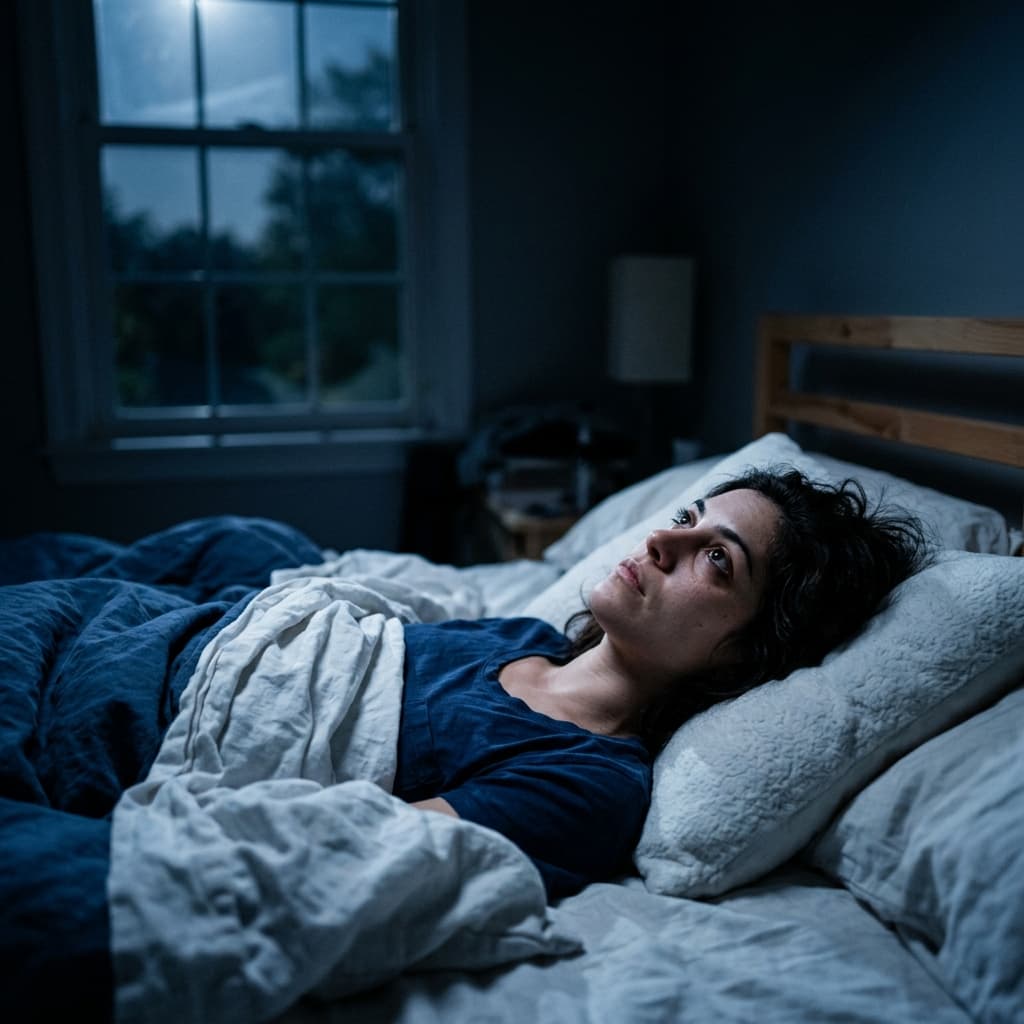
At 11pm last Thursday I was lying in bed, lights off, phone on the nightstand face-down, and I thought a thought I would never allow during daylight. It was a quiet thought, far from dramatic, and it carried nothing dangerous or destructive. It was simply true, and the truth of it was the kind that the daytime mind keeps behind a locked door labeled later, and impractical, and some other time.
The thought was this: I do not want the thing I have been working toward.
Twelve words. Unremarkable. And yet the daytime mind, the one that manages the schedule and maintains the trajectory and answers how are you with good, busy, would never have permitted those twelve words to form. The daytime mind would have intercepted them at word four, rerouted them to the department of motivation, and issued a corrective statement about gratitude and perspective. But the daytime mind was off duty. The night had arrived, and the night self does not have a department of motivation.
The Night Self
I have been paying attention to the thoughts that arrive after dark, and they are a different species from the thoughts that operate in daylight. Daytime thoughts are groomed. They have been through editorial review. They arrive wearing appropriate clothing and carrying supporting evidence. Nighttime thoughts arrive barefoot, unedited, smelling of something feral, and they say the things that daytime thoughts are too well-mannered to say.
This is not the same as the anxious spiral at 3am, which is the nervous system in overdrive, not insight. The thoughts I am talking about arrive earlier, in the liminal window between the end of the day’s performance and the beginning of sleep. Between 10pm and midnight, roughly. This is the window where the body has finally unclenched from the day’s holding, the jaw has softened, the shoulders have descended, the breath has found its resting depth, and in this unclenching, the thoughts that were held tight along with the muscles are released.
The body opens, and the thoughts that were compressed come out.
Why the Night Is Braver
I have a theory about this, and it is a searching theory, not a settled one. I think the night is braver because the performance is over. During the day, the self is public. Even when alone, the daytime self operates as though observed, maintaining a version of reality that is consistent with the story it has been telling: I am fine, I want this, I am on track. You can feel the story in the set of the posture, the clipped pace, the guarded pitch of the voice. The story is muscular. It lives in the jaw that stays set and the shoulders that stay squared and the breath that stays shallow because deep breathing would require relaxation and relaxation would require admitting that the performance is a performance.
At night, the performance ends. Not because you choose to end it, but because the body can no longer sustain it. The muscles release. The jaw opens. The shoulders fall. And in the falling, the story loosens its grip, and the thoughts that were underneath the story, the ones that were being held down by the muscular effort of maintaining the narrative, rise to the surface the way objects rise in water when the weight holding them under is removed.
The night thought was there all along, pressed down and waiting. It has been riding in the tightness behind the sternum since morning, maybe longer, and the night is simply the first moment that grip loosens enough to let it surface.
What Clarissa Pinkola Estes Knows
Clarissa Pinkola Estes writes about the night as the territory of the instinctual self, the self that operates below the socialized surface, the self that knows things the civilized mind has been trained to ignore. She is writing about something larger than bedtime thoughts, but the mechanism she describes is the one I recognize: that the body has a knowing that the mind censors during daylight hours, and that the knowing does not disappear. It waits. It waits for the conditions to change, for the noise to drop, for the muscles to soften, and then it speaks.
The night thought is the instinctual self speaking in the only window the daytime self has left open.
The Morning Erasure
Here is the part I am still working through. The morning erases. The alarm sounds and the body tightens and the jaw resets and the shoulders square and the daytime self resumes its performance, and the night thought, the twelve-word truth that arrived so clearly in the dark, is reclassified. It becomes a mood. A passing feeling. Something that felt true at 11pm but looks different in daylight, like a dream that made perfect sense while you were inside it and dissolves the moment you try to describe it at breakfast.
Matthew Walker writes about the neurochemistry of sleep, and I find his work illuminating but incomplete for what I am describing, because the night thoughts I mean arrive before sleep, in the threshold space where the body is awake but the performance is not. Walker describes how sleep processes emotion. I am interested in what happens before the processing begins, in the raw, unprocessed, unedited moment where the body is open enough to let the truth through and the mind has not yet organized it into something manageable.
I do not think the morning is correcting the night. I think the morning is overriding it. The night thought is inconvenient. The twelve words, I do not want the thing I have been working toward, require action if taken seriously. They require dismantling. They require the admission that the trajectory has been wrong, or at least incomplete, and admissions of this kind are daytime projects that the daytime self does not want to take on. So the morning reclassifies: it was late. I was tired. Things look different in the morning.
Things do look different in the morning. That does not mean the morning is right.
The Permission
I am circling this without landing because I have not landed. What I am reaching toward is this: the night self deserves a hearing. Not every night thought is wisdom. Some night thoughts are fatigue wearing the mask of insight, and some are anxiety rehearsing its favorite monologues, and some are the mind doing its nightly declutter, tossing out incomplete ideas the way a kitchen closes by wiping down surfaces. But some night thoughts, the ones that arrive with the body’s full weight behind them, the ones that the chest opens to receive, the ones that do not feel like anxiety or fatigue but like recognition, those thoughts deserve to survive the morning.
The permission is not to act on every night thought. The permission is to let the night thought exist alongside the morning thought without either one cancelling the other. To hold, during the day, the possibility that the thought you had at 11pm was not a mood but a message. To let the twelve words sit in the body without rushing to reclassify them.
I still do not know what to do with my twelve words. But I have stopped telling myself they were just a late-night feeling. They arrived when the body was open and the performance was down and the muscles were telling the truth, and that arrival deserves more than dismissal over breakfast.
The night thought is not a new thought. It is a suppressed thought. The body has been carrying it all day, and the night is the first moment the body has had enough slack to let it surface.
Tonight, if a thought arrives in the window between the day ending and sleep beginning, try writing it down. Not to analyze. Not to act on. Just to give it a record that survives the morning. One sentence, on a piece of paper, on the nightstand. Let the morning self read it in daylight and sit with the discomfort of a truth that arrived when the performance was down. It may be fatigue. It may be wisdom. The body, which was there when it arrived, already knows which one.
