The bath was drawn. The candles were lit. The phone was in another room. The lavender oil was doing whatever lavender oil does, which is to say it was smelling like lavender and feeling extremely important about it. Everything was in place for a Restful Evening, capital R, capital E, the kind of rest that looks good from the outside and feels like a to-do list from the inside.
My body was not resting. My body was lying in warm water calculating how many minutes of Restful Evening it needed to complete before it could officially declare the rest achieved and return to the thing it actually wanted to do, which was sit on the couch in old clothes and stare at the ceiling without a strategy.
This is the problem. Not that we do not rest. We rest constantly. We have commodified rest so thoroughly that there is an entire economy built on selling it back to us: the weighted blanket, the sleep app, the meditation subscription, the yoga retreat, the digital detox that requires you to pay someone to take away the phone you could simply put down. We rest with intention. We rest with purpose. We rest with goals and metrics and a post-rest Instagram story that proves we rested. And the body, which has been resting on its own terms for three hundred thousand years of human existence, looks at all of this and says: no.
The Jaw That Stays Tight
Here is the thing I cannot get past: the body can tell. There is a loosening in the shoulders for rest that serves the body, and a held breath for rest that serves the performance of having rested. It knows this the same way it knows the difference between a genuine smile and a polite one, between a laugh that starts in the diaphragm and one that starts in the social cortex. It reads the signals, and the signals of performed rest are unmistakable: the jaw that stays tight even in the bath, the shoulders that hold their position even on the yoga mat, the breath that does not deepen because the mind is still running its efficiency calculations in the background.
Performed rest is work wearing a robe. The body is not fooled by the robe.
I am not against baths. I am not against candles. I am not even against lavender oil, though I maintain that it has an inflated sense of its own importance. What I am against is the idea that rest is something you do, something you perform, something you can get right or wrong, something that requires equipment and ambiance and a dedicated evening in the calendar. Rest is not a task. The moment you put it on the to-do list, it becomes one, and the body, which does not have a to-do list and is skeptical of anyone who does, withdraws its cooperation.
The Industry of Exhaustion
Tricia Hersey, whose work on rest as a form of resistance I carry with me like a talisman, makes a distinction that the wellness industry has been working very hard to blur: the distinction between rest as a consumer product and rest as a human right. The wellness industry wants to sell you rest. It wants to optimize your rest. It wants to give your rest a Return on Investment. It wants to assure you that resting will make you more productive, more creative, more efficient, as though the only way to justify stopping is to prove that stopping will help you go faster.
This is a strategic pause masquerading as rest. It is the corporate version of sleep: we are not resting because we are tired. We are resting because the data shows that rested employees produce 14% more output, and the board would like to see that reflected in Q3.
The body does not produce output. The body is not an employee. The body does not care about Q3. And the body can tell, with a precision that would embarrass most HR departments, when it is being rested for its own sake and when it is being rested for someone else’s bottom line. The insomnia that arrives on Sunday night is the body’s refusal to be rested strategically. It is the body saying: you are not resting me. You are servicing me, like a machine, so I can run more efficiently next week. And I am not a machine. And I will not sleep until you understand this.
What Rest Actually Looks Like
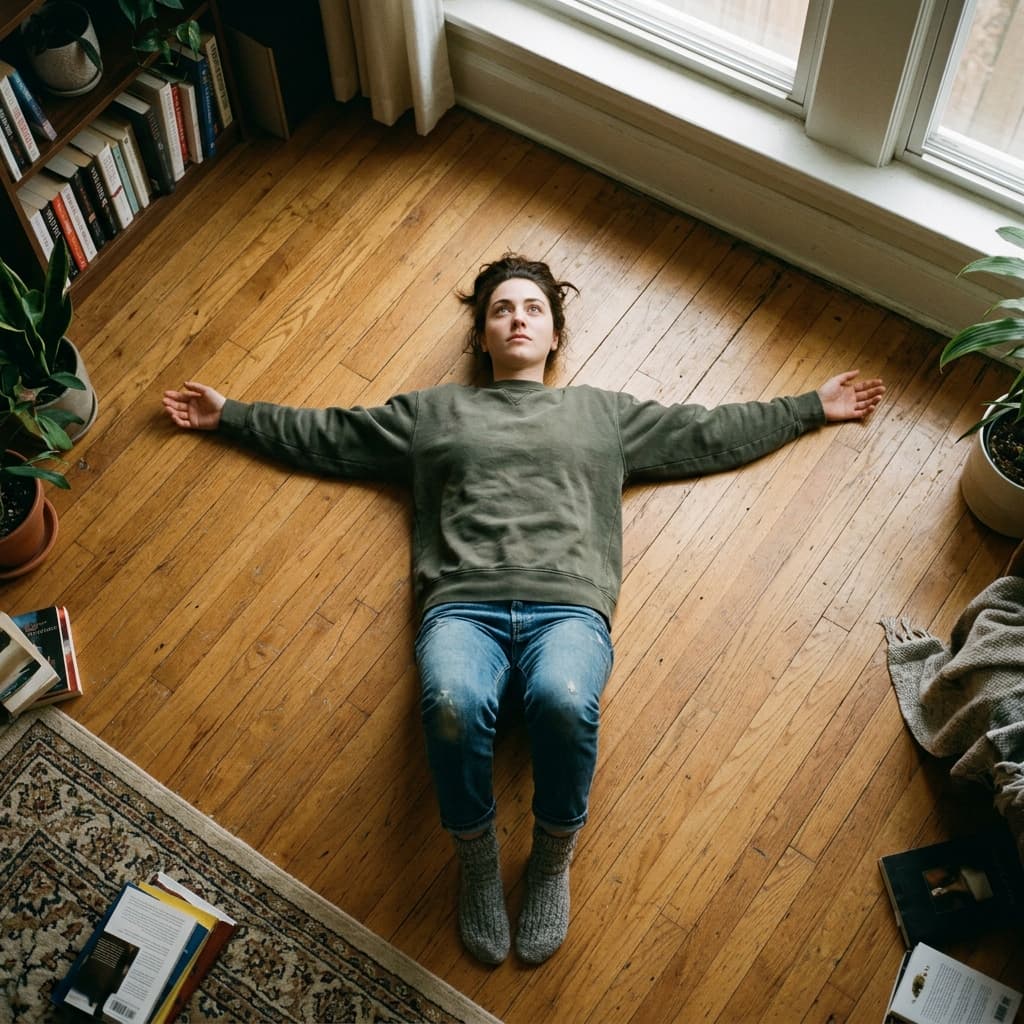
I have been paying attention to when my body actually rests, and the results are unflattering to every lifestyle brand I have ever followed. My body rests in the following situations: lying on the floor for no reason; sitting in the car in the driveway for four minutes after arriving home, doing nothing, the engine off, the key still in my hand; staring out a window with my mouth slightly open like a person who has recently been unplugged; standing in the shower after I have finished showering, just standing there, letting the water hit my back while my mind does the mental equivalent of a screen saver.
None of these activities are photogenic. None of them involve products. None of them were planned, scheduled, or optimized. They happened because the body found a gap in the mind’s itinerary and took it, the way a cat takes a patch of sun: instantly, without negotiation, without checking whether the timing was convenient.
Alex Soojung-Kim Pang argues that rest is a skill, and I want to agree with him, but I hold the idea at a distance. Calling rest a skill risks turning it into another competency to develop, another thing you can be good or bad at, another metric on which you can fail. I think rest is less a skill than a permission. Not the permission to stop, but the deeper and harder permission: the permission to stop without a reason. To stop without a goal. To stop without the stopping being in service of the eventual starting again.
The Rebellion
I call it a rebellion because I think that is what it is. In a culture that has monetized every hour, that measures human value in productivity, that has convinced us that time spent doing nothing is time wasted, the act of genuinely resting, resting without justification, resting without an app tracking the quality of your rest, resting in a way that would embarrass you if anyone saw, is a radical act. The body knows this. The body has always known this. It has been staging small rebellions all your life: the yawn in the meeting, the heavy eyelids at three in the afternoon, the leg that falls asleep because it has decided, unilaterally, that sitting in this chair is no longer acceptable.
These are not failures of discipline. They are the body’s picket line. They are the body saying: I did not agree to this schedule. I did not consent to this pace. And I will not rest on your terms, because your terms are just more work in softer lighting.
The body wants to rest the way it wants to rest: without fanfare, without intention, without a candle within a ten-mile radius. It wants to lie on the floor. It wants to sit in the car. It wants to stand in the shower doing nothing while the hot water runs and the electricity meter ticks and the productivity gurus weep. It wants rest that is messy, unoptimized, unphotographable, and entirely its own.
The body does not need your permission to rest. It needs your permission to rest badly: without a plan, without a product, without proof that the resting was worthwhile. The worthwhile is the rest itself. Nothing else. Nothing after.
I am not going to give you a rest practice. A rest practice is an oxymoron, and the body would see through it immediately. What I will say is this: the next time your body stages one of its small rebellions, the yawn, the heavy limbs, the sudden inability to care about the email, do not override it. Do not redirect it into a branded rest experience. Just let the body do the thing it is trying to do, which is stop, without any of the apparatus we have built around stopping. Lie on the floor if it wants the floor. Sit in the car if it wants the car. Left alone, your limbs go heavy without a single instruction. It has been trying to show you for years. All it needs is for you to stop helping.
