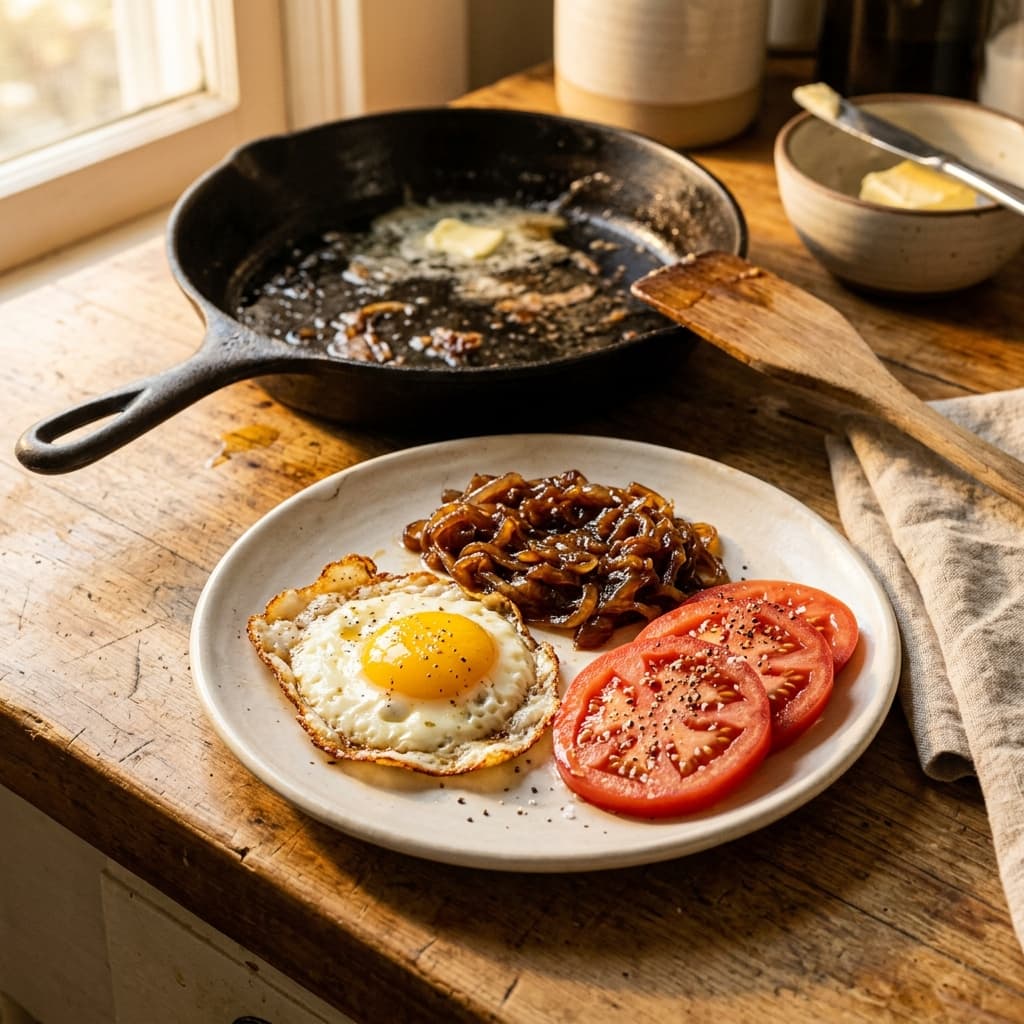
Cooking for yourself is a conversation with a body you are deciding to take seriously. I want to say this quietly, because it deserves quiet, because the loudness of food culture, the recipes, the trends, the aesthetics, the performance, has drowned out the simplest thing: that cooking is a form of attention, and attention directed at your own nourishment is a form of care so basic that many of us have never received it from ourselves.
I am not talking about elaborate meals. I am not talking about culinary ambition. I am talking about the first time you stood in your own kitchen and made something with more than one ingredient, more than one texture, more than one color on the plate, not because anyone would see it, not because it would photograph well, but because the body was hungry and you decided that the hunger deserved an answer that was not toast.
The Toast Phase
I lived on toast for longer than I want to admit. Toast and its relatives: cereal from the box, cheese on crackers, an apple eaten over the sink, the kind of eating that is not really eating but refuelling. The body receives calories. The mouth performs chewing. The stomach registers something. But the nourishment, the kind that involves the hands and the nose and the sound of something in a pan, the kind that fills the kitchen with a smell that says someone lives here and that someone is worth feeding, that nourishment was absent.
I do not judge the toast phase. The toast phase is real and it is common and it is the body’s minimum viable product: calories in, survival maintained, questions of worthiness deferred. The toast phase says I will keep this body running but I will not invest in it. The toast phase says I am functional. The toast phase does not say I matter.
The toast phase lasted, for me, about three years.
The Onion
The shift began with an onion. I do not remember the day. I remember the onion: yellow, papery, sitting on the counter because someone had given me a bag of them and I had nowhere else to put them. I was going to eat toast. I was already reaching for the bread. And something, some small mutiny in the body, made my hand go to the onion instead.
I peeled it. The papery skin came away in pieces. I cut it in half and the smell hit, that sharp, wet, eye-stinging smell that is the onion’s way of saying you have opened something. I put butter in a pan, which was itself unusual because using butter meant using a pan, and using a pan meant cooking, and cooking meant deciding that this meal would take longer than two minutes, that this body was worth the extra time. The butter melted. The onion went in. And the sizzle, that specific, irreplaceable sound of something alive happening in a kitchen, changed the room.
Tamar Adler writes that cooking begins with an onion and a pan and the willingness to let something take time. I did not know this then. I only knew that the kitchen smelled like a place where someone was being fed, and the someone was me, and that felt like a sentence I had been waiting to say without knowing I was waiting.
The Color
The onion led to an egg. The egg led to the thought that eggs are yellow and onions are golden and the plate was monochromatic, and before I could talk myself out of it, I was pulling a tomato from the fridge, a tomato I had bought three days ago with no plan, and I sliced it and put it on the plate next to the egg and the onion, and the plate had two colors, and the two colors mattered.
I am telling you this with the tenderness it deserves: two colors on a plate is a revolution when you have been eating toast. Two colors means someone arranged this. Two colors means someone looked at the plate and thought about the plate and cared about what the plate held. Two colors is a body saying to itself, for the first time in years: you are worth the tomato.
You are worth the tomato.
What M.F.K. Fisher Understood
M.F.K. Fisher, who wrote about food and solitude with a directness that still startles me, understood that cooking for one is not a lesser version of cooking for others. It is its own practice, with its own dignity, its own rewards, its own quiet authority. She wrote about eating alone without apology, about setting a table for one with the same care you would set it for a guest, because you are the guest. You are always the guest in your own kitchen, and the meal you prepare is an act of hospitality directed inward.
I did not set a table. I ate the onion and egg and tomato standing at the counter, because the counter is where I eat when no one is watching, and no one was watching. But I ate it slowly. I tasted the onion, which had gone sweet and soft in the butter. I tasted the egg, which was slightly overcooked because I had been distracted by the tomato. I tasted the tomato, which was cold from the fridge and sharp and red and alive in the mouth in a way that toast is not alive, in a way that cereal from the box is not alive, in a way that food becomes alive only when someone has stood in a kitchen and paid attention to it.
The body noticed. Not the food, exactly. The effort. The body noticed that someone had chosen to spend twelve minutes on a meal instead of two. The body noticed the butter, the pan, the slicing, the color. And what the body did with this noticing was small and enormous at the same time: it relaxed. The shoulders dropped. The jaw, which I had not realized was tight, softened. The eating slowed. The body received the meal as what it was, not calories but care, and the care registered in the muscles as permission.
The Practice
That was four years ago. I cook for myself now. Not elaborately. Not always well. Some nights are still toast. Some nights the body is too tired for care and the care it needs is the permission to eat simply, without guilt, without the sense that every meal must be an occasion. The toast phase is not the enemy. The toast phase served a purpose. What changed is that the toast is now a choice, not a default. The onion is also a choice. The tomato is also a choice. And the choosing, the standing in the kitchen and deciding what this body will eat tonight, that choosing is the practice.
I do not always get it right. I overcook the eggs more often than I would like to admit. The tomatoes are sometimes mealy. The onion occasionally burns because I got distracted by the window, or the radio, or the particular quality of evening light that makes me stop what I am doing and just look at it. But the imperfection is part of the tenderness. Cooking for yourself does not need to be good. It needs to be real. It needs to involve the hands and the nose and the sound of something in a pan and the body standing in its own kitchen deciding that it will feed itself with attention, tonight, because the body is worth the attention.
Two colors on a plate is a revolution when you have been eating toast. Two colors means someone looked at the plate and cared. That someone was you. You are worth the tomato.
If tonight is a toast night, let it be a toast night. The body does not need you to perform nourishment every evening. But if there is an onion on the counter, and a pan in the cupboard, and ten minutes between now and hunger, see what happens when you let the butter melt and the onion sizzle and the kitchen fill with the smell of someone being fed. You do not need to set a table. You can eat at the counter. Just let the body notice that someone is cooking, and the someone is you, and the meal, however imperfect, is the body’s evidence that you showed up for it tonight.
