When was the last time you enjoyed something without immediately calculating what it cost you? Not in money, though that too. In time, in calories, in productivity lost, in the nagging suspicion that enjoyment without a purpose is a form of negligence. When was the last time the body was simply having a good time and the mind did not arrive with a clipboard?
The Peach
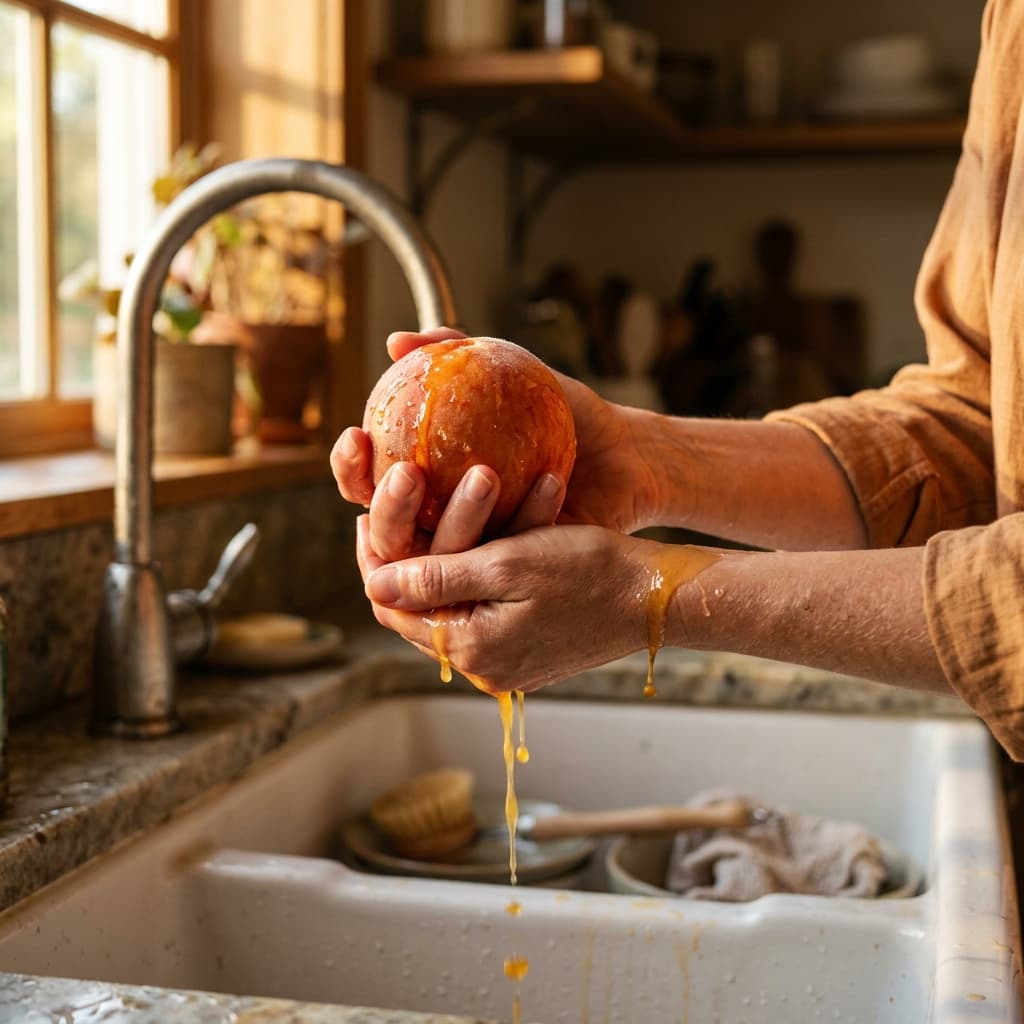
I need to tell you about the peach. It was a Tuesday, late afternoon, the kind of hour where the day has already decided what it is and you are just seeing it out. I was standing at the kitchen sink. The peach was on the counter. It had been sitting there for two days, reaching the exact stage of ripeness where the skin gives under the slightest pressure and the smell fills a radius of about eighteen inches with something so purely good that even the word good feels insufficient.
I picked it up. I bit into it over the sink because I am a person who has learned, through decades of peach-eating, that a ripe peach does not respect boundaries. The juice went immediately down my wrist, past the sleeve I had not rolled up, and onto the counter I had just cleaned. And for four seconds, maybe five, I was nowhere else. The sweetness. The slight resistance of the skin before it gave way. The temperature of the juice, cooler than the air, warmer than the fridge. My body was having a complete experience, and my mind, for once, had not shown up to audit it.
Then the mind arrived. It arrived with questions. Should you be eating over the sink like an animal? Is this your second piece of fruit today? Should you not be finishing the thing you were supposed to finish? The peach was still in my hand, still dripping, still magnificent, but the experience had been annexed. The body was eating a peach. The mind was doing cost-benefit analysis.
This is, I think, the central problem. Not that we lack pleasure, but that we have lost the discipline to stay inside it.
What Epicurus Actually Said
Epicurus has been slandered for two thousand years. His name became a synonym for indulgence, for the person who orders the expensive wine and has a second dessert. Epicurean, we say, meaning excessive, meaning hedonistic, meaning guilty. But Epicurus himself lived on bread, water, and the occasional piece of cheese, and considered this a life of extraordinary pleasure.
What he actually argued was this: pleasure is the absence of pain in the body and the absence of disturbance in the mind. That is it. The whole philosophy. Nothing about more pleasure, or bigger pleasure, or pleasure that justifies itself through some secondary benefit like stress reduction or immune function. Just the body, at ease, undisturbed. The peach over the sink without the clipboard.
I find this radical in a way that most contemporary wellness advice is not. The wellness industry has turned pleasure into a prescription. Take a bath; it reduces cortisol. Eat dark chocolate; it contains antioxidants. Go for a walk; it improves cardiovascular health. Every pleasure is laundered through a medical or productivity benefit, as though the body cannot be trusted to enjoy something without a doctor’s note. Epicurus would have found this baffling. The peach is not good for you. The peach is good. The for you is already a contamination, a suggestion that enjoyment requires a justification outside of itself.
Fragment: The Stretch
Here is a small inventory of pleasures that my body has recently enjoyed in spite of my mind’s scheduling department.
The stretch. Not a yoga stretch, not a targeted flexibility exercise, not something with a name or a sequence. The stretch that happens involuntarily when you have been sitting too long and the body, without consulting anyone, extends one arm overhead and twists the torso and produces a sound from somewhere near the spine that is part crack, part groan, and entirely satisfying. This stretch is so pleasurable that it has a medical name: pandiculation. It is the body’s way of resetting the sensory-motor system, recalibrating muscle length and tension, but the body does not care about the mechanism. The body does it because it feels extraordinary, and the fact that it also serves a function is, from the body’s perspective, a coincidence it is willing to accept.
Fragment: The First Sip
The first sip of tea in the morning, when the mug is still too hot and you have to hold it with both hands and blow across the surface, and the steam hits your face, and the first sip is more heat than flavor but the heat itself is the pleasure, the mouth knowing before the caffeine arrives that something good is happening.
I have measured this. Not scientifically. Personally. The first sip is approximately four hundred percent more pleasurable than the second sip, and the difference has nothing to do with the tea. It has to do with the body’s response to the first encounter with a sensation it has been anticipating. The anticipation heightens the receptors. The first sip delivers into a nervous system that is primed for exactly this, and the result is a moment of somatic satisfaction so complete that it requires both hands, a sound, and a brief closing of the eyes.
By the fourth sip, the tea is just tea. The body has already moved on to the next project. But that first sip, I will defend that first sip against anyone who tells me I should be drinking something more optimized.
Fragment: Sun on Skin
Adrienne Maree Brown writes about pleasure as a political act, a refusal to let productivity colonize every hour of the body’s day. I carry her argument with me, though I hold it at a slight angle. She is interested in pleasure as resistance. I am interested in pleasure as attention, as the body’s way of saying this, right here, is worth noticing, and the mind’s habitual response of yes but what is it for?
The sun on bare forearms in late June. I was sitting on a step outside the back door, doing nothing that could be reported to anyone as an activity. The sun was on my arms. The warmth was precise, located, the way good warmth always is: not a general sensation but a specific one, arriving at particular square inches of skin and reporting itself there with a clarity that made the rest of the world go slightly out of focus. My arms were the most interesting thing happening. My arms, in the sun, doing nothing.
I lasted about ninety seconds before I picked up my phone. I want to be honest about this. Ninety seconds of unmediated, purposeless pleasure is, for me, close to a personal best. The discipline of pleasure asks nothing of endurance. What it asks is that you not reach for the device, the task, the justification, the thing that converts the present moment into a means to some future end. It is the discipline of letting the sun be the point.
The Guilt Engine
I think the reason pleasure requires discipline is not that pleasure is difficult but that guilt is fast. Guilt arrives before the second bite, before the stretch is finished, before the sun has warmed both arms. It arrives with the same message every time: this is a waste, this is unearned, this hardly counts as a reason to be doing nothing. The message is so familiar that it feels like common sense rather than what it actually is, which is a cultural program running on hardware that was designed for something else entirely.
The body was designed for pleasure. Not exclusively, and not extravagantly, but reliably. The nervous system has reward circuits for a reason. The skin has nerve endings tuned to gentle pressure for a reason. The tongue has receptors for sweetness for a reason. These are features, and the body deploys them with the same precision it deploys everything else: pain, temperature, hunger, fatigue. Pleasure is information. It says: this is good for you. Stay here a moment.
The guilt says: you do not have a moment. But the guilt, I have started to suspect, is not very good at math. It overestimates the cost of four seconds with a peach and underestimates the cost of never having them.
Pleasure is not the reward for discipline. It is the discipline. The practice of letting the body enjoy what it is enjoying, without the mind’s audit, without the guilt’s invoice, for as long as the enjoyment lasts. Which is usually about four seconds. But what a four seconds.
If you are willing, find a small, purposeless pleasure today. Something the body enjoys that the mind cannot monetize. A stretch. A sip. A square of sunlight on skin. When the guilt arrives, and it will, see if you can let it sit in the room without giving it the microphone. You do not need to argue with it. You do not need to justify the pleasure. Just let the body have its four seconds. The clipboard can wait.
