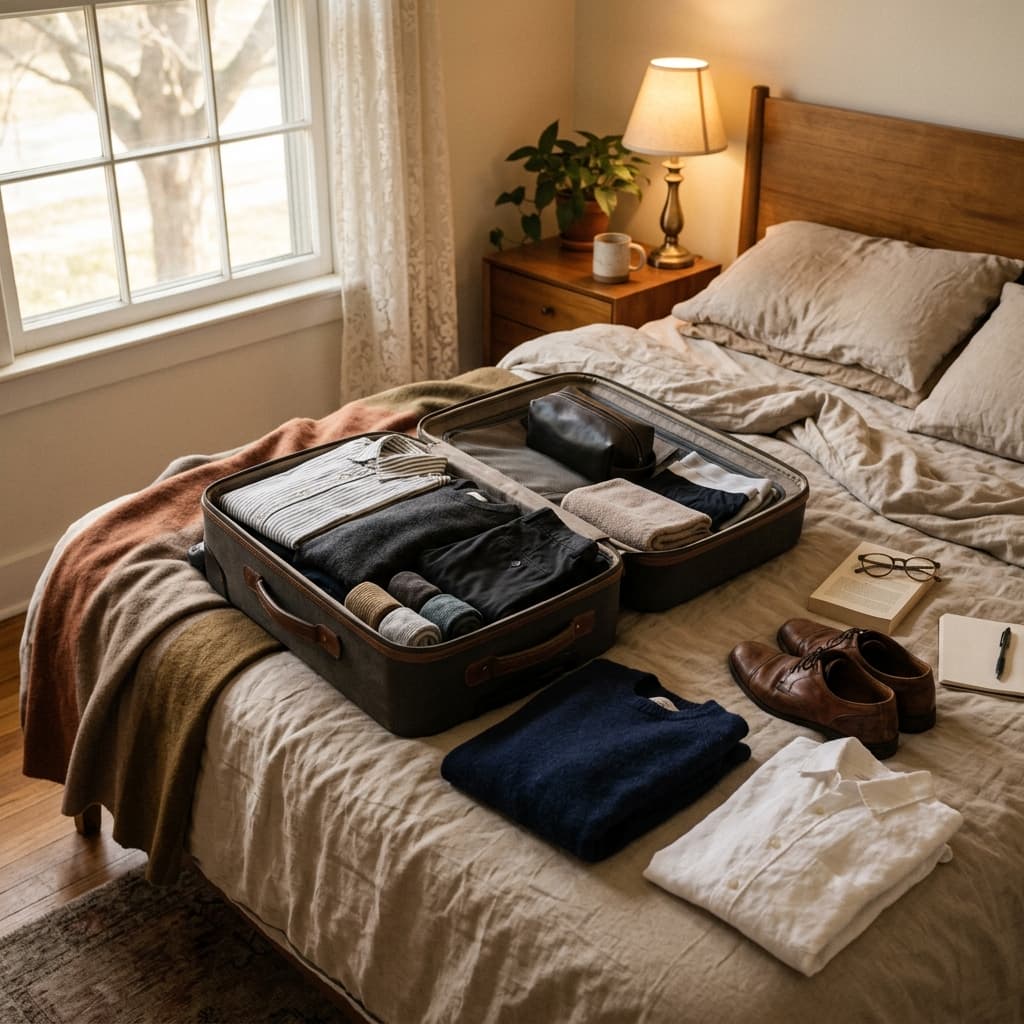
I was packing a suitcase on a Wednesday evening when I noticed that my hands were working without me. They folded the shirts in thirds, not halves, because thirds fit the case better. They tucked the socks into the shoes, because shoes waste space otherwise. They placed the heavy items at the bottom, along the wheels, because weight distribution matters when you are dragging your life through an airport at six in the morning and the floor is that particular airport tile that makes every wheel sound like a small complaint.
I did not decide any of this. My hands decided it. My hands have packed this suitcase, or suitcases like it, enough times that the packing has moved from the conscious mind to the motor cortex, from decision to reflex, from something I do to something the body does while I watch.
That is when I sat on the bed and cried. Not because of the packing. Because of what the automation meant.
The First Leaving
The first time I packed a suitcase to leave somewhere that mattered, I was twenty-three. I remember every fold. I remember standing in front of the wardrobe, pulling things off hangers with the slow deliberation of someone who is not sure what climate they are packing for, emotionally speaking. I remember the weight of the suitcase when it was full. I remember how it felt different from the weight of the suitcase when I arrived, as though the leaving had added something the coming had not, some density that was not in the clothes but in the closing of the zip.
That leaving took hours. It took hours because every item required a decision, and every decision required a confrontation with the fact that I was going. The hairbrush: am I taking this? Yes. Then I am leaving. The book on the nightstand: am I taking this? Yes. Then I am leaving. Each object placed in the suitcase was a small confirmation of departure, and the body resisted each one, slowing the process, making the hands clumsy, dropping things, folding badly, as though inefficiency could delay the inevitable.
The body did not want to learn this. The body wanted packing to stay difficult, because difficulty is friction, and friction is time, and time is the space between being here and being gone.
What the Body Learns
But the body learns. That is what it does. The body is an adaptation machine, and it adapts to everything, including the things you wish it would not adapt to. Van der Kolk writes about the body’s capacity to automate survival responses, how actions that begin as conscious, effortful coping strategies gradually sink into the procedural memory and become reflexes. He is writing about trauma. I am writing about suitcases. But the mechanism is the same: repetition converts intention into automation, and automation is the body’s way of saying I have done this enough times that I no longer need the mind’s involvement.
By the fifth leaving, the packing took ninety minutes. By the tenth, an hour. By the twentieth, thirty-seven minutes. I know this because I timed it once, not on purpose but because I glanced at the clock when I started and again when I zipped the case shut, and the number, thirty-seven, struck me as obscene. Thirty-seven minutes to disassemble a life from a room. Thirty-seven minutes to make a space look as though you had never been in it.
The hands had learned. The hands could now fold and stack and tuck and zip without hesitation, without the clumsiness that had once served as the body’s brake pedal. The leaving had become smooth. Efficient. Practiced. And the smoothness was its own kind of grief, because smoothness meant the body had accepted that this is something it does. The body had filed leaving under routine.
The Spiral: Returning to the Suitcase
I come back to the suitcase on the bed, the Wednesday evening, the hands working without instruction. I come back because this is where the spiral tightens.
What I felt, sitting on the bed, watching my hands fold shirts in thirds, was not sadness about leaving. It was sadness about the competence. The expertise. The fact that my body had become so good at departure that departure no longer cost me anything visible. The hands did not shake. The breathing did not change. The eyes did not sting. The whole apparatus of leaving was running at factory efficiency, and the absence of difficulty was the most difficult thing.
Because difficulty is evidence that something matters. When the hands fumble and the breath catches and the packing takes hours, the body is saying this leaving is significant. When the hands are smooth and the breath is steady and the packing takes thirty-seven minutes, the body is saying this leaving is familiar. And familiar is a word that sits next to normal, and normal is a word that sits next to this is just what we do now, and that, for me, was the grief.
The Choreography
I have a leaving choreography. I did not design it. It designed itself, over years, through repetition. It goes like this: pack the suitcase. Check the drawers. Check the bathroom. Stand in the doorway and scan the room. Close the door. Do not look back. Walk to the car, the taxi, the station. Do not look back. Do not look back.
The do not look back is the most automated part. It is so practiced that my neck does not even attempt the turn anymore. The muscles that would rotate the head toward the place I am leaving have been overridden by the muscles that keep the head facing forward, and the forward-facing muscles are stronger now because they have been trained by every leaving to hold the gaze ahead, to resist the pull of the backward glance, to maintain the posture of a person who is going and not a person who is being pulled back.
Judith Herman writes about the way repeated experiences create procedural scripts that the body follows without conscious direction. The script becomes the body’s default response to a familiar situation. My leaving script is efficient and complete and runs without error, and every time it runs, I am less present for it, which means I am less present for the goodbye, which means the goodbye happens to the body but not to the person inside it.
The Spiral Tightens
Here is what I keep circling back to. I keep circling back because the thing will not resolve and I will not pretend it has.
The muscle memory of leaving is a kindness and a theft. It is a kindness because it protects. It lowers the cost. It gets you through the airport and onto the train and into the new room without the collapse that the first leaving cost you. The body automates the pain so the mind can function. This is generous. This is the body looking after the mind in the only way it knows how: by absorbing the difficulty into the muscles and carrying it there, silently, efficiently, so the conscious self can keep moving.
It is a theft because it takes the feeling with it. The automation that protects you from the pain also protects you from the significance. The body that can pack in thirty-seven minutes is a body that has lost the ability to register what it is doing as an event. The leaving has become a procedure. And a procedure does not grieve.
I want both. I want the competence and the feeling. I want the hands that know how to fold shirts in thirds and the heart that still understands that folding shirts means going. I do not know how to have both. The body does not seem to offer that option.
The body learns to leave the way it learns everything: through repetition, until the leaving becomes automatic. The automation is the body’s protection. It is also the body’s forgetting. The grief lives in the smoothness.
If you are someone who has left many times, you may recognize this. The efficiency. The script. The hands that work without instruction. I am not going to tell you to slow down the packing or to look back at the door. But the next time the hands are folding and the body is running the program, see if you can pause, just for a breath, between one fold and the next. Not to feel the grief. Just to feel the fold. To be inside the action instead of behind it. The hands will resume. The suitcase will close. But the breath was yours, not the automation’s, and that may be enough.
