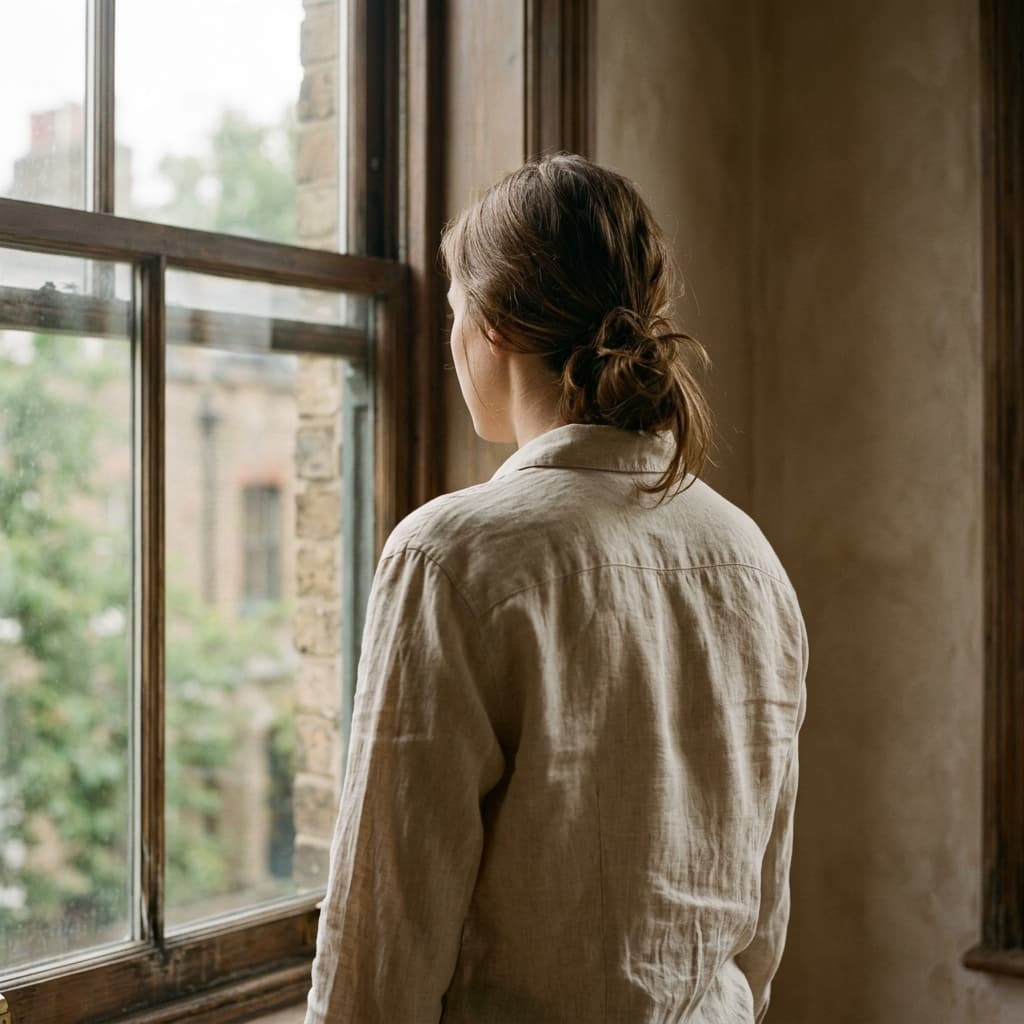
My mother’s shoulders live in my body. I did not inherit them genetically. I absorbed them the way children absorb everything: by watching, by proximity, by years of sitting beside a woman whose upper body carried a particular shape, a forward rounding of the shoulders that drew the collarbones inward and narrowed the chest, as though she were perpetually bracing for a cold wind that was not there. I did not notice this until I was thirty-one, standing outside a store on a Saturday, when my reflection in the glass stopped me with the force of a recognition I had not been looking for.
Those were her shoulders. In my body. Doing her work.
The Body as Archive
We talk about inherited traits as though they travel exclusively through DNA. Eye color, bone structure, the shape of a jaw. But the body inherits posture through a different mechanism entirely: imitation so prolonged and so unconscious that it becomes structural. A child who grows up beside a parent with rounded shoulders does not decide to round their own. The child’s developing neuromuscular system simply maps the pattern it sees most frequently, the way a river does not decide to follow a valley but follows it anyway because the landscape gives it no other option.
Moshe Feldenkrais understood this decades before the neuroscience caught up. He argued that most of what we call posture is not a position the body holds but a habit the body performs, a continuous, unconscious action that repeats so reliably it begins to feel like structure rather than behavior. You do not have bad posture. You are doing a posture, and you learned it from someone, and they learned it from someone, and the chain extends backward through bodies that are no longer alive but whose patterns persist in the bodies that watched them.
This should unsettle you. It unsettles me. The shape of my upper body belongs only partly to me. The rest is a collaboration between my skeleton, my musculature, and the woman who raised me, whose own posture was a collaboration between her skeleton, her musculature, and the woman who raised her. I am carrying weight that predates me. Not metaphorical weight. Actual, measurable, biomechanical weight, distributed across muscles and fascia according to a blueprint I never consented to.
The Politics of Standing Up Straight
Before we go further, I need to say something about the instruction to stand up straight, because it has a history and the history is not neutral.
Stand up straight has been used, for centuries, as a tool of class discipline. Military posture as moral posture. The erect spine as evidence of character. The slouch as evidence of laziness, poor breeding, insufficient self-control. Deportment classes for young women. Posture grades in American schools in the 1950s, where children were photographed in their underwear and scored on their spinal alignment by people who had confused geometry with virtue.
Iris Marion Young, the philosopher whose essay on feminine body comportment remains one of the sharpest pieces of somatic criticism I have read, described how women’s posture is shaped not by anatomy but by a lifetime of being told, implicitly and explicitly, to take up less space. The narrowed shoulders, the crossed arms, the legs pressed together—far from natural positions, they are political ones. They are the body’s accommodation to a world that has opinions about how much room a woman is allowed to occupy.
So when I tell you that my mother’s shoulders live in my body, I am not telling you a simple story about imitation. I am telling you that the forces that shaped her, the particular pressures of being a woman in a particular place at a particular time, traveled through her posture into mine. I did not inherit her shoulders. I inherited the conditions that produced them.
What the Body Learns Without Lessons
I began paying attention to other people’s posture the way a person who has just learned a new word begins hearing it everywhere. I saw my father’s rigid lower back in the way my brother stands at a kitchen counter, both of them locking the lumbar spine as though flexibility in that region were a concession to weakness. I saw a friend’s mother’s tilted head, the perpetual slight lean to the left that signals listening, reproduced exactly in my friend, who tilts the same way when she is concentrating and does not know she is doing it.
Bessel van der Kolk writes about the body as a repository of experience, a living record of everything that has happened to it. I have always read his work with the understanding that he means personal experience: trauma held in the muscles, stress stored in the fascia, the body’s own biography. But I think the record goes further than one life. The body stores its own experience, yes. It also stores the experience of the bodies it grew up beside, the ones it watched most closely, the ones it loved. Your posture holds more than you alone. It is a museum of everyone who held you, fed you, and stood near you long enough for your nervous system to take notes.
This is not a comfortable realization. I do not offer it as one. It means that the body is less sovereign than we like to believe, less entirely our own. It means that the project of inhabiting your body fully, which is the only project I keep coming back to in this journal, must eventually include the question: whose body am I also carrying?
The Practice of Noticing
I am not going to tell you to fix your posture. I have no interest in adding another instruction to the pile of instructions the body has already received without its consent. What I will say is this: the noticing is worth something.
I have started a practice, small and intermittent, of catching my reflection in windows and asking the question before the judgment arrives. Not is this good posture or bad posture, but whose posture is this? Where did this particular arrangement of muscle and bone come from? Who held their body this way in front of me for long enough that my body decided it was the template?
Sometimes the answer is clear. The shoulders are my mother’s. The locked jaw is my own addition, acquired during a period of my life when I was holding words inside my mouth that I was not ready to say. Sometimes the answer is unclear, and the not-knowing is its own kind of information: there are patterns in this body that predate my ability to track them, and they are doing their work whether I understand them or not.
The practice does not change the posture. I want to be honest about that. Awareness is not a correction. My shoulders still round forward in moments of stress, reaching for my mother’s shape the way a hand reaches for a familiar object in the dark. But the awareness creates a space, a fraction of a second, between the pattern and my response to it. In that fraction I am not my mother. I am not her conditions. I am a body noticing its own inheritance, and the noticing, even when it changes nothing structural, changes something about the relationship between me and the weight I carry.
Your posture is not a verdict. It is a history. And histories, unlike verdicts, can be understood without being served.
If this lands for you, try the window practice. The next time you pass a reflective surface, before the aesthetic judgment arrives, ask the other question: whose body is this? You do not need an answer. You do not need to fix what you find. Just let the question exist in the same space as the reflection, and see if the body responds to being asked. If the question feels like too much today, let it go. The reflection will be there tomorrow. So will the shoulders.
