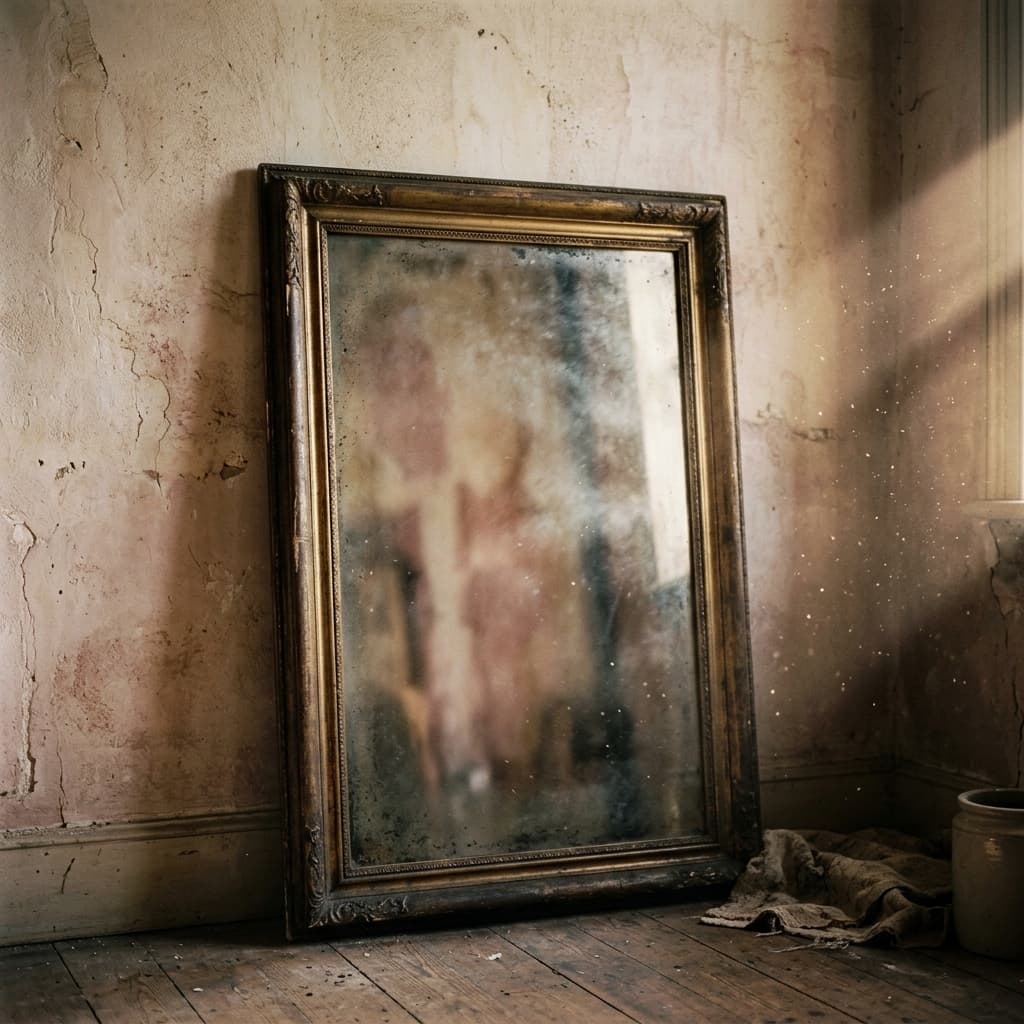
We are the only species that looks at itself this much. Other animals glance, startle at their reflection, occasionally mistake it for a rival. But humans have built an entire infrastructure of self-observation: mirrors in every room, cameras in every pocket, screens that double as reflective surfaces in the right light. We look at ourselves more in a single day than most creatures do in a lifetime. And yet, for all that looking, most of us have no idea what we actually look like from the inside.
The mirror shows a surface. The inside registers a depth. And the distance between those two forms of knowing is where most of our suffering about our bodies lives.
The Observed Body
I remember the first time I understood that my body was something to be looked at. I was eleven, standing in a department store fitting room under fluorescent lights that turned my skin a shade of blue-white I had never seen on a living person. My mother was on the other side of the curtain. I was looking at myself in a three-panel mirror that showed me from angles I had never considered: the side of my jaw, the back of my arm, the place where my shoulders met my neck. I did not recognize myself. Not in the dramatic, cinematic sense. In the quiet, disorienting sense of realizing that the version of me I knew from the inside, the one who ran and climbed and carried things without thinking about what any of it looked like, was entirely different from the version in the mirror.
The mirror version was an object. The inside version was a process. They did not match, and I did not know which one to believe.
The Lived Body
Maurice Merleau-Ponty, the French phenomenologist, spent much of his career distinguishing between what he called the objective body and the lived body. The objective body is the one you can see, measure, photograph, weigh on a scale. It is the body as a thing among other things. The lived body is the body as you experience it from within: the feeling of your feet on the floor, the weight of your own head, the particular way your breath moves when you are about to cry. Far from being an object you observe, the lived body is the medium through which you experience everything else.
Merleau-Ponty argued that we know our bodies primarily through this lived experience, through proprioception, through the constant background awareness of where our limbs are in space, how our weight is distributed, what our muscles are doing. This knowing is so continuous and so foundational that we rarely notice it until it is disrupted: the moment of vertigo when an elevator drops, the disorientation of waking up in an unfamiliar bed, the strange heaviness of a limb that has fallen asleep and temporarily stopped reporting.
The lived body knows things the mirror cannot show. It knows the warmth that pools in the chest during a good conversation. It knows the particular tension in the forearms that means you have been gripping the steering wheel too tightly. It knows the weight of sadness as a dragging sensation behind the sternum, as if gravity has temporarily increased in the region of the heart, arriving well before you could name it.
What We Lost
Somewhere between childhood and now, many of us shifted our primary relationship with our bodies from the lived to the observed. We stopped trusting the body’s internal report and started relying on external evidence: the mirror, the photograph, the number on the scale, the size on the label. This shift is a cultural achievement rather than a personal failing. Billions of dollars and decades of visual media have been invested in teaching us to see our bodies from the outside, to evaluate them by appearance rather than by feel.
The cost of this shift is a peculiar form of grief that most people cannot name. It is the grief of being dispossessed from your own body, of living inside a form that you have learned to experience primarily as a visual object to be managed. You know what your body looks like. You have lost track of what it feels like. The cold tile under your bare feet in the morning, the stretch across the ribs when you reach for something on a high shelf, the deep satisfaction of a yawn that involves your entire face: these sensations are still happening. But the attentional pipeline has been rerouted toward the mirror, and the internal signal gets quieter each year.
This is the grief I mean. Not the grief of having a body that does not match an ideal. The grief of having a body you no longer know how to inhabit.
The mirror can show you what you look like. It cannot show you what you feel like. And what you feel like is the only body you will ever actually live in.
Coming Back Inside
The return happens quietly, without revelation or breakthrough, more like tuning an old radio, slowly, until the static resolves into a signal that was always there. You start by noticing what you are already feeling. The texture of the fabric against your skin right now. The temperature of the air on the back of your neck. The specific pressure of your sitting bones against whatever surface is holding you. These are proprioceptive facts rather than spiritual experiences. But attending to them, even briefly, begins to shift the balance from observed back toward lived.
I have been practicing this return for several years now, and the most honest thing I can say about it is that it is slow. There are days when the mirror still wins, when I catch my reflection in a store window and the outside view eclipses everything the inside knows. But there are also days when I feel my feet on the ground with such clarity that the question of what they look like does not even arise. The warmth of bathwater against my shins. The satisfying ache in my legs after a long walk. The way my ribcage expands when I breathe deeply and the soft click of something releasing in my mid-back. These moments are the body reminding me that it is an instrument, not a portrait. And instruments are known by their sound, not by their shape.
If you are willing, try this: close your eyes for ten seconds and feel your body from the inside. Not what it looks like, not what you think about it, just what it feels like right now. The weight of your hands. The rhythm of your breathing. The temperature difference between the air in your nostrils and the air leaving your mouth. You do not need to like what you find. You do not need to change anything. Just notice that your body has a report to give, and that it has been giving it all along, whether or not anyone was listening. If closing your eyes feels uncomfortable, keep them open and soften your gaze instead. The practice is the same. The invitation is not to look better. It is to look less, and feel more.
