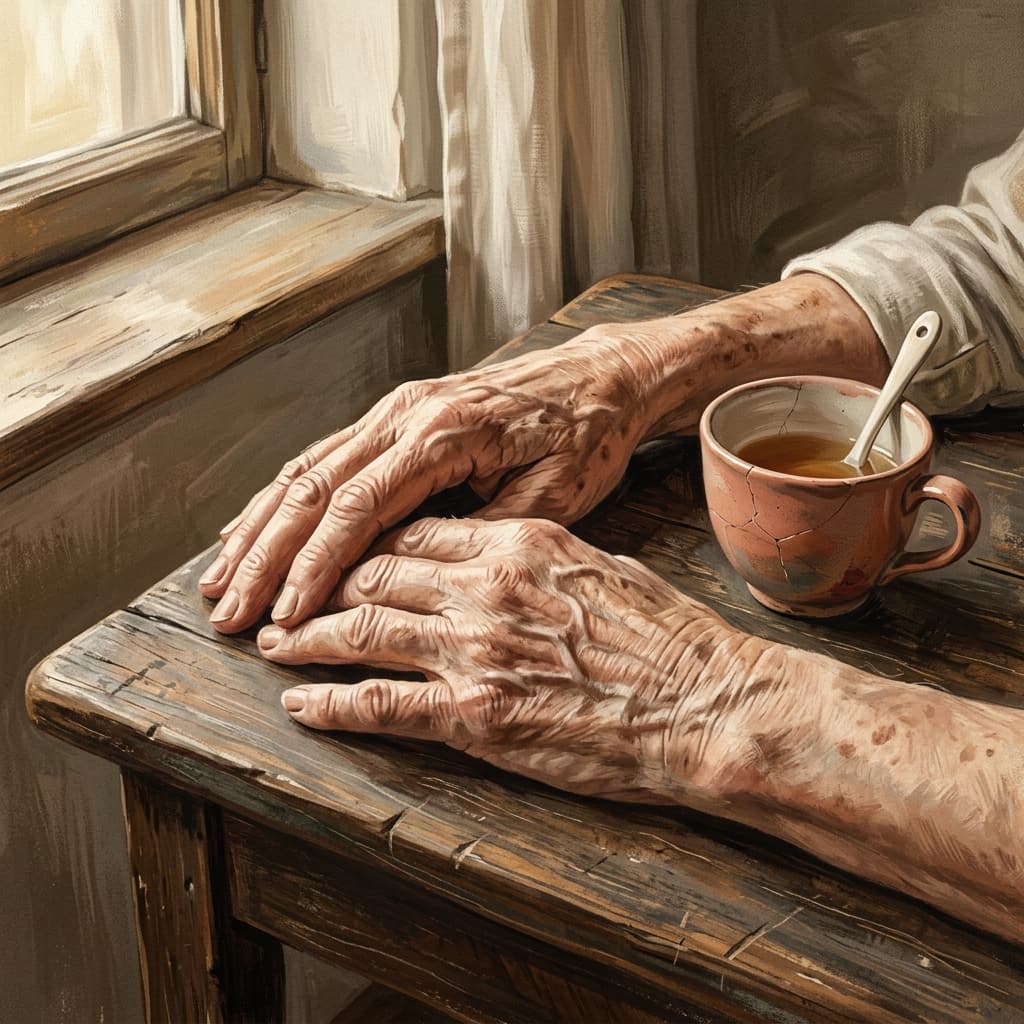
We do not notice the body aging on the day it happens. We notice it afterward, in the small translation errors that accumulate without announcement. The shoulder that protests a movement it used to make without comment. The ankle that stiffens in the night and needs a full minute of careful flexion before it will bear weight in the morning. The skin on the back of your hand that stays tented for a breath longer than it used to when you pinch it. These are not failures. They are dispatches from a body that is becoming something new.
The First Translation
There was a morning, about two years ago, when I reached for a jar on the top shelf and heard a sound I had never heard before: a dry, fibrous pop in my right shoulder, followed by a deep ache that radiated down to my elbow. The jar was not heavy. The shelf was not particularly high. Nothing was wrong, exactly. But something had changed, and the change announced itself with the blunt specificity of a body that does not bother with euphemism.
I stood in the kitchen with the jar in my hand and felt, for the first time, that I was living in a body with a history it had not yet fully shared with me. The shoulder had been aging for years, probably. The cartilage thinning, the tendons losing their elastic confidence, the joint accumulating a quiet record of every reach, every carry, every night spent sleeping on the wrong side. I had not noticed because the body is generous with its silence. It compensates, it adapts, it covers for itself. Until one Tuesday morning, it decides to stop.
What the Culture Refuses to Say
The dominant story about aging in Western culture is a story of loss. You lose flexibility. You lose speed. You lose the taut, efficient body of your thirties and receive, in exchange, a body that bruises more easily and recovers more slowly. The language is all deficit: decline, deterioration, degeneration. Even the clinical vocabulary is structured around what is leaving.
But the Japanese aesthetic philosophy of wabi-sabi, rooted in the acceptance of transience and imperfection, offers a radically different frame. In the wabi-sabi tradition, the beauty of an object is inseparable from its wear. A tea bowl is more valuable for its cracks, not despite them. A wooden floor is more beautiful for its scuffs. Far from damage, the marks of time are evidence of use, of a life fully inhabited.
I do not pretend that applying a ceramic philosophy to a human body is straightforward. My shoulder does not feel like a beautiful tea bowl on the mornings when it wakes me at three with a deep, metallic ache that settles behind the joint like something lodged. But the reframe matters because it changes the question. The deficit story asks: what have I lost? The wabi-sabi story asks: what has this body lived through?
Simone de Beauvoir, in her 1970 work La Vieillesse (translated as The Coming of Age), argued that Western society treats aging as something that happens to other people, a condition we observe from a safe distance until the morning it arrives in our own joints, our own mirror, our own suddenly unfamiliar hands. She was not being metaphorical. She meant the literal shock of recognition: the moment you look down and see your mother’s hands at the end of your own arms.
The Intelligence of Slowing
The body slows because it has learned something the young body has not yet needed to know: that precision matters more than speed. Moshe Feldenkrais, the physicist who developed the Feldenkrais Method of somatic education in the mid-twentieth century, argued that the quality of movement matters more than its range or force. He observed that people who moved slowly and with full awareness used their bodies more efficiently than those who moved quickly and without attention. The aging body, whether it knows Feldenkrais or not, begins to practice something similar. It trades range for accuracy. It chooses the surer path over the faster one.
I notice this in myself on the stairs. I used to take them two at a time, a habit born of impatience and surplus cartilage. Now I take them one at a time, and I place my foot with a care I did not used to need. But the care has given me something the speed never did: I feel the stairs. I feel the cool grain of the wooden banister under my palm, the shift of weight from heel to ball, the specific muscular negotiation my left knee makes on the third step, where the tread is slightly higher than the others. The slower body is a more attentive body. It has to be.
Learning the New Body
The hardest part of aging is the grief of comparison, more than the physical limitation. The body remembers what it used to do, and the memory becomes a measuring stick against which the present body always falls short. I caught myself, last winter, watching a woman in her twenties run for a bus with an ease that made my knees ache sympathetically. She did not think about running. She just ran. And I remembered, with a clarity that felt almost tactile, the sensation of my own legs moving that way: the bounce of the sidewalk under the balls of my feet, the cool air filling my lungs without effort, the total unselfconsciousness of a body that had never yet given me a reason to doubt it.
But the comparison is a trap, because the younger body, for all its ease, was different—calling it better misses the point. It had less information. It had not yet learned the careful negotiation of a morning stretch, the pleasure of a joint that releases after patient coaxing, the deep relief of heat applied to the right spot on a cold evening. The hiss of a heating pad, the specific warmth that seeps through muscle and settles into bone: these are comforts the younger body did not need, and therefore did not know how to enjoy.
The body I am in now is more expensive to maintain and slower to forgive. But it is also more honest. It does not pretend. It does not override its own signals for the sake of appearance or ambition. When it is tired, it says so with an authority the younger version never had. When it is hungry, the hunger has a specificity: not just food, but this food, this warmth, this texture. The palette narrows and deepens simultaneously.
The body does not decline. It translates. The language changes, the grammar becomes more complex, but the conversation between you and your own flesh does not end. It deepens.
If your body is changing in ways you did not expect, if the knees and the shoulders and the mornings are speaking a language you are still learning to read, you do not need to grieve the body that was. It did its work. It brought you here. The body you are in now stands equal to what came before, only recast as the next chapter, written in a hand that is slower, steadier, and more deliberate. You are allowed to take your time reading it. Or not. Some mornings, you are allowed to simply sit with the stiffness and wait for it to pass, without making meaning of it at all.
