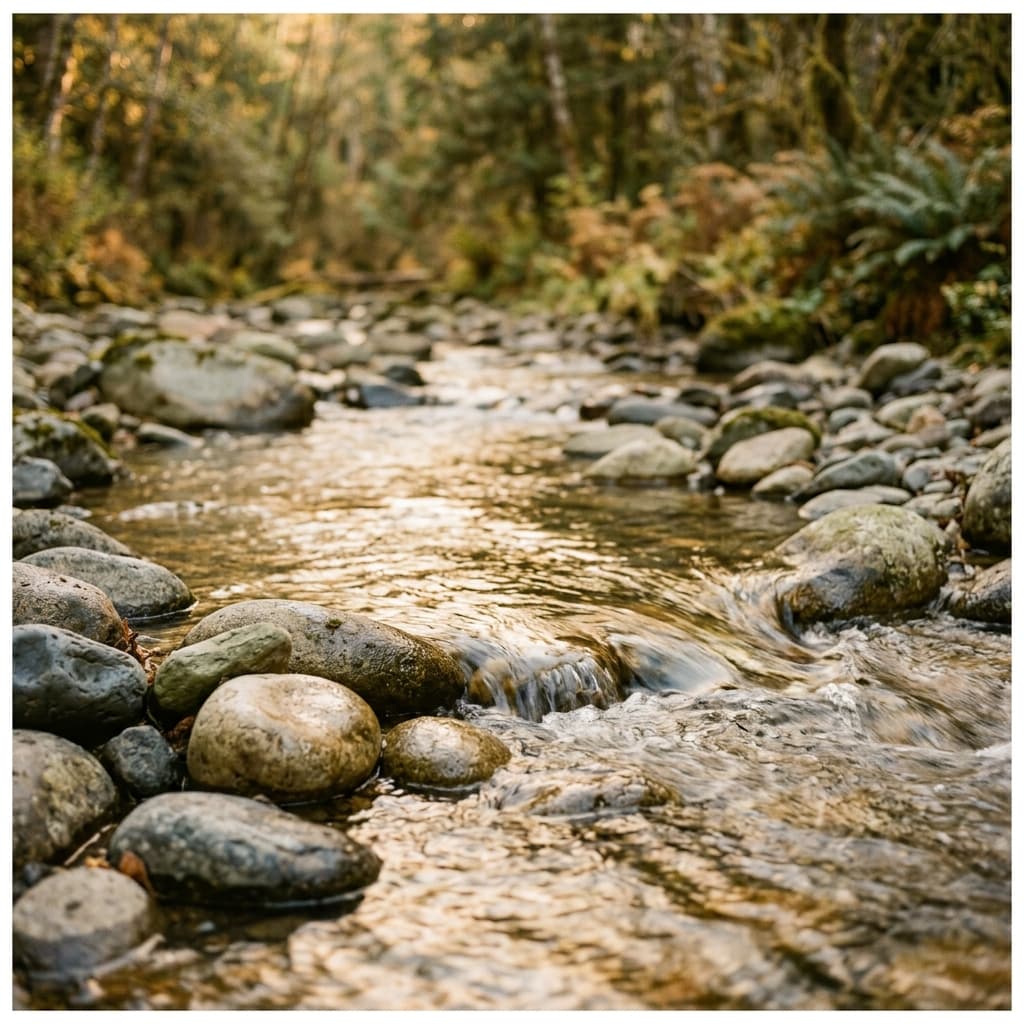
I grew up near a river. Not a grand one, not a river anyone would travel to see. Just a quiet, brown-watered thing that ran along the edge of town, half-hidden by willows and blackberry brambles. I walked beside it most afternoons as a child, not out of any poetic intention, but because it was there and I had time to fill. I did not realize then that I was learning something. The river was teaching me the way water always teaches: without words, without urgency, without caring whether you are paying attention.
Years later, living in a city with no river, I found myself drawn to water in smaller forms. The sound of rain on a window. The weight of a full glass in my hand. The particular calm of standing in a shower with the water too hot, feeling it hit the back of my neck like a conversation that requires nothing from me. I have come to believe that our relationship with water is one of the oldest forms of self-care there is, older than language, older than medicine, older than any wellness practice with a name.
The Principle of Least Resistance
Water does not push through obstacles. It goes around them. It finds the path of least resistance, not because it is weak, but because it is efficient. Over time, that soft persistence outlasts any force. No flood carved the Grand Canyon; patience did, water repeating the same small gesture for millions of years until the rock had no choice but to yield.
I think about this when I find myself forcing outcomes. Pushing through exhaustion. Arguing past the point of usefulness. Gripping a plan so tightly that I cannot feel it crumbling. The water would not do this. The water would find another way, not because it does not care about the destination, but because it trusts that the destination can be reached without breaking itself against the rock.
Water and the Nervous System
There is substantial research on the calming effects of water on the human nervous system. Marine biologist Wallace J. Nichols coined the term blue mind to describe the mildly meditative state that people enter when they are near, in, on, or under water. Brain imaging studies have shown that the sound of flowing water activates the parasympathetic nervous system, lowering cortisol and heart rate. Even looking at the color blue has been associated with reduced anxiety in some studies.
This may be evolutionary. Our ancestors depended on water for survival. A reliable water source meant safety, sustenance, the possibility of staying in one place. It is not a stretch to imagine that our nervous systems still carry that ancient association: water means safe. Water means you can rest here. It is worth noting that many of the most calming environments people describe, the beach, the forest after rain, the sound of a stream, share one element: the presence of water.
Water never arrives in a hurry. It fills every space it enters completely before it moves on, which is either the most patient thing in the world or the most stubborn, depending on the day you are having.
Small Water Rituals
I have built small water rituals into my day. They are not elaborate. In the morning, I fill a glass and drink it slowly, standing by the window, before I do anything else. The water is room temperature. I can feel it move through my chest, into my stomach, a physical reminder that I am here, in a body, beginning a day. It takes thirty seconds. It costs nothing. And it anchors the start of the morning in sensation rather than thought.
In the evening, I wash my hands before I sit down for the night. Not because they are dirty, but because the warm water on my skin feels like a transition. A small ceremony marking the end of doing and the beginning of being. I notice the temperature. I notice the sound. I let the water run a few seconds longer than necessary. Those seconds are the hinge of the evening, when I stop being productive and start being present.
The next time you are near water, in any form, try pausing. Not to do anything with it, not to drink it or wash with it or use it. Just to be near it. Listen to it if it makes a sound. Feel it if it touches your skin. Watch it if it moves. Water has been teaching the same lesson since before there were students: that softness is not weakness, that patience is not passivity, and that the gentlest persistence in the world can, given enough time, reshape stone.
