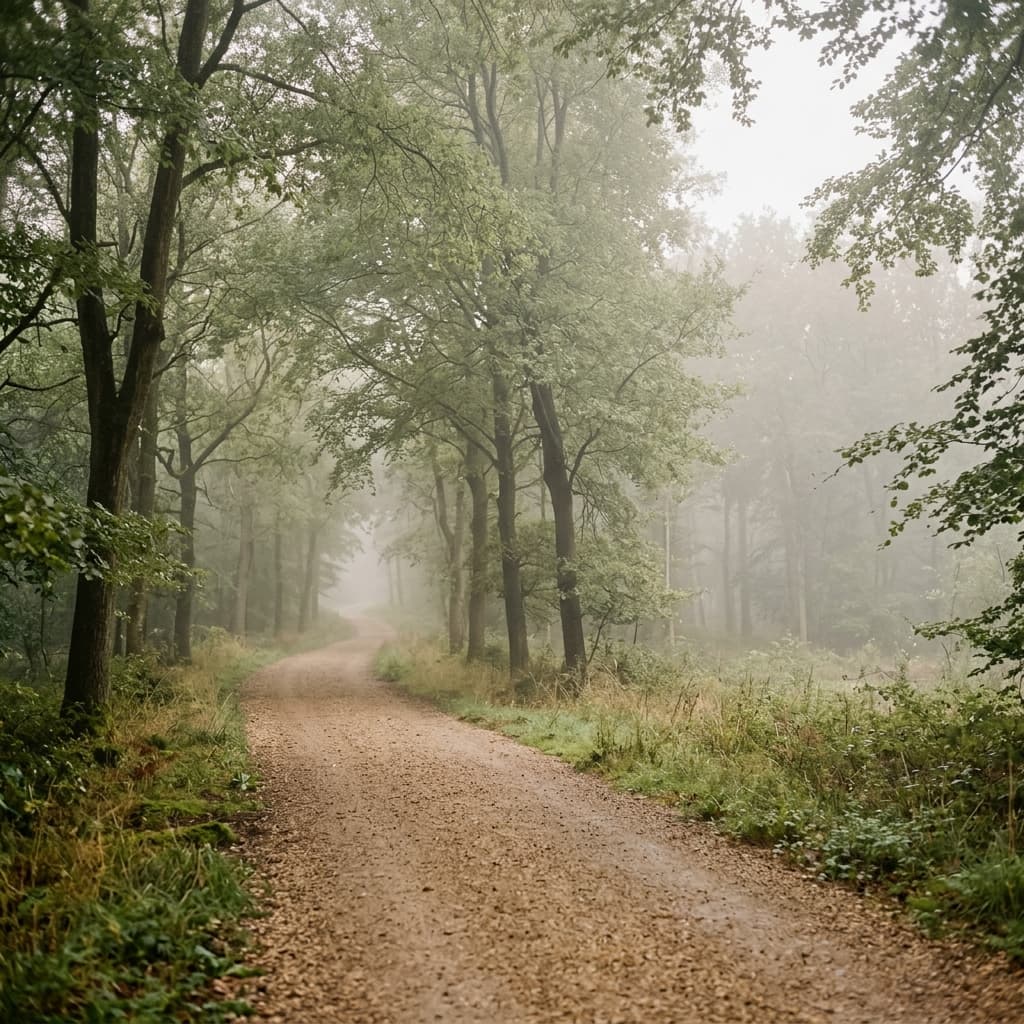
Last Sunday I walked out the front door with no plan. I did not put on shoes for a specific errand or check the weather for a specific route. I put on the shoes that were by the door, the ones with the soles worn smooth on the left heel from the way I drag that foot slightly when I am tired, and I turned right instead of left, which is the direction of the grocery store and the post office and everything else I usually walk toward, and the moment I turned right I felt something change in my body. A settling. A release of the forward lean that I did not know I was carrying until it was gone.
The forward lean is the posture of destination. I have noticed it in myself so many times now that I can feel it arrive the moment I decide where I am going: the weight shifts to the balls of my feet, the stride lengthens, the chin lifts slightly as the eyes focus on the middle distance, scanning for obstacles rather than looking at anything. I am not in the walk. I am passing through it, using the walk as a corridor between two places that matter, and the corridor itself does not matter at all.
But Sunday I had nowhere to be. And when you have nowhere to be, the body does something different. The weight shifts back toward the heels. The stride shortens. The eyes stop scanning and start noticing. I walked three blocks before I realized I was looking at the moss on a stone wall, a particular shade of green so vivid against the gray that it seemed to be generating its own light, and I had been standing in front of it for what felt like a long time, and I did not care.
The Attention That Is Not Work
Rachel Kaplan, the environmental psychologist, spent decades studying what nature does to the human mind. Her central finding was deceptively simple: nature restores attention, not by demanding it but by inviting it. Kaplan called this soft fascination, a quality of engagement where the mind is present but unstrained, the way you attend to moving water or shifting clouds. The opposite of concentration, which is effortful and finite. Soft fascination is effortless and renewable. It does not deplete the cognitive budget. It replenishes it.
What I have found, walking without a destination, is that soft fascination does not require wilderness. It does not require a trail or a park or the dramatic scenery of somewhere special. It requires the absence of a goal. That is all. Remove the destination, and the city becomes as fascinating as a forest, because the filtering mechanism that destination imposes, the filter that sorts the world into relevant-to-my-route and everything-else, switches off, and everything else turns out to be most of the world.
On Sunday, without the filter, I noticed: the sound my shoes made on wet sidewalk versus dry, a difference in pitch I had never registered. The warmth of a south-facing brick wall against my palm when I stopped to lean against it, a pocket of heat that seemed improbable on a gray afternoon. A garden behind a chain-link fence where someone had trained a clematis so thick the fence had disappeared entirely, and from the sidewalk it looked like the flowers were growing out of nothing, suspended in mid-air, purple against the overcast sky.
What the Feet Know
When I walk with purpose, my feet are instruments of efficiency. They land and push off, land and push off, and I am barely aware of them except when my left knee reminds me, on certain grades, that it has an opinion about the pace. When I walk without purpose, my feet become sensors. They report the texture of the ground with a specificity that surprises me every time: the give of wet earth in a park, the unyielding density of old concrete, the slight vibration of a sidewalk above a basement, the uneven seams where one slab has shifted a quarter-inch higher than the next and the sole of my shoe catches it and my weight adjusts and my knee adjusts and the entire body recalibrates around that quarter-inch, all of it below the level of conscious decision.
My daughter, who is nine, walks this way naturally. When we walk to the mailbox together, a trip that should take two minutes, she turns it into fifteen. She steps on every crack. She stops to examine a beetle. She runs her hand along the neighbor’s hedge, dragging her fingers through the leaves so they make a sound like a deck of cards being shuffled. She is not dawdling, though it looks like dawdling to the adult eye. She is in the walk the way a fish is in water: completely, without effort, without the idea that the walk is a container for something else.
I watch her and I see what I have lost: not the capacity for aimless attention, but the assumption that aimless attention is the default. Somewhere between nine and thirty-nine, the default switched. Walking became transit. Looking became scanning. The world became a set of obstacles between here and there, and the space between here and there became dead time, time to fill with a podcast, a phone call, a mental to-do list, anything to make the transit productive. The aimless walk is my attempt to switch the default back, and it works, but it works the way all relearning works: slowly, imperfectly, with the old habit always ready to reinstall itself the moment I forget to choose the new one.
The Walk That Thinks for You
A Stanford study found that walking increases creative thinking by an average of sixty percent, and the effect persists even after you sit back down. The researchers tested treadmill walking and outdoor walking and found that both worked, which means scenery has nothing to do with it. What matters is the rhythmic, bilateral movement of the body, left-right-left-right, a pattern that engages both hemispheres in a way that sitting does not.
I have experienced this enough times to trust it. Problems I have been circling for days at my desk will untangle themselves during a twenty-minute walk, not because I am thinking about them harder but because I am not thinking about them at all. The walk thinks for me. The rhythm loosens whatever was stuck, the way tapping the side of a jar loosens the lid, and the solution arrives not as an insight but as a sensation: a releasing of the knot in my thinking that I feel first in my chest and then, a few seconds later, in my mind.
But this only works when the walk has no destination. The moment I assign one, the mind switches to planning mode: the route, the time, the errand at the other end. The walk becomes a corridor again. The creative loosening stops. The body returns to forward lean and efficient stride, and the ground beneath my feet goes silent, because I have stopped listening.
A walk without a destination is not wasted time. It is the time when the body and the mind are finally doing the same thing, moving through the world at the same pace, noticing the same things, unhurried and unburdened by the need to arrive.
What I Have Not Resolved
I want to be honest about the difficulty. Aimless walking is simple in description and hard in practice, because the culture I live in does not value aimlessness, and I have absorbed that culture so thoroughly that an unproductive hour feels like a debt I am accumulating against my future self. Twenty minutes into a walk with no destination, the old reflex arrives: I should be doing something. I should at least be listening to something. I should be walking faster, covering more ground, earning the time.
I do not know how to fully silence this reflex. Some days I manage. Some days the reflex wins and I put in earbuds at minute twelve or reroute toward the store to justify the outing. I do not think this makes the practice a failure. I think it makes the practice a practice: something you return to rather than something you perfect, a direction rather than a destination, which is, of course, the entire point.
Last Sunday’s walk lasted forty minutes. I covered maybe a mile. I saw the moss, the clematis, a cat sleeping in a window with its paw pressed against the glass. I felt the warmth of the brick wall and the uneven sidewalk seams under my shoes. I noticed the moment, around minute twenty-five, when my breathing deepened without my choosing it, and the noise in my head, the low-grade hum of tasks and worries and plans that accompanies most of my waking hours, dropped in volume by a degree I could feel but not measure.
I came home with nothing accomplished. My shoes were wet. My left knee ached from a grade I had not anticipated. And something in my chest felt different, more open, as if the walk had physically rearranged the space inside my ribs. I do not know how to explain this. I do not know if it matters that I cannot explain it. The body does not require explanation. It requires the walk.
If you can, try this: take fifteen minutes and walk with no destination. No earbuds, no planned route, no step count. Turn whichever way feels interesting. If you use a wheelchair or have limited mobility, this can be any form of moving through space at your own pace. The walking itself is beside the point. What counts is the willingness to go nowhere, to let the feet lead, to notice what the ground feels like when you stop treating it as a surface to cross and start treating it as a surface to meet. If something catches your eye, stop. If nothing catches your eye, keep going. The walk does not need to produce anything. That is the whole practice.
