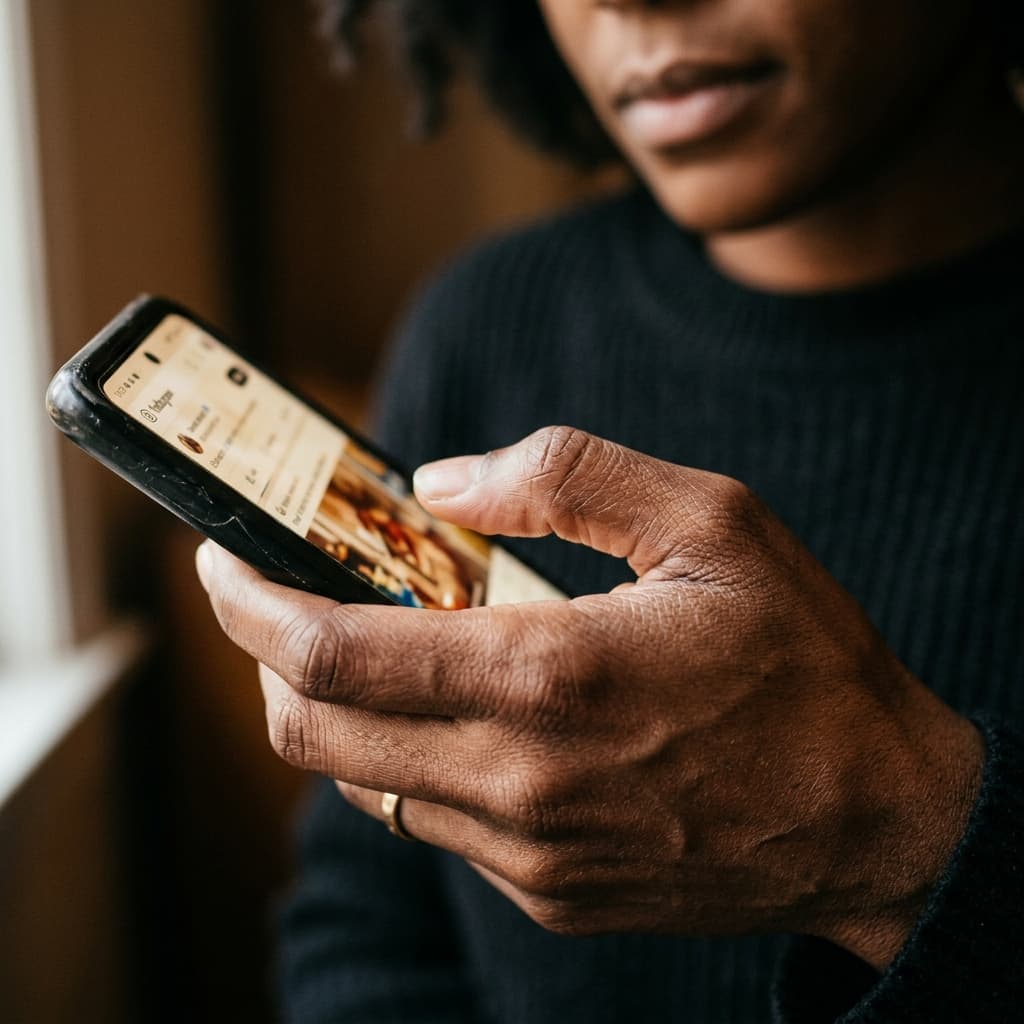
You hold your phone like it owes you money. I hold mine like a small animal I am trying not to startle. The person next to me on the bus holds hers with two hands, thumbs poised, like a concert pianist approaching a very small keyboard. The man across the aisle holds his at arm’s length, squinting, as though the phone has said something offensive and he is deciding whether to engage.
None of us has chosen our grip. The grip chose us.
Fragment: The Chin
The chin drops first. Before the thumb swipes, before the eyes focus, the chin descends by approximately twenty degrees, tilting the head forward, compressing the cervical vertebrae, adding roughly ten kilograms of effective weight to the muscles at the back of the neck. The muscles accept this weight without complaint because they have been accepting it forty-seven times a day, on average, for the last decade, and the muscles no longer consider the weight unusual. It is simply what the neck does now. The neck has been redesigned by a rectangle.
I find this hilarious and horrifying in equal measure. A six-inch screen has restructured the human spine.
Fragment: The Thumb
The thumb was not designed for this. The thumb was designed for gripping, pinching, opposing the other fingers in the action that separates us from most of the animal kingdom. The thumb was designed for tools. It was not designed for the particular lateral swiping motion that the modern thumb performs approximately 2,617 times per day, a number I did not make up, a number that someone counted, a number that the thumb itself is too busy swiping to appreciate.
The thumb is the most overworked digit in human history, and it does not even get a union.
There is a condition now. They call it texting thumb. The tendons of the thumb become inflamed from repetitive lateral motion, which is the thumb’s way of filing a formal complaint with the body’s HR department. The complaint is noted. The swiping continues. The thumb has learned that HR is not particularly responsive.
Fragment: The Grip Styles
I have been watching people hold their phones, which is either field research or a peculiar hobby, depending on your generosity. I have identified several grip styles, and each one tells a story the gripper is not aware of telling.
The cradle: the phone rests in the palm, fingers loosely wrapped, thumb free. This is the grip of browsing, of idle scrolling, of the body in a state of low alertness. The cradle says: I am here but I am not here. I am present to this device in the way I am present to background music. The muscles are relaxed. The jaw is soft. The breathing is shallow but untroubled.
The clamp: the phone is gripped tightly, fingers white at the knuckles, thumb pressing harder than the screen requires. This is the grip of waiting. Waiting for a text that has not arrived. Waiting for news. Waiting for the read receipt that will confirm the message was seen and the silence that follows is therefore a choice. The clamp says: this device holds something I need and I am not letting go until it gives it to me. The jaw mirrors the grip: tight, set, clenched around its own waiting.
The shield: the phone is held with the screen pressed against the chest or turned face-down on the table. This is the grip of someone who does not want the phone to see them, or does not want to see the phone, or both. The shield says: I know there is something on this screen I am not ready for. The body protects itself from information the way it protects itself from cold: by turning away, by covering the exposed surface, by reducing the area available for contact.
Fragment: The Phantom
Sherry Turkle writes about the way devices become extensions of the self, blurring the boundary between body and object. I hold this observation at a slight angle, because I think it understates the case. The phone has not become an extension of the self. It has become a limb. The body treats it as such. The phantom vibration, that twitch in the thigh when the phone is not even in your pocket, is the body’s version of a phantom limb: the nervous system expecting input from a body part that is not there.
The body has incorporated the phone into its schema. The phone has a place in the body map, filed somewhere between the right hand and the chest, and when it is absent, the body registers the absence the way it would register a missing finger: with a low, persistent sense that something is wrong, something has slipped out of place, something needs to be retrieved before the body can feel complete.
This is either a marvel of neural plasticity or a catastrophe of dependence, and I have not decided which.
Fragment: The Face
The face you make at your phone is not the face you make at people. It is a private face, a face for an audience of one, unguarded and unperformed. The brow furrows without social consequence. The lip curls without anyone to misread it. The micro-expressions flow freely because the phone does not judge them, does not mirror them, does not respond to them with micro-expressions of its own.
Watch someone on a train looking at their phone. The face is a weather system: clouds of irritation, bursts of amusement, the slow sunset of boredom. None of it is performed. All of it is real. The phone face is the body’s most honest face, which is ironic, given that it is the face directed at the least human thing in the room.
The phone has a place in your body map. When it is missing, the body registers the absence like a phantom limb. The grip you did not choose tells the story you are not aware of telling.
The next time you pick up your phone, pause for half a second before you look at the screen. Notice the grip. Cradle, clamp, or shield? Notice the chin: has it dropped? Notice the thumb: is it already in position, poised, ready to swipe before the eyes have even focused? You do not need to change anything. Just notice that the body has a relationship with this object that the mind has never examined, and the relationship is written in the muscles of the hand, the angle of the neck, the expression on the face you show to no one.
