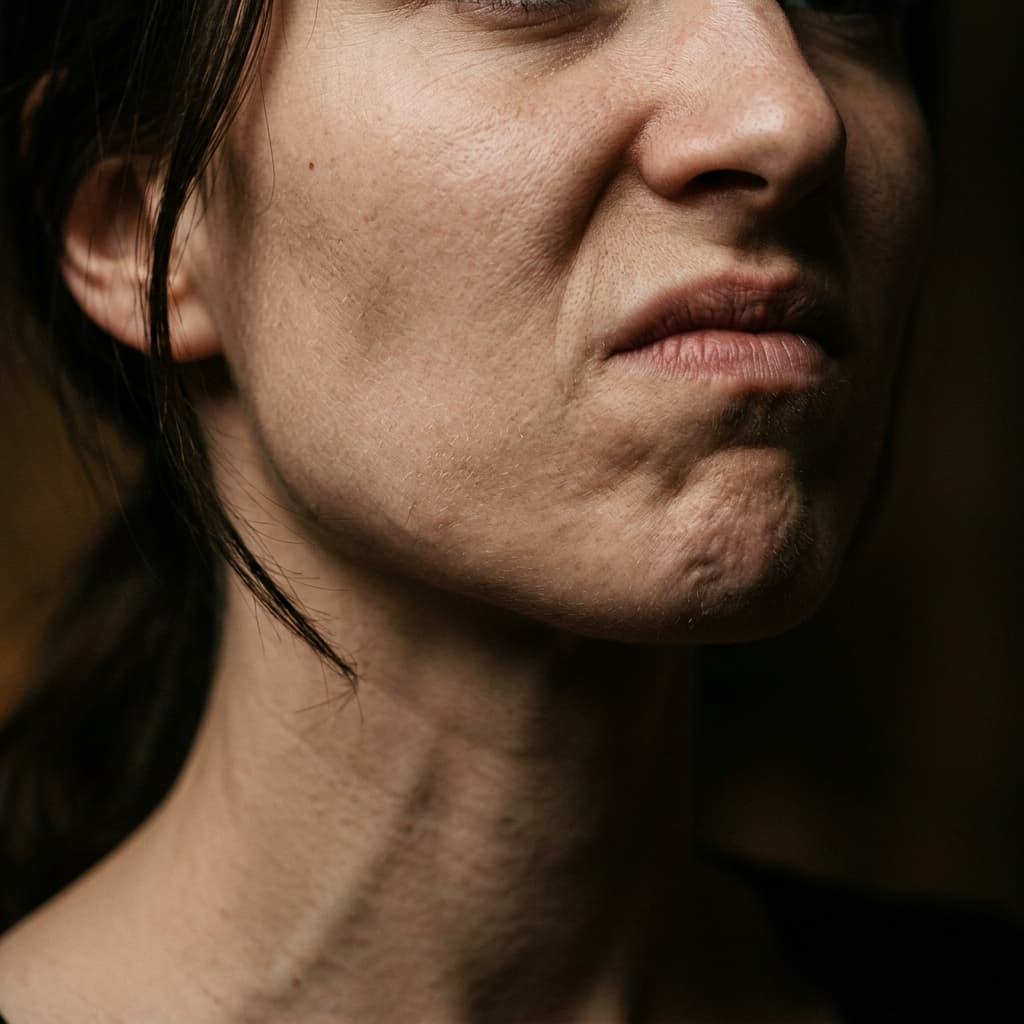
I have a sentence I have been carrying in my mouth for four months. It sits behind my back teeth, on the left side, where I grind at night. The dentist sees the evidence every six months: the enamel wearing thin, the jaw muscle overdeveloped from nocturnal effort. She asks if I am stressed. I say probably. She makes a note. We do not discuss what the mouth is doing in the dark.
The sentence is seven words long. It is addressed to a specific person. It is true and it is necessary and I have not said it.
Where Words Live Before They Are Spoken
Far from a passive opening, the mouth is a gate. It has muscles whose sole purpose is to open and close, and these muscles are among the most tightly innervated in the body, meaning they have a disproportionately large representation in the motor cortex. The brain devotes an extraordinary amount of real estate to the lips, the tongue, the jaw, the soft palate. We are, neurologically speaking, mouth-forward creatures. The mouth is where the inner life meets the outer world, and the body guards this border with the seriousness of a customs officer who has seen too much.
When a sentence forms in the mind but does not leave the mouth, the body does not simply discard it. The body holds it. The muscles of articulation, the tongue, the lips, the jaw, begin the micro-movements of speech and then arrest them. Peter Levine calls this thwarted motor action: the body initiating a response and then freezing mid-execution. The freeze is a conflict rather than a decision. The impulse to speak and the impulse to withhold are both active, both muscular, both consuming energy, and the mouth becomes the site where they meet.
This is what grinding is. Not stress. Conflict. Two forces using the same muscles for opposite purposes, and the muscles, unable to resolve the contradiction, rehearsing it all night.
The Weight of the Unsaid
I keep a rough inventory of the things I have not said. Not all of them. Just the ones the body is still holding. I know which ones those are because the body tells me. The throat tightens when I think of them. The jaw sets. The tongue presses against the roof of the mouth, which is the body’s way of sealing the exit.
There is the sentence for the person I love. Seven words. Four months.
There is the sentence for the colleague who said something six weeks ago that landed wrong. Fourteen words. I have rehearsed it in the shower so many times that the hot water runs out before the sentence does.
There is the sentence for my mother. I do not know how many words this one is. It keeps changing shape. It has been in my mouth for years, shifting between my molars like a stone I cannot swallow and will not spit out.
None of these sentences are cruel, which is beside the point. They are stuck because they are true, and the truth, in the mouth, has a weight that fiction does not. Fiction is light. Fiction slides out easily, polished and frictionless. Truth catches. It snags on the soft palate. It drags against the teeth. The difference is the resistance.
The Cost of Holding
The masseter, the primary muscle of the jaw, is the strongest muscle in the body by weight. It can generate up to 200 pounds of force on the molars. This is the muscle that holds the words back. This is the muscle that works all night, chewing on sentences it cannot digest, grinding the enamel down to the evidence that the dentist sees every six months and politely calls stress.
But the cost extends beyond the jaw. The throat tightens. The neck stiffens. The shoulders rise. The whole upper body enters a posture of containment, drawing inward, closing around the thing that the mouth will not release. I have noticed that on days when the unsaid sentences are particularly heavy, my voice changes. It gets smaller. Not quieter, exactly, but narrower, as though the throat has reduced its aperture to prevent anything unauthorized from escaping.
The body is spending energy to hold these words inside. Real, measurable, caloric energy. The muscles are working. The nervous system is monitoring the gate. The whole apparatus of speech is engaged not in speaking but in not-speaking, which is its own form of effort, its own form of exhaustion. Silence is speech suppressed, and suppression is labor.
What Maggie Nelson Knows
Maggie Nelson writes about the unsayable with a precision I envy. She describes the space between knowing a thing and saying it as a space with weather, its own temperature, its own pressure system. I hold this idea at an angle, because my experience of the unsayable is less meteorological and more muscular. For me, the unsaid does not create weather. It creates tension. A specific, located, physical tension in the muscles of the mouth, the jaw, the throat, that is indistinguishable from the tension of a muscle that is working but producing no visible movement.
I think this is what makes unsaid things so tiring. They are isometric. The muscle contracts, holds, contracts, holds, but nothing moves. No word exits. No sentence lands. The effort is invisible and continuous, and the body, which was designed for dynamic action, for contraction and release, contraction and release, finds the static hold unbearable in the way that holding a heavy bag with an outstretched arm is unbearable: not because the weight is too great, but because the muscle never gets to put it down.
What I Have Not Figured Out
I want to tell you that the answer is to say the thing. I want to tell you that the body releases when the words are released, that the jaw unclenches, that the shoulders drop, that the throat opens. And I think that is sometimes true. I have said difficult things and felt the body soften afterward, the way a muscle softens after a cramp. The release is real.
But I have also said difficult things and felt the body tighten further, not because the saying was wrong but because the saying was incomplete, because the truth in the mouth was only part of the truth, and the part that remained was heavier for the part that left. Sometimes saying the thing creates a new unsaid thing, and the jaw finds new material to grind on.
I do not know how to resolve this. I am telling you honestly. The sentence for the person I love is still behind my back teeth. The sentence for my mother is still shifting shapes. The shower is still the place where I rehearse the fourteen words for my colleague, and the hot water still runs out, and I still do not say them the next day.
The mouth holds. The jaw works. The enamel thins. The dentist makes her note.
Silence is not the absence of speech. It is speech held in the muscles of the mouth, working all night, wearing the teeth down to the evidence of everything you have not yet said.
I am not going to tell you to say the thing. Sometimes the thing is not ready. Sometimes you are not ready. Sometimes the readiness matters more than the release. But if you notice your jaw tonight, if you catch it clenching around something that has no name yet, see if you can soften it by a fraction. Not to let the words out. Just to let the muscle rest, for a moment, from the work of holding them in. The words will still be there in the morning. The jaw deserves the pause.
