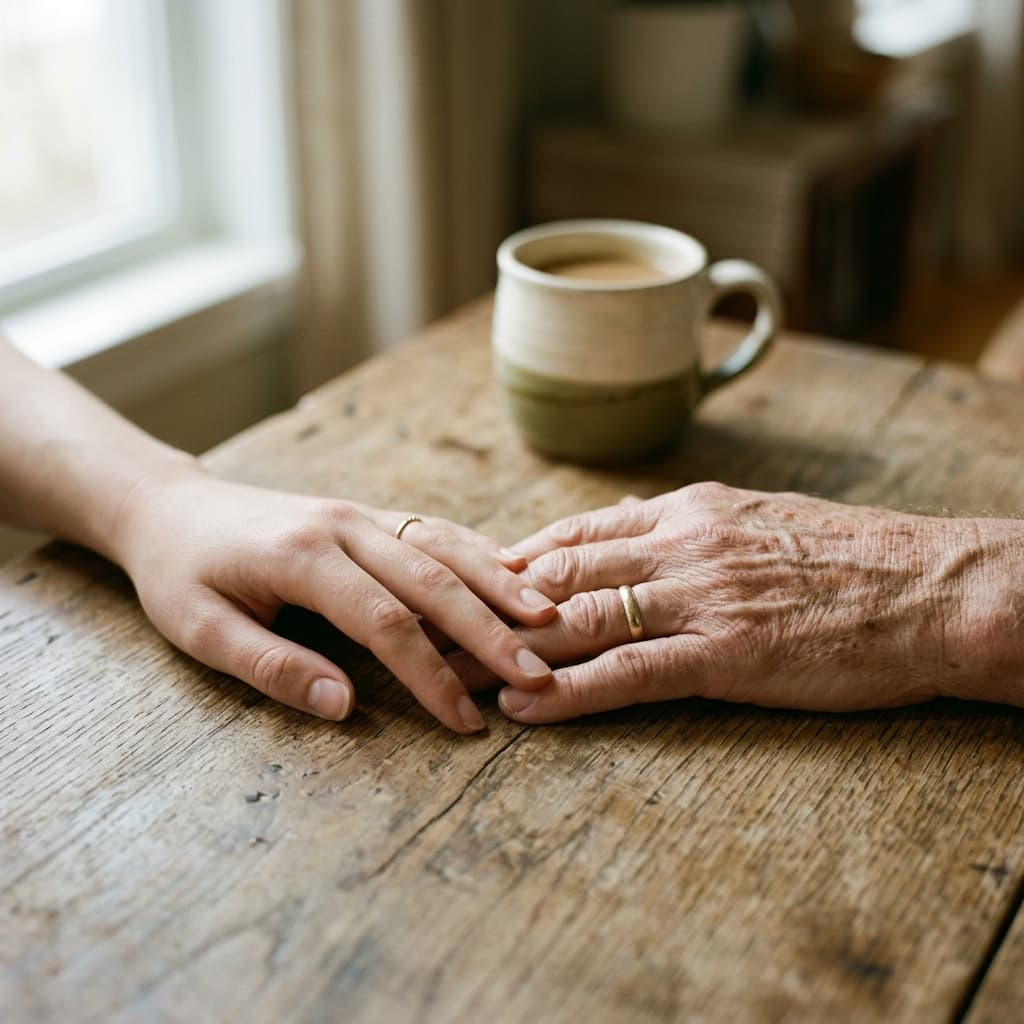
If the body I had at twenty could write a letter to the body I have now, it would begin with an apology for all the things it took for granted. The ability to sleep four hours and function. The knees that bent without commentary. The back that held any posture for any duration without filing a complaint. The body at twenty did not know it was young. That was its genius and its waste.
If the body I have now could write back, it would begin with a correction. Not all those things are gone, it would say. Some of them just changed address.
Then: The Hands
At twenty, my hands were fast and unthinking. They typed without looking. They opened jars without strategy. They held cups of coffee at careless angles, trusting the grip, trusting the wrist. The nails were bitten short. The knuckles were unlined. The right index finger had a callus from writing in longhand, which I did constantly, filling notebooks with a pressure that dented the page beneath.
The hands at twenty did not know they were beautiful. Beauty was something they assumed happened elsewhere, above the wrist, in the face. The hands were tools. They opened, gripped, released. They did not ask for attention.
Now: The Hands
At thirty-nine, my hands are slower and more specific. They know the exact pressure needed to crack an egg one-handed (a skill the twenty-year-old hands did not have). They know how to hold a child’s hand without squeezing, which is a calibration so fine it took years to learn. They open jars with a particular technique: left hand braces, right hand twists, and there is a micro-adjustment at the point of resistance that the young hands never needed because the young hands were stronger.
The callus is gone. The writing happens on a keyboard now. But the right index finger still presses harder than the others, as if the hand remembers the pen and compensates for its absence.
Drew Leder writes about how the body disappears from awareness during smooth functioning. The young body is the ultimate disappearing act: so reliable that it becomes invisible. You do not notice a knee until it complains. You do not appreciate a grip until it weakens. The body at twenty is experienced precisely by not being experienced at all.
Then: The Morning
The body at twenty woke up all at once. The eyes opened and the body was ready, as if someone had flipped a switch. There was no warm-up period, no slow negotiation with the mattress. The feet hit the floor and the day began. Mornings ignited. There was nothing gradual about them.
Coffee was a preference, not a requirement. I drank it because I liked the taste, not because my central nervous system had placed a standing order. The morning body was available immediately: legs ready, back straight, eyes focused. The body at twenty did not need to be coaxed into the day. It arrived on its own terms, which were always prompt.
Now: The Morning
The body at thirty-nine wakes in stages. First the awareness: I am in a bed. Then the inventory: left shoulder, stiff. Lower back, unremarkable. Right knee, the one that predicts weather, reporting mild displeasure. Then the negotiation: five more minutes, says the body. Two more minutes, says the schedule. We settle on three, which is neither a victory nor a defeat but a compromise so practiced it no longer requires words.
Coffee is no longer optional. It is the bridge between the body that is lying down and the body that will eventually stand up. The first sip lands in the stomach like a small announcement. The second sip travels further, warming the center of the chest. By the third, the eyes have decided to participate.
Far from being less capable than the morning body at twenty, the morning body at thirty-nine is more informed. It knows things the young body did not bother to learn. The stiff shoulder will loosen by 9 a.m. The knee’s complaint will fade once the joint warms up. The lower back is fine; it was fine yesterday, too, and will be fine tomorrow. The inventory is not a list of failures. It is a weather report, and the weather is mostly fair.
The body at twenty was experienced precisely by not being experienced at all. The body at thirty-nine is experienced by being noticed, cataloged, and, on good days, appreciated.
Then: The Run
At twenty, running was a given. The legs had a gear for it, an automatic setting that engaged when the feet started moving. The lungs opened without resistance. The heart rate climbed and the body accommodated it without alarm. I ran because the body wanted to run, and the wanting was so uncomplicated that it did not feel like a decision.
I ran in the wrong shoes. I ran without warming up. I ran in ninety-degree heat and in rain and once, memorably, in snow, and the body tolerated all of it with the indifference of a machine that has never heard of a service interval.
Now: The Run
At thirty-nine, running is a negotiation. The body says: the left Achilles tendon would like to be consulted. The warm-up counts as a prerequisite now, like a meeting agenda that must be circulated before anyone shows up. The first mile is a lie, always harder than it should be, the body complaining in a language of reluctance. The second mile is the truth: the body finding its rhythm, the breath settling, the feet striking the sidewalk with a cadence that feels earned rather than given.
The run at thirty-nine is shorter than the run at twenty. It is also better. Better without being faster or longer or more impressive. Better the way a second draft is better than a first: less material, more precision, every word in the right place. The body at thirty-nine does not have the endurance of the young body. It has the editing skills.
The Correspondence
Simone de Beauvoir wrote about aging as a shock of recognition: the moment when the body in the mirror stops matching the body in the memory. She described it as a betrayal, and I understand why. The young body lives in a permanent present tense. The aging body lives in a permanent past tense, always comparing, always noting what has changed. The gap between the two is where grief lives.
But I wonder if de Beauvoir’s framing, beautiful as it is, misses something. The conversation between the two bodies carries loss, but it carries translation too. The body at twenty knew things it could not articulate. The body at thirty-nine can articulate things it no longer does as easily. Between them, something is being communicated that neither could manage alone.
The young body ran without thinking. The current body thinks about running and then runs, and the thinking makes the running different: more deliberate, more curious, more aware of the foot’s angle at impact. The young body slept without effort. The current body negotiates with sleep, and the negotiation has taught it things about rest that effortless sleep never could.
The letter, if it were real, would not end with a conclusion. It would end mid-sentence, the way conversations between two versions of the same person always do. One body trails off. The other picks up where it left off, in a different hand, at a different speed, on the same page.
