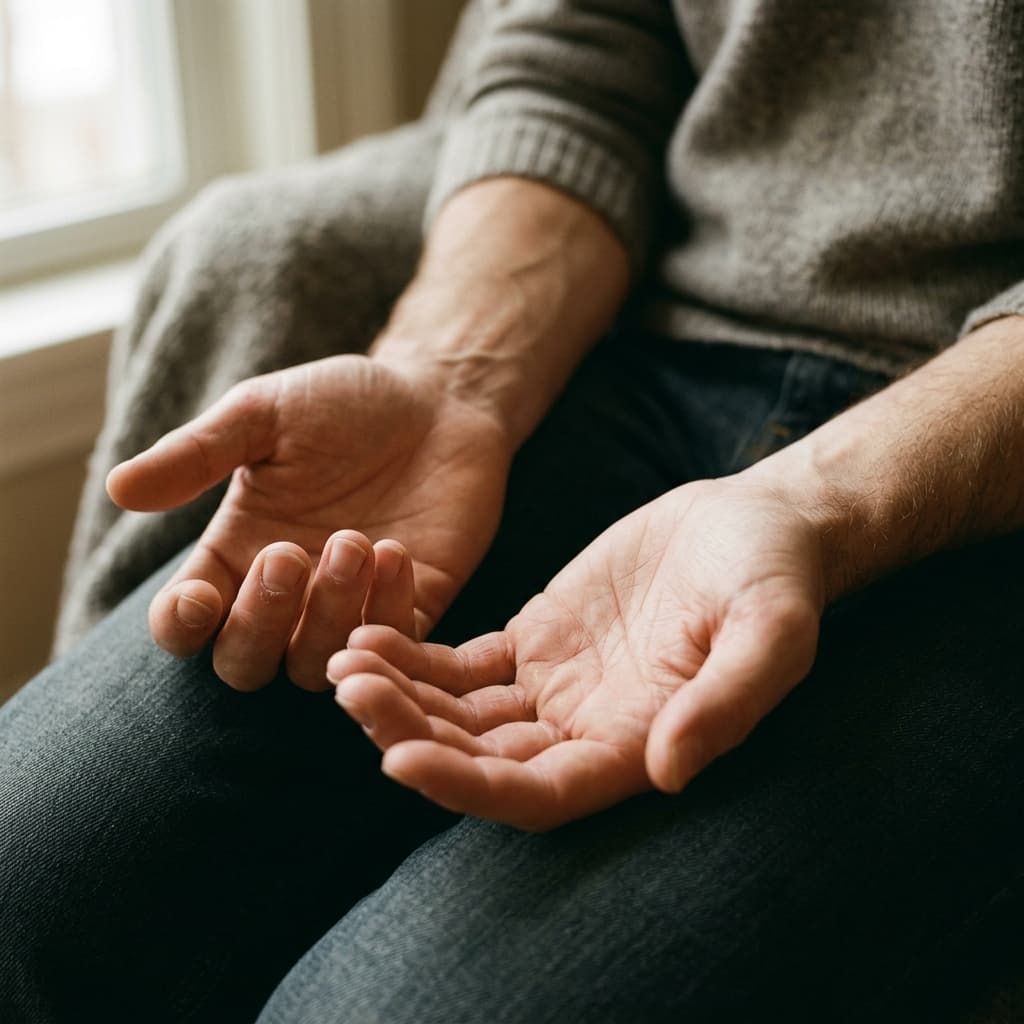
The hands are the last part of the body to agree to rest, because the hands have been told their entire lives that still hands are idle hands, and idle hands are the devil’s playground, and so the hands play, constantly, with anything within reach, because if they are playing they are not idle and if they are not idle they are safe from whatever it is the devil does with playgrounds.
I say this with tenderness, because the hands did not choose this. The hands were taught.
What the Hands Do
Watch your hands the next time you sit down with nothing to do. Not the sitting-down-with-a-book nothing, which is structured nothing. Not the sitting-down-with-a-phone nothing, which is disguised productivity. The actual nothing. The sitting on a bench in the park with no device, no book, no task, no excuse for the hands to hold.
The hands will begin to search. They will find the seam of your trousers and run a thumb along it. They will find a thread on your sleeve and worry it. They will find each other and begin the elaborate choreography of fidgeting: interlacing, unlacing, drumming on the thigh, picking at a cuticle, rubbing a thumbnail across the pad of the index finger in that particular circular motion that produces no result and consumes no material and serves no purpose except to give the hands something, anything, to do.
The hands are panicking. Quietly, politely, without making a scene, the hands are in a state of low-grade panic, because they have been asked to do nothing and nothing is the one thing they have never been trained for.
The Training
The training began early. The hands were given crayons, then pencils, then keyboards. The hands were praised for making, building, writing, typing, producing. The hands received gold stars and good grades and promotions and pay rises, all conditional on the hands continuing to move, continuing to produce, continuing to convert time into output. The still hand received nothing. The still hand was told to find something to do.
Jenny Odell writes about the radical act of doing nothing in a culture that equates productivity with worth. She is writing about attention, about refusal, about the political dimensions of rest. But I keep returning to the hands, because the hands are where the refusal lives or fails to live. You can decide to do nothing. You can sit on the bench. You can put the phone away. But the hands will betray you. The hands will fidget and pick and drum and worry, because the hands have not received the memo that doing nothing is a choice. The hands still believe that stillness is failure.
The hands are the body’s middle managers: loyal to the old regime, slow to adopt new policy.
The Spiral: Coming Back to the Hands
I keep returning to my own hands, so I will stay with them. My hands, right now, as I write this, are doing the one thing they know how to do with competence and confidence: they are producing. They are typing. They are converting thought into output. They are behaving. Later, when the writing is done and I close the laptop and sit with nothing, the hands will lose their composure. They will reach for the phone. They will reach for the mug, even if the mug is empty. They will reach for the pen on the desk, not to write but to click, because clicking is something and something is better than nothing and better is the only metric the hands understand.
I have tried putting my hands in my lap, palms up, the way the meditation teachers suggest. Open hands, receiving hands, hands that are not grasping or producing or holding but simply existing, palm-up, in the lap. The hands tolerate this for approximately eleven seconds. I have counted. Eleven seconds of open, resting, unproductive stillness, and then the thumb begins its circuit, rubbing the pad of the index finger, the tiny circular motion that is the hands’ minimum viable product: not quite doing something, but not quite doing nothing either. A compromise. A negotiation between the rest the body wants and the productivity the hands have been conditioned to deliver.
What Rest Looks Like for Hands
Tricia Hersey, whose work on rest as resistance I hold with deep respect, argues that rest is not a reward for productivity but a right that exists independently of output. Rest is not earned. Rest is claimed. The body does not need to produce in order to deserve stillness. This is revolutionary thinking for a culture that treats busyness as a virtue, and it is especially revolutionary for the hands, which are the culture’s most visible enforcers of the busyness doctrine.
I want my hands to rest. I want them to lie in the lap, palms up or palms down or any way they choose, without the fidgeting, without the searching, without the low-grade panic of enforced idleness. I want the hands to experience stillness not as unemployment but as presence. Not as the absence of doing but as the experience of being. I want the hands to know that they are not their output.
But the hands do not know this yet. The training runs deep. The muscles of the fingers carry the memory of every keystroke, every stir, every swipe, every productive motion that was rewarded with approval, and the muscles do not distinguish between the approval and the motion. They are fused. To rest the hands is to withdraw the approval, and the hands, which have been earning approval since they first held a crayon, do not know who they are without it.
The Spiral Returns
I am back with my hands. I am back because this is the spiral, and the spiral does not resolve, it deepens. My hands are typing again. They are, in this very sentence, doing the thing I am writing about them not being able to stop doing. The irony is not lost on me. The irony is, in fact, the hands’ way of proving their point: even the examination of their restlessness requires them to work. Even the essay about stillness is a product.
I think the gentleness lives here, in the not-resolving. The hands are not going to learn rest in a single afternoon or a single essay or a single meditation. The hands are going to learn rest the way they learned everything else: slowly, through repetition, through the patient accumulation of seconds where they were still and the world did not end and the approval did not withdraw and the value of the person attached to them did not diminish.
Eleven seconds at a time. That is what the hands can offer right now. Eleven seconds of palms up, of stillness, of being instead of doing. Eleven seconds is not nothing. Eleven seconds is the hands’ first tentative step toward a version of themselves that does not need to earn their place.
The hands are the body’s last outpost of hustle culture. They fidget not from restlessness but from training, because still hands were never praised, and the hands do not yet know who they are without the approval of motion.
If you can, right now, put your hands in your lap. Palms up or palms down, whichever feels less alarming. Set no timer. Make no commitment. Just see how many seconds the hands can be still before they begin their search for something to do. Notice the search without judging it. The hands are not failing at rest. They are learning rest, and learning is allowed to be slow, and slow is allowed to include fidgeting, and the fidgeting, far from a defeat, is the hands’ honest negotiation with a stillness they have never been told is safe.
