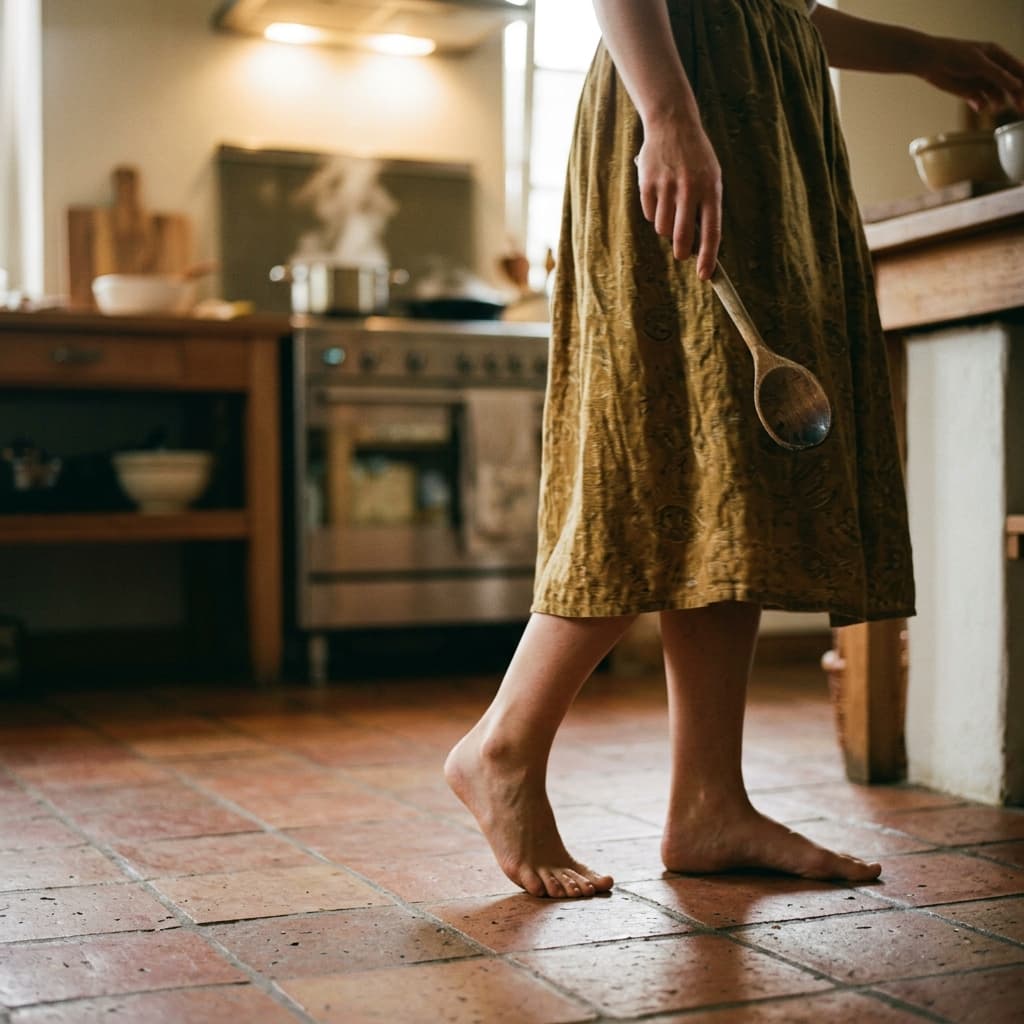
Last Thursday, I caught myself doing something in the kitchen that I can only describe as a hip-led celebration of the lentil soup being ready. It was not choreographed. It involved a wooden spoon, a weight shift from my left foot to my right, and a shoulder roll that I would deny under oath. The song on the radio was not even particularly good. My body did not care.
I know this because I saw myself in the dark window above the sink, just for a second, before the self-consciousness arrived. There was a woman in that reflection who was moving without checking first. Her hips were doing something her brain had not approved. Her bare feet were warm on the tile. She looked, if I am being honest, ridiculous. She also looked like someone I had not seen in a very long time.
The Movements No One Teaches
I am not talking about dance classes. I took a jazz class once, in my twenties, and spent the entire hour watching other people’s feet in the mirror and trying to match them. That is learned movement: choreography, instruction, correction. It has its value. But it is not what I mean.
I mean the foot-tap under the desk during a phone call. The way your head tilts when a song you love comes on, before you have decided to listen. The swagger that appears in your walk when you are alone on a street and the air is warm and there is nowhere you need to be. The shimmy. The hip check against the kitchen counter as you pass. The drumming on the steering wheel with both hands at a red light.
These are the movements the body makes when the audience has gone home. They are the body’s first language, the one it spoke before anyone taught it to sit up straight.
A Theory of Private Choreography
Maxine Sheets-Johnstone, the philosopher of movement at the University of Oregon, argues that kinesthetic consciousness, the body’s felt sense of its own motion, is the foundation of all thought. We do not think and then move. We move and then think. The body’s first understanding of the world is kinetic, arriving long before the eyes or the words have their say. We know the world because we have moved through it.
If that is true, then the dance in the kitchen is not a frivolous break from real thinking. It is thinking. The body working something out in the only language it has had since before words existed. The hip sway is a sentence. The shoulder roll is a paragraph. The bare feet on the tile are the body’s way of saying: I am here, in this room, and I am not performing for anyone, and that is enough.
Peter Lovatt, the psychologist at the University of Hertfordshire who studies the cognitive effects of dance, found that different kinds of movement improve different kinds of thinking. Improvised, unstructured movement, the kind that has no choreography and no goal, enhances divergent thinking: the ability to generate multiple solutions, to see around corners, to make connections that linear thought would miss.
So the next time your body does a small, unrequested shimmy while you wait for the kettle to boil, consider the possibility that it is solving a problem you have not identified yet.
The body’s first language is movement, and its most honest dialect is the one spoken when the audience has gone home.
The Catalog of Private Dances
I asked my partner once if he dances when he is alone. He said no. Then I watched him make breakfast the next morning. He was doing a thing with his hips while cracking eggs that could only be described as a very restrained samba. When I pointed it out, he stopped immediately, and his ears turned pink. The private dance does not survive observation. It is the Schrodinger’s cat of movement: it exists only when no one is measuring it.
My daughter, who is nine, has not yet learned this. She dances constantly, in the grocery store, on the sidewalk, in the bathroom while brushing her teeth. Her whole body participates. The toothbrush becomes a microphone. The bath mat becomes a stage. She does not check the mirror first. She does not adjust her movement based on who might be watching.
I have been trying to pinpoint the exact age when the private dance goes underground. When the body learns that its unselfconscious movement is something to manage rather than something to trust. I think it happens gradually, the way a river slows when it meets a wider bed. One day you are dancing in the cereal aisle. The next year you are checking who is behind you before you let your hips move at all.
What the Kitchen Knows
There is a reason most private dancing happens in the kitchen. The kitchen is the room where the body is already busy, already warm, already moving with purpose. The hands are chopping, stirring, reaching. The feet are barefoot on tile. The music, if there is music, is whatever was already playing, chosen for no one’s benefit. The body, occupied with a task it has done a thousand times, relaxes its surveillance. The hips begin to move because the hips have been wanting to move all day and the kitchen is the first room that did not say no.
I chopped onions last week and found myself swaying. Not to any song; to the rhythm of the knife. Tap, tap, tap on the cutting board, and the body fell into it the way it falls into any reliable beat. The onion fumes were stinging my eyes. My hips were doing their Thursday evening thing. My hands knew where the blade was going without my visual attention. The whole operation was running on a kind of body-autopilot that freed up some other part of me to just move.
I want to be precise about why this matters. Dancing is good for you, the research suggests, and movement does release endorphins—but neither of those is the reason. It matters because the private dance is the body’s report card on safety. You do not shimmy in a room where you feel watched. You do not sway when you are bracing. The unrequested hip movement while the onions cook is the body’s verdict: this room, this moment, this particular arrangement of warmth and smell and sound, is safe enough to be stupid in.
The Accumulation
I have been paying attention to my private dances for about three months now. Not to improve them; that would defeat the purpose. Just to catalog them. To see what the body does when no one is looking, including me.
The head tilt when a song starts. The weight shift at the bus stop. The shoulder shimmy while folding laundry. The hip sway while washing dishes. The full-body bounce in the shower when the hot water hits the back of my neck. The toe-tap under the blanket while reading. The arm swing on a walk when I forget to hold my phone.
Each one is small. Each one is involuntary. Each one is the body saying: right now, in this specific moment, I am not being managed.
The accumulation is the point. No single private dance changes anything. But a life with enough of them, scattered through the days like spare change in a coat pocket, adds up to a body that remembers what unselfconsciousness felt like. A body that has not entirely lost the cereal aisle.
My daughter came into the kitchen last Thursday while I was mid-sway. She watched for a moment with the frank, evaluative gaze of a nine-year-old. Then she joined in, because that is what she does. We stood at the counter, barefoot on the tile, moving to a song neither of us had chosen, while the soup bubbled and the window reflected two people who were, for the duration of one song, not managing anything at all.
I wonder, sometimes, if she will remember this. If the kitchen will be the room where her private dance survives the longest. If the warmth of the tile and the smell of lentils will be enough to keep the audience from arriving.
