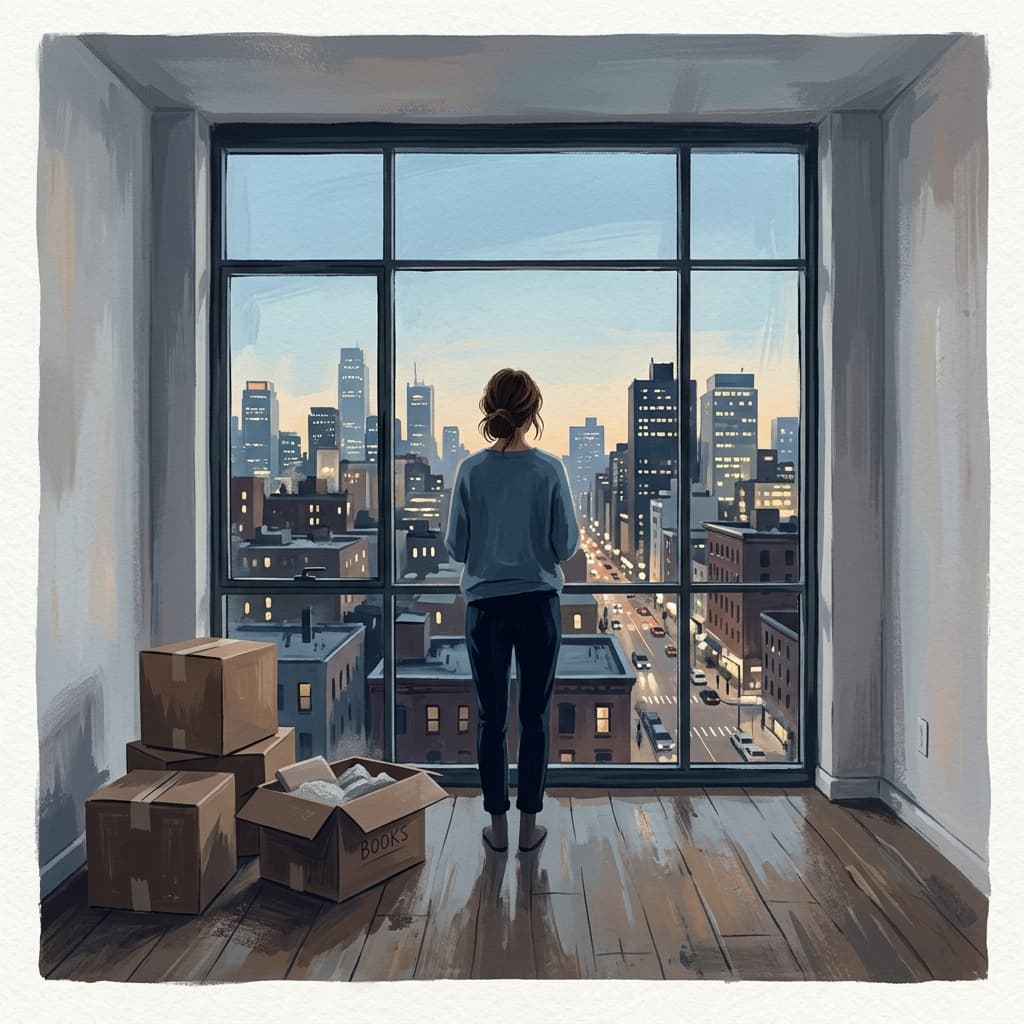
I moved to a city where no one knew my name, and for the first three weeks I called it freedom. I walked streets that held no memories of me. I sat in cafes where no one expected me to be the person I had been in the place I left. I told myself this was what I wanted: a clean page, a fresh geography, a life without the weight of being known. It took about a month for the freedom to start feeling like something else entirely.
The Fantasy of the Clean Start
The idea of moving to a new city carries a particular mythology: that place and self are separable, that you can leave the version of yourself that was not working in the old zip code and arrive somewhere new as someone slightly different, slightly better, slightly more free. I believed this completely. I packed my books and my kitchen things and a conviction that the new city would make possible something the old one had not.
What I did not pack, because you cannot, is the internal weather. The low-grade restlessness that had followed me through the last year of my old life was waiting in the new apartment when I arrived. It was sitting on the bare mattress. It was in the unfamiliar silence of a street I did not yet know how to read. Blaise Pascal wrote in 1654 that all of humanity’s problems stem from the inability to sit quietly in a room. I would add: especially a room you have just moved into, in a city that owes you nothing.
The Loneliness of Unfamiliar Rooms
There is a specific quality to the loneliness of a new city. Far from the loneliness of being rejected or excluded, it is the loneliness of being irrelevant. The city does not know you. The barista does not know your order. The neighbor does not nod. The streets do not hold your history: no corner where you had that conversation, no park bench where you sat after that phone call, no bakery where they remember you like cinnamon in your coffee.
The first thing I noticed was the light. It came through the windows at the wrong angle. I had lived for years with afternoon sun that entered from the west and pooled on the kitchen table, warming the wood until it smelled faintly of pine and old varnish. The new apartment had morning light from the east, sharp and pale, and it fell on a table I had not yet sat at enough to call mine. I kept reaching for the light switch on the wrong wall. My hand would move to the right, where the switch used to be, and meet empty plaster. It happened a dozen times a day. The body was still living in the old apartment.
What Follows You When You Move
Yi-Fu Tuan, the humanistic geographer, published Topophilia in 1974: a study of the emotional bond between people and place. He argued that attachment to a place is sensory rather than intellectual. It is built through the smell of the air after rain on a particular street, the specific acoustics of a room you have slept in for years, the way your feet know the uneven step at the bottom of the stairs without your eyes needing to confirm it. You do not decide to love a place. Your body accumulates it.
This is why moving is grief, even when the move is chosen, even when the new city is better by every measurable standard. You are not just leaving an address. You are leaving a sensory library your body spent years building. The creak of the third floorboard in the hallway. The draft that came under the bedroom door on cold nights. The exact pressure needed to close the front gate so it latched without slamming. These are the things no one photographs and everyone misses.
I missed the sound of the train. My old apartment was four blocks from the tracks, and every evening at half past nine, a freight train passed with a low rumble that I could feel in the floor more than hear with my ears. I had complained about it for years. When it was gone, the silence at half past nine was louder than the train had ever been.
Building the New Map
Gaston Bachelard, in The Poetics of Space, published in 1958, wrote that a house, rather than a mere building, is our corner of the world. The phrase stayed with me during those first months because I had voluntarily given up my corner and had not yet earned a new one. A corner has to be built after you arrive, slowly, through the repetition of small acts: the coffee shop where you begin to sit in the same seat, the walk you take often enough that the dog behind the fence stops barking, the neighbor who begins to lift a hand in greeting because you have been here long enough to be expected.
It took seven months before the new city began to feel like mine. Not in the full, inhabited way the old one had, but in the tentative way of a relationship that has survived its early awkwardness. I found a route to the market that I preferred, not because it was shorter but because it passed a garden with a fig tree whose leaves smelled sweet and dusty in the late summer heat. I found a bench by the canal where the light at five in the afternoon was the color of weak tea. I found a bakery. They do not know my name yet, but they know my order.
You do not belong to a place because you chose it. You belong because you stayed long enough for it to learn the shape of your days, and for your body to learn the grammar of its streets.
If you have recently moved, or are thinking about it, or are sitting in a new apartment with boxes still unpacked and a feeling you cannot name, you are not failing to adjust. You are in the gap between two attachments: one your body built over years and has not yet released, and one that has not yet had time to form. The gap is uncomfortable. It is supposed to be. It is the space where a new belonging begins, not with a decision but with repetition, one ordinary day at a time. Or you can sit with the strangeness for a while. It does not need to resolve tonight.
