There is a particular kind of arithmetic that happens at two in the morning. It does not use a calculator or a spreadsheet. It uses the ceiling. You lie on your back and you run the numbers on the plaster above your head: rent, groceries, the bill you forgot about, the car that is making a sound it should not be making, the school trip your daughter mentioned casually at dinner that you have not yet worked out how to pay for. The numbers do not add up. They never add up at two in the morning, because at that hour mathematics gives way to fear, and it is fear that does the counting.
The Weight You Do Not Name
Money anxiety is the worry no one talks about at dinner parties. We will discuss our sleep problems, our therapy breakthroughs, our complicated relationship with our mothers. But the sentence I am frightened about money remains, for most people, unsayable. It carries a shame that other anxieties do not, because financial struggle is still read, in most cultures, as personal failure. As though the economy were a test you could study for and pass if you were only disciplined enough.
I have been frightened about money. Not in the abstract, philosophical way of someone who reads about wealth inequality and feels concerned. In the specific, physical way of someone who has stood in a supermarket holding two items, doing the calculation of which one she can afford, feeling the heat rise in her face because the person behind her in the line is waiting and she cannot decide, and the not-deciding is the loudest sound in the room.
What Scarcity Does to the Mind
Sendhil Mullainathan, the economist at the University of Chicago, and Eldar Shafir, the psychologist at Princeton, published Scarcity: Why Having Too Little Means So Much in 2013. Their central finding was counterintuitive: financial scarcity does not just reduce your bank balance. It reduces your cognitive bandwidth. The mind under financial stress becomes a different mind than the mind at ease—a mind with less capacity for planning, less patience, less ability to think long-term, because the urgent arithmetic of the present is consuming processing power that would otherwise be available for everything else.
This research gave language to something I had felt but could not name: the fog. When money is tight, a fog descends. You forget appointments. You lose your keys more often. You snap at your children over small things because your nervous system is already at capacity and the spilled juice is the thing that tips it. You are not careless. You are overloaded. The bandwidth has been consumed by a problem that runs in the background of every waking hour, like a program you cannot close.
The Body Under the Numbers
Financial anxiety lives in the body before it lives in the mind. I felt it first in my jaw: a clenching I did not notice until the dentist told me I was grinding my teeth at night, wearing down the enamel on my molars. Then in my stomach: a low, persistent nausea that arrived with the post and left when I put the envelopes in the drawer without opening them. Then in my hands: a tremor so slight no one else could see it, but I could feel it when I held a cup of tea, a fine vibration in my fingers that said something your bank statement has not yet confirmed.
The body does not distinguish between financial threat and physical threat. To the nervous system, the letter from the bank and the sound of a predator in the undergrowth trigger the same cascade: cortisol, adrenaline, the heart rate climbing, the muscles bracing for something that never arrives because there is nothing to run from. You cannot outrun a direct debit. You cannot fight a spreadsheet. So the body stays in the brace position, month after month, and calls it normal.
What Helped, and What Did Not
What did not help: budgeting advice from people who had never been frightened. The suggestion to make a spreadsheet, as though the problem were organizational rather than existential. The cheerful financial literacy content that assumed I was overspending on lattes when I was, in fact, not spending on anything I did not strictly need and still coming up short. The advice assumed a surplus I did not have and, in doing so, made the shame worse.
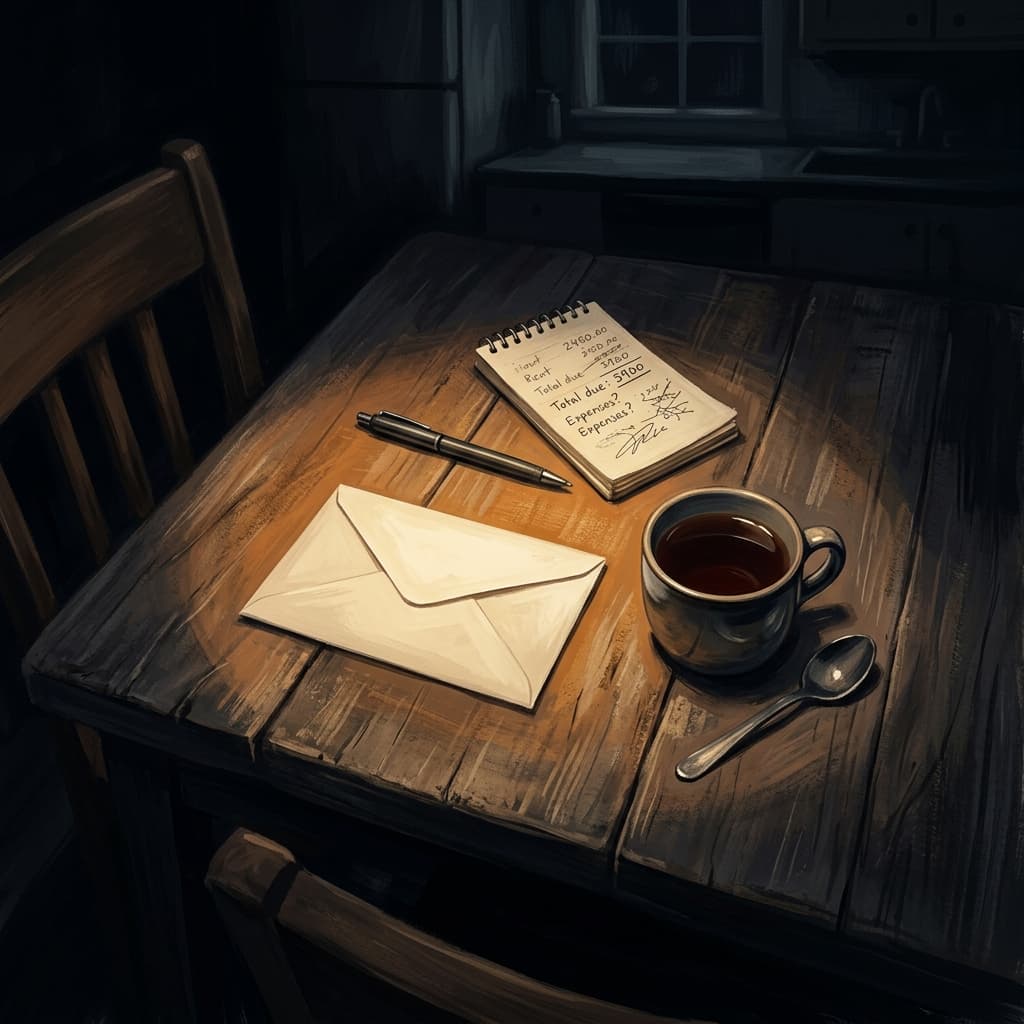
What helped was smaller and less impressive. Opening one envelope. Just one, on a Tuesday, with a cup of tea and the radio on, so the kitchen was not silent while I read the number. The number was bad. But the number was real, and real was better than the imagined number that had been growing larger in the dark of two in the morning. The real number had edges. It could be held. The imagined number was infinite, and infinity is what the body braces against.
What helped was telling one person. Not a financial advisor. A friend, over a walk by the canal, with the sound of the water and the geese and enough ambient noise that the sentence did not have to be delivered into silence. I said: I am frightened about money. She said: I know. I have been too. And the shame, which had been sitting on my chest like a stone for months, did not disappear. But it shifted. It made room for something that was not quite comfort but was close: the knowledge that this fear was not mine alone.
The numbers at two in the morning are not real numbers. They are the body’s translation of fear into arithmetic. The real numbers, the ones that can be worked with, only appear in daylight, one envelope at a time.
If the arithmetic is keeping you up, if the fog has settled and you are navigating your days with less bandwidth than you need, you are not failing. You are carrying something that consumes more energy than anyone who has not carried it can understand. You do not need to fix it tonight. You do not need to open every envelope at once. One is enough. One, and a cup of tea, and the radio, and the willingness to look at a real number instead of the one the ceiling invented. Or not tonight. Tonight you can just breathe. The envelopes will still be there tomorrow, and tomorrow you might have a fraction more capacity to face them.
