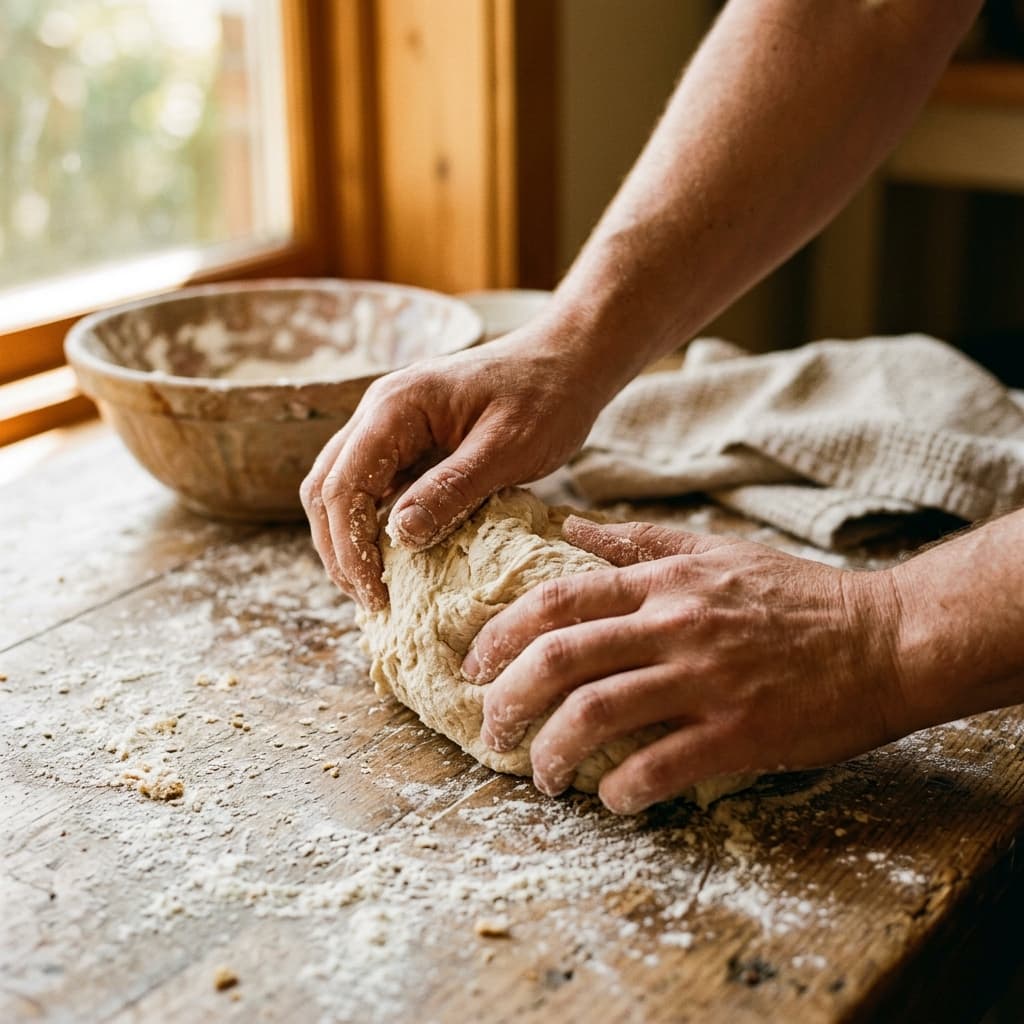
Saturday morning, and my hands were buried in dough. The kitchen was warm from the oven preheating, and flour had settled across the wooden counter in a fine white map of everywhere I had been standing. I was not following a recipe. I was following my hands, which seemed to know something my mind had forgotten: the right pressure, the quarter-turn, the moment when the dough shifts from sticky resistance to smooth give under the heel of my palm.
I had not made bread in over a year. My hands remembered anyway.
What the Hands Know
There is a kind of memory that lives in the muscles and tendons of the hands, separate from anything the conscious mind stores. Neuroscientists call it procedural memory: the encoding of learned motor sequences that can be retrieved without deliberate recall. It is why you can tie your shoes without thinking, why your fingers find the right keys on a keyboard in the dark, why a pianist can play a piece she has not practiced in years if she stops trying to think about it and lets her hands lead.
Kelly Lambert, a neuroscientist at the University of Richmond, has spent her career studying the relationship between hand use and emotional well-being. Her research on what she calls effort-driven rewards suggests that when the hands are engaged in purposeful, tangible work, the brain’s reward circuits activate in ways that passive activities cannot replicate. The satisfaction of kneading dough, pulling weeds, knitting a row, or sanding a piece of wood is not merely psychological. It is neurochemical.
The Catalog of Hand Memory
- The way someone’s hands moved when they folded sheets, pulling the corners tight with a snap you can still hear.
- The particular grip you use on a pen when writing by hand, the angle and pressure only your fingers know.
- The muscle memory of braiding hair, learned at eight years old and never fully forgotten.
- The exact pressure needed to crack an egg one-handed, learned through a dozen broken yolks and one triumphant breakfast.
Each one is a physical archive of your life, stored in the body rather than the mind. Every hand memory carries a context: the person who taught you, the kitchen where you learned, the afternoon light slanting across the counter and the smell of whatever was cooking. The hands remember the whole scene, not just the motion.
Why This Matters Now
We live in an era of increasing hand passivity. We scroll, we tap, we swipe. The fingers move, but the movements are small, uniform, and repetitive in a way that engages almost no procedural complexity. There is nothing wrong with a phone, but there is something lost when the hands spend most of their day performing the same two-centimeter gestures on a glass surface. Lambert’s research suggests that this loss is not merely physical. The hands that do less meaningful work feel less, and the mood follows.
The remedy is a return to what the hands already know.
Your hands are older than your worries. They remember how to make things, mend things, hold things steady. Let them.
Small Hand Rituals
I have started paying attention to the moments when my hands are doing something they know well. The click and slide of knitting needles on a winter evening, a sound so particular that I can hear it now just by thinking about it. The specific satisfaction of chopping vegetables with a sharp knife, the onion falling apart in clean half-moons on the cutting board. The warmth of a ceramic mug, held with both hands for no reason other than the comfort of holding something warm and round. The hands, practicing being alive.
What I notice, when I let my hands lead, is that my mind quiets without being asked. There is no meditation technique involved. There is just flour and water and the heel of my palm, and for twenty minutes the anxious narration in my head has nothing to attach to. The hands are busy. The mind, for once, can rest.
There is something almost comic about it. All the productivity systems and focus apps in the world, and the thing that stills my mind is a ball of dough and a floured counter.
If you are willing, try this: choose one thing today that your hands know how to do without instruction. It could be kneading, folding, braiding, sketching, or peeling an orange in one slow spiral. Do it without rushing. Pay attention to the temperature of what you touch, the pressure your fingers apply, the small adjustments your hands make without being told. You do not need to call it a practice or a ritual. Just let your hands remember. If nothing comes to mind, try holding a warm cup with both hands for a minute and feeling the heat move into your palms. That is enough.
